01 / Morfologi

Ciri dan struktur

H. pallidomarginatum is characterized by its white to yellowish-white pileus, 2–4 sterigmata, and globose to subglobose basidiospores. It was described from Yunnan Province, China. We examined collections from Yunnan and several DNA sequences from China annotated as H. pallidomarginatum in the database. No major differences were found between our specimens and the holotype, except for the color of the pileus. The multi-marker phylogenetic analyses revealed that the two Chinese H. pallidomarginatum specimens form a monophyletic cluster within H. pallidomarginatum.

Sebagian uraian ditampilkan dalam bahasa sumber; terjemahannya belum tersedia atau belum lolos pemeriksaan.

Rujukan: [1]

Pengukuran mengikuti objek, spesimen atau kultur, dan metode yang disebutkan sumber. Baca uraian asli untuk konteks lengkap.

02 / Kehidupan

Habitat dan peran ekologis

The species grows gregariously in a Q. serrata forest within the core zone of Tianma National Nature Reserve, China (ca. 900–1000 m, subtropical monsoon climate). It is currently documented in Anhui Province, Yunnan Province, Heilongjiang Province, and Liaoning Province in China. The specimen was collected at a distance of 10.6 cm from a Q. serrata tree (DBH: 36.2 cm). Soil temperature was 19.8 °C, soil volumetric water content was 23.2%, soil pH was 6.2, air temperature was 22.0 °C, and relative humidity was 92.5%. Soil temperature, moisture content, and pH were measured at the time of sample collection; air temperature and humidity were monitored over the long term within the sample plot (measurements were taken at 10-minute intervals; these data are mean values calculated over the 3 days preceding and following sample collection).

Sebagian uraian ditampilkan dalam bahasa sumber; terjemahannya belum tersedia atau belum lolos pemeriksaan.

Rujukan: [1]

Habitat atau konteks temuan
hutan
Substrat
Informasi belum tersedia pada sumber rilis ini.
Peran atau konteks
Belum dikategorikan pada rilis ini.
Temukan hubungan serupa
03 / Siklus hidup

Reproduksi

H. pallidomarginatum is characterized by its white to yellowish-white pileus, 2–4 sterigmata, and globose to subglobose basidiospores. It was described from Yunnan Province, China. We examined collections from Yunnan and several DNA sequences from China annotated as H. pallidomarginatum in the database. No major differences were found between our specimens and the holotype, except for the color of the pileus. The multi-marker phylogenetic analyses revealed that the two Chinese H. pallidomarginatum specimens form a monophyletic cluster within H. pallidomarginatum.

Sebagian uraian ditampilkan dalam bahasa sumber; terjemahannya belum tersedia atau belum lolos pemeriksaan.

Rujukan: [1]

04 / Batas informasi

Catatan identitas dan cakupan

  • Nama diterima mengikuti Catalogue of Life Base2026-09-11; uraian mempertahankan konsep dan nama sumber aslinya.
  • Preserve original treatment localities, hosts and substrate scope. Materials examined describe documented specimens, not the full global range.
  • Impor dan terjemahan otomatis belum diperiksa editorial per profil. Struktur reproduktif yang disebutkan tidak membuktikan seluruh siklus hidup diketahui.
  • Pengukuran pada uraian mengikuti spesimen, kultur, dan metode sumber; angka tidak diperluas ke semua populasi.

Catatan distribusi dalam narasi mengikuti sumbernya. Dokumentasi spesimen atau foto mengikuti catatan sumber. Bukti wilayah Indonesia dan penilaian konservasi tidak disimpulkan dari gambar.

05 / Dokumentasi

Melihat dengan konteks

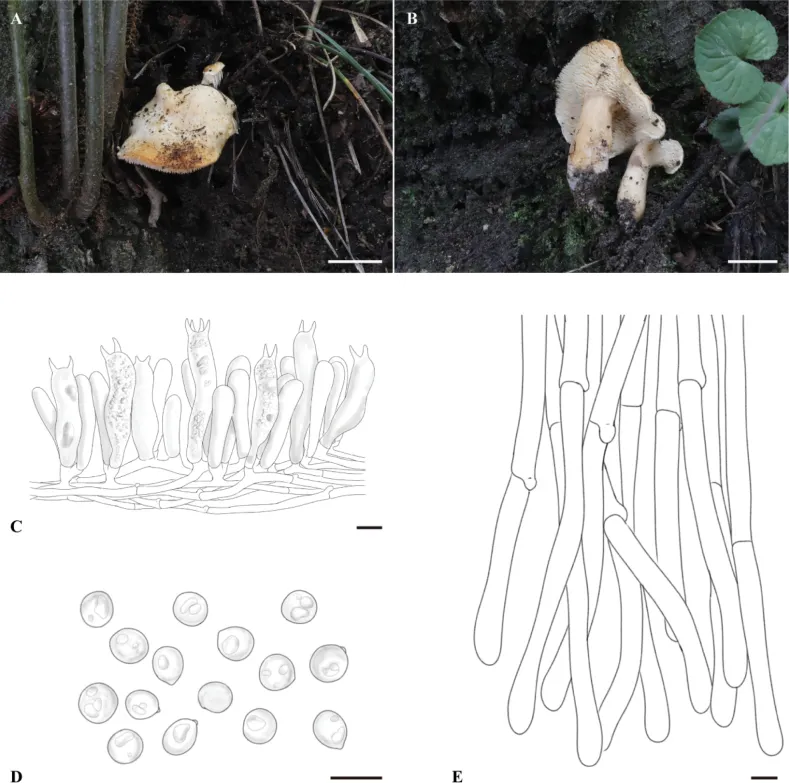
Macroscopic and microscopic features of H. pallidomarginatum. A, B. Basidiomata; C. Hymenium and subhymenium; D. Basidiospores; E. Pileipellis. Scale bars: 2 cm (A, B); 10 μm (C–E).

Jenis
Pelat ilmiah
Kredit
Yonglan Tuo, Hang Chu, Libo Wang, Zhengxiang Qi, Jiajun Hu, Bo Zhang, Yu Li, Xiao Li
Lisensi
CC BY 4.0
Sumber media
Buka entri sumber

Gambar menunjukkan objek menurut identifikasi sumber, bukan verifikasi independen spesimen oleh Fungi. Tidak ada skala baru yang ditambahkan.

06 / Rujukan

Sumber profil

  1. [1] Three new species and two new records of Hydnum (Hydnaceae, Cantharellales) from the Dabie Mountains, China — Hydnum pallidomarginatumBagian sumber: PMC12914258_section_37
    Tanggal penghimpunan sumber: 2026-10-12
    Teks sumber: CC BY 4.0 · Tuo Y, Chu H, Wang L, Qi Z, Hu J, Zhang B, Li Y, Li X.
  2. [2] Catalogue of Life Base2026-09-11 — Hydnum pallidomarginatumBagian sumber: ColDP NameUsage.tsv ID 9Z94H; accepted species; source 2073
    Tanggal penghimpunan sumber: 2026-10-12
  3. [3] Dokumentasi visual — Hydnum pallidomarginatumBagian sumber: Individual media record; identification follows the source, not independent determination
    Tanggal penghimpunan sumber: 2026-10-12
    Media sumber: CC BY 4.0 · Yonglan Tuo, Hang Chu, Libo Wang, Zhengxiang Qi, Jiajun Hu, Bo Zhang, Yu Li, Xiao Li

Adaptasi teks: CC BY 4.0. Tuo Y, Chu H, Wang L, Qi Z, Hu J, Zhang B, Li Y, Li X. — Three new species and two new records of Hydnum (Hydnaceae, Cantharellales) from the Dabie Mountains, China — Hydnum pallidomarginatum

Uraian asli dan riwayat sumber

Riwayat atau halaman sumber

Ringkasan sumber

H. pallidomarginatum is characterized by its white to yellowish-white pileus, 2–4 sterigmata, and globose to subglobose basidiospores. It was described from Yunnan Province, China. We examined collections from Yunnan and several DNA sequences from China annotated as H. pallidomarginatum in the database. No major differences were found between our specimens and the holotype, except for the color of the pileus. The multi-marker phylogenetic analyses revealed that the two Chinese H. pallidomarginatum specimens form a monophyletic cluster within H. pallidomarginatum.

Revisi sumber

Morfologi sumber

H. pallidomarginatum is characterized by its white to yellowish-white pileus, 2–4 sterigmata, and globose to subglobose basidiospores. It was described from Yunnan Province, China. We examined collections from Yunnan and several DNA sequences from China annotated as H. pallidomarginatum in the database. No major differences were found between our specimens and the holotype, except for the color of the pileus. The multi-marker phylogenetic analyses revealed that the two Chinese H. pallidomarginatum specimens form a monophyletic cluster within H. pallidomarginatum.

Revisi sumber

Ekologi sumber

The species grows gregariously in a Q. serrata forest within the core zone of Tianma National Nature Reserve, China (ca. 900–1000 m, subtropical monsoon climate). It is currently documented in Anhui Province, Yunnan Province, Heilongjiang Province, and Liaoning Province in China. The specimen was collected at a distance of 10.6 cm from a Q. serrata tree (DBH: 36.2 cm). Soil temperature was 19.8 °C, soil volumetric water content was 23.2%, soil pH was 6.2, air temperature was 22.0 °C, and relative humidity was 92.5%. Soil temperature, moisture content, and pH were measured at the time of sample collection; air temperature and humidity were monitored over the long term within the sample plot (measurements were taken at 10-minute intervals; these data are mean values calculated over the 3 days preceding and following sample collection).

Revisi sumber

Struktur reproduksi sumber

H. pallidomarginatum is characterized by its white to yellowish-white pileus, 2–4 sterigmata, and globose to subglobose basidiospores. It was described from Yunnan Province, China. We examined collections from Yunnan and several DNA sequences from China annotated as H. pallidomarginatum in the database. No major differences were found between our specimens and the holotype, except for the color of the pileus. The multi-marker phylogenetic analyses revealed that the two Chinese H. pallidomarginatum specimens form a monophyletic cluster within H. pallidomarginatum.

Revisi sumber

Rujukan halaman ini

Fungi. Hydnum pallidomarginatum. Rilis data fungi-2026-10-12-expansion-2. https://fungi-atlas.mgadib.chatgpt.site/jamur/hydnum-pallidomarginatum/.

Status: impor sumber; pemeriksaan editorial per profil belum selesai. Untuk klaim biologis, gunakan rujukan pada bagian terkait dan periksa konteks sumber aslinya.