01 / Morfologi

Ciri dan struktur

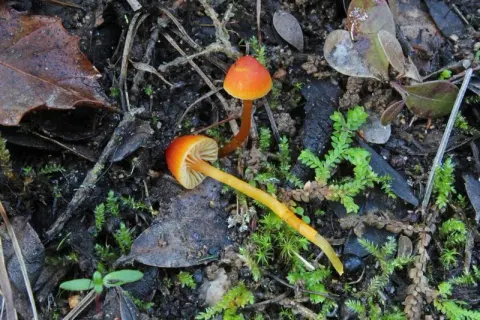
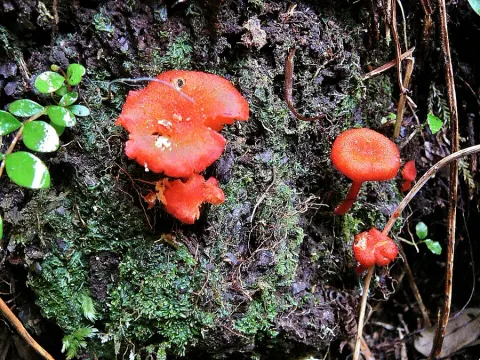
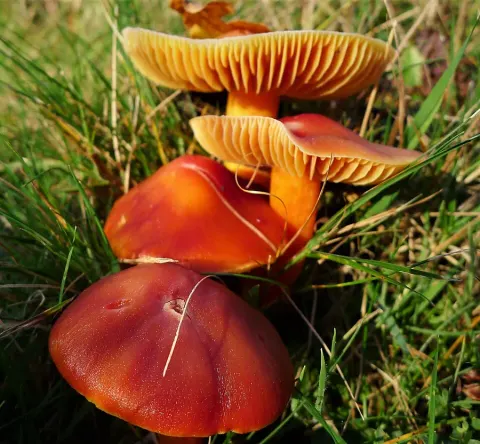
The red-to-yellow cap is convex initially, but later flattens and becomes depressed with a wavy edges; it is hygrophanous with small scales which can be seen with a magnifying glass. The centre of mature fruiting bodies is noticeably scurfy, or scaly. This is a feature that is best seen on dry specimens, that have not been rained on. The cap colour is scarlet-orange with a yellow striate margin, and is 0.5–3.5 cm in diameter. The bare stem is often long, (up to 3 times the cap diameter) and tapering towards the base, with a tendency to flatten. It is the same colour as the cap, or slightly paler, with a white base. The gills are orange, adnate (with a broad attachment to the stem) or slightly decurrent; widely spaced, and somewhat notched. The flesh is orange, and is devoid of any odour. The spore print is white, and the ellipsoid spores measure 7–9 x 4–5 μm.

Sebagian uraian ditampilkan dalam bahasa sumber; terjemahannya belum tersedia atau belum lolos pemeriksaan.

Rujukan: [1]

Pengukuran mengikuti objek, spesimen atau kultur, dan metode yang disebutkan sumber. Baca uraian asli untuk konteks lengkap.

02 / Kehidupan

Habitat dan peran ekologis

Hygrocybe miniata adalah spesies kosmopolitan, yang telah tercatat di sebagian besar zona sedang. Itu telah dikumpulkan dari Inggris, Eropa, Amerika Utara timur, Pada Britain it muncul pada musim gugur, terutama pada periode bebas es, dan lebih suka rumput berpasir, padang rumput, atau ladang yang belum ditingkatkan. Hal ini sering terlihat di perusahaan tikus-telinga hawkweed (Hieracium pilosella). Di Australia, bisa ditemukan di hutan hujan tropis dan hutan eukalypt serta daerah panas. Fruiting bodies dapat muncul dalam kelompok di antara daun dari January to Juni.

Rujukan: [1]

Habitat atau konteks temuan
hutan
Substrat
Informasi belum tersedia pada sumber rilis ini.
Peran atau konteks
Belum dikategorikan pada rilis ini.
Temukan hubungan serupa
03 / Siklus hidup

Reproduksi

The red-to-yellow cap is convex initially, but later flattens and becomes depressed with a wavy edges; it is hygrophanous with small scales which can be seen with a magnifying glass. The centre of mature fruiting bodies is noticeably scurfy, or scaly. This is a feature that is best seen on dry specimens, that have not been rained on. The cap colour is scarlet-orange with a yellow striate margin, and is 0.5–3.5 cm in diameter. The bare stem is often long, (up to 3 times the cap diameter) and tapering towards the base, with a tendency to flatten. It is the same colour as the cap, or slightly paler, with a white base. The gills are orange, adnate (with a broad attachment to the stem) or slightly decurrent; widely spaced, and somewhat notched.

Sebagian uraian ditampilkan dalam bahasa sumber; terjemahannya belum tersedia atau belum lolos pemeriksaan.

Rujukan: [1]

Sinonim menurut acuan taksonomi rilis: Agaricus coccineus subsp. miniatus; Hygrocybe miniata f. albida; Hygrocybe miniata var. turundoides; Hygrocybe strangulata; Hygrophorus miniatus; Hygrophorus miniatus f. longipes; Hygrophorus miniatus var. firmus; Hygrophorus miniatus var. lutescens; Hygrophorus strangulatus; Pseudohygrocybe miniata
04 / Batas informasi

Catatan identitas dan cakupan

  • Nama diterima mengikuti Catalogue of Life Base2026-09-11; uraian mempertahankan konsep dan nama sumber aslinya.
  • Original geographic, specimen and life-cycle scope retained; source import awaits individual editorial review.
  • Impor dan terjemahan otomatis belum diperiksa editorial per profil. Struktur reproduktif yang disebutkan tidak membuktikan seluruh siklus hidup diketahui.
  • Pengukuran pada uraian mengikuti spesimen, kultur, dan metode sumber; angka tidak diperluas ke semua populasi.

Catatan distribusi dalam narasi mengikuti sumbernya. Dokumentasi spesimen atau foto mengikuti catatan sumber. Bukti wilayah Indonesia dan penilaian konservasi tidak disimpulkan dari gambar.

05 / Dokumentasi

Melihat dengan konteks

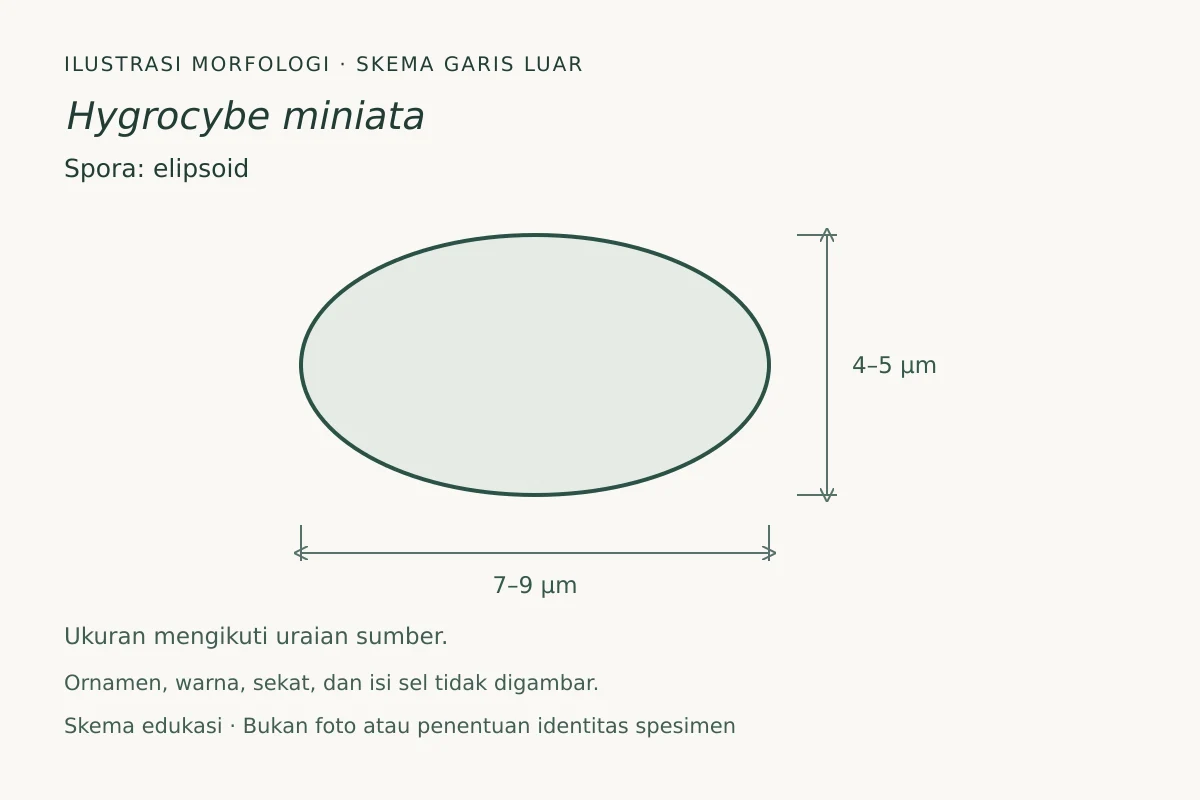
Ilustrasi skematis garis luar spora Hygrocybe miniata, berdasarkan uraian sumber; ukuran yang dilaporkan 7–9 × 4–5 µm. Proporsi disederhanakan, bukan salinan satu spesimen. Ornamen permukaan, warna, sekat, dan isi sel tidak direkonstruksi. Spora elipsoid, 7–9 × 4–5 µm. Bentuk dan warna tudung tidak dipindahkan ke spora. Ornamen, warna, sekat, dan isi sel tidak digambar. Skema edukasi, bukan alat identifikasi.

Jenis
Ilustrasi skematis
Kredit
Fungi, ilustrasi orisinal (2026); fakta morfologi berdasarkan Wikipedia contributors
Sumber media
Buka entri sumber

Gambar menunjukkan objek menurut identifikasi sumber, bukan verifikasi independen spesimen oleh Fungi. Tidak ada skala baru yang ditambahkan.

06 / Rujukan

Sumber profil

  1. [1] Hygrocybe miniata — Wikipedia (en)Bagian sumber: Frozen revision 1290955065
    Tanggal penghimpunan sumber: 2026-10-12
    Media sumber: CC BY-SA4.0 · Wikipedia contributors
  2. [2] Catalogue of Life Base2026-09-11 — Hygrocybe miniataBagian sumber: ColDP NameUsage.tsv ID 3NBB7; accepted species; source 2073
    Tanggal penghimpunan sumber: 2026-10-12

Adaptasi teks: CC BY-SA 4.0. Wikipedia contributors — Hygrocybe miniata — Wikipedia (en)

Uraian asli dan riwayat sumber

Riwayat atau halaman sumber

Ringkasan sumber

Hygrocybe miniata, commonly known as the vermilion waxcap or miniature waxy cap, is a small, bright red or red-orange mushroom of the waxcap genus Hygrocybe. It is a cosmopolitan species, that is found worldwide. In Europe, it is found in fields, on sandy heaths, or grassy clearings in the autumn. In Australia, it is found in rainforest and eucalypt forest as well as heathland.

Revisi sumber

Morfologi sumber

The red-to-yellow cap is convex initially, but later flattens and becomes depressed with a wavy edges; it is hygrophanous with small scales which can be seen with a magnifying glass. The centre of mature fruiting bodies is noticeably scurfy, or scaly. This is a feature that is best seen on dry specimens, that have not been rained on. The cap colour is scarlet-orange with a yellow striate margin, and is 0.5–3.5 cm in diameter. The bare stem is often long, (up to 3 times the cap diameter) and tapering towards the base, with a tendency to flatten. It is the same colour as the cap, or slightly paler, with a white base. The gills are orange, adnate (with a broad attachment to the stem) or slightly decurrent; widely spaced, and somewhat notched. The flesh is orange, and is devoid of any odour. The spore print is white, and the ellipsoid spores measure 7–9 x 4–5 μm.

Revisi sumber

Ekologi sumber

Hygrocybe miniata is a cosmopolitan species, having been recorded in most of the temperate zones. It has been collected from Britain, Europe, eastern North America, In Britain it appears in autumn, particularly in frost-free periods, and prefers sandy heaths, grassy clearings, or unimproved fields. It is often seen in the company of mouse-ear hawkweed (Hieracium pilosella). In Australia, it can be found in temperate to subtropical rainforest and eucalypt forest as well as heathland. Fruiting bodies may appear in groups among the leaf litter from January to June.

Revisi sumber

Struktur reproduksi sumber

The red-to-yellow cap is convex initially, but later flattens and becomes depressed with a wavy edges; it is hygrophanous with small scales which can be seen with a magnifying glass. The centre of mature fruiting bodies is noticeably scurfy, or scaly. This is a feature that is best seen on dry specimens, that have not been rained on. The cap colour is scarlet-orange with a yellow striate margin, and is 0.5–3.5 cm in diameter. The bare stem is often long, (up to 3 times the cap diameter) and tapering towards the base, with a tendency to flatten. It is the same colour as the cap, or slightly paler, with a white base. The gills are orange, adnate (with a broad attachment to the stem) or slightly decurrent; widely spaced, and somewhat notched.

Revisi sumber

Rujukan halaman ini

Fungi. Hygrocybe miniata. Rilis data fungi-2026-10-12-expansion-2. https://fungi-atlas.mgadib.chatgpt.site/jamur/hygrocybe-miniata/.

Status: impor sumber; pemeriksaan editorial per profil belum selesai. Untuk klaim biologis, gunakan rujukan pada bagian terkait dan periksa konteks sumber aslinya.