Ciri dan struktur
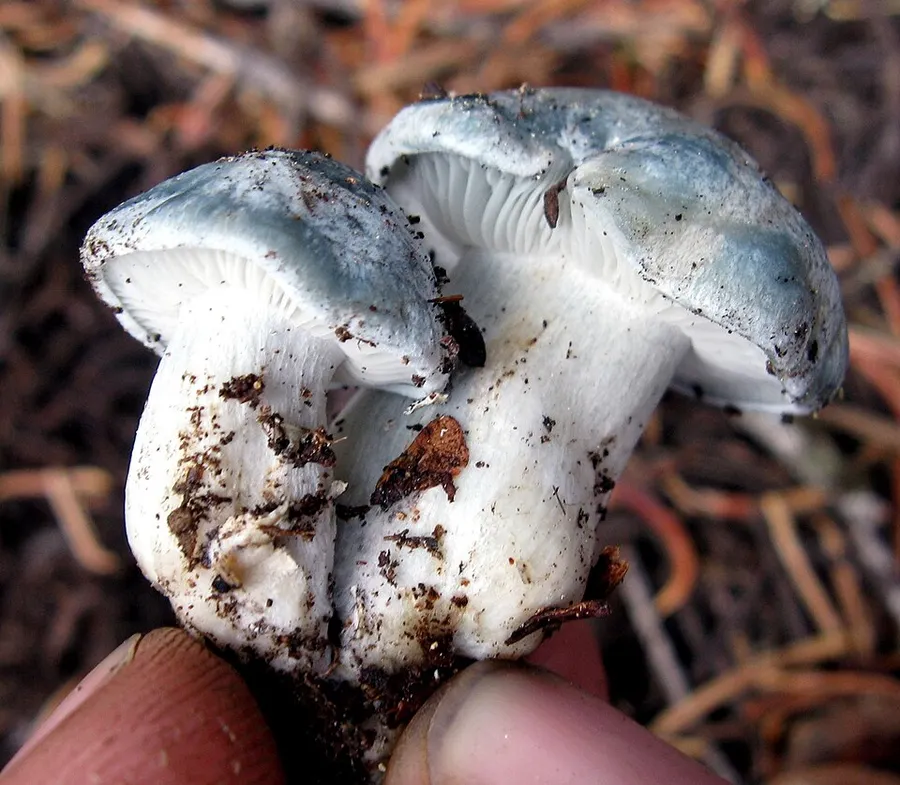
Fruit bodies of Hygrophorus caeruleus have broadly convex caps that are 5 – 9 cm in diameter. They are cream in color, with a blue tint, especially around the margin. The cap surface is felt-like and moist, and covered with a coarse network of cracks and small crevices. The gills, colored bluish-green to gray, have a close to somewhat distant spacing and an adnate to slightly decurrent attachment to the stipe. There are two tiers of lamellulae (short gills) interspersed between the gills. Like most Hygrophorus species, crushed gills have a waxy feel. The stipe measures 2.5 – 5 cm long by 1.5 – 2.5 cm thick and tapers abruptly at the base. Usually somewhat twisted, its surface comprises longitudinally arranged flattened fibrils. Its color is bluish-green to cream at the base. Near the top, it is somewhat pruinose (as in covered with a dusting of fine white powder), while at the base, it is attached to fine white rhizomorphs. The dingy cream flesh bruises a fading bluish-gray to blue-green when injured, and smells strongly of rancid meal. The spore print is white, while spores are elliptical, thin-walled, hyaline, and measure 2.5–5 μm. The basidia (spore-bearing cells) are four-spored and measure 35–45 by 7–8 μm.
Habitat dan peran ekologis
The fruit bodies of Hygrophorus caeruleus grow in scattered groups under Douglas fir, Grand Fir, and Engelmann spruce, typically partially buried in the forest floor. A rare species, it has been reported from the states of Idaho, Oregon, and Washington.
- Habitat atau konteks temuan
- hutan
- Substrat
- Informasi belum tersedia pada sumber rilis ini.
- Peran atau konteks
- Belum dikategorikan pada rilis ini.
Reproduksi
The spore print is white, while spores are elliptical, thin-walled, hyaline, and measure 2.5–5 μm. The basidia (spore-bearing cells) are four-spored and measure 35–45 by 7–8 μm.
Catatan identitas dan cakupan
- Nama diterima mengikuti Catalogue of Life Base2026-09-11; uraian mempertahankan konsep dan nama sumber aslinya.
- Original geographic, specimen and life-cycle scope retained; source import awaits individual editorial review.
- Impor dan terjemahan otomatis belum diperiksa editorial per profil. Struktur reproduktif yang disebutkan tidak membuktikan seluruh siklus hidup diketahui.
- Pengukuran pada uraian mengikuti spesimen, kultur, dan metode sumber; angka tidak diperluas ke semua populasi.
Catatan distribusi dalam narasi mengikuti sumbernya. Dokumentasi spesimen atau foto mengikuti catatan sumber. Bukti wilayah Indonesia dan penilaian konservasi tidak disimpulkan dari gambar.
Melihat dengan konteks
Dokumentasi Hygrophorus caeruleus dari Wikimedia Commons. Fruit bodies of the agaric fungus Hygrophorus caeruleus O.K. Miller. Collected in Eastern Shasta-Trinity National Forest, Siskiyou Co., California, USA. Identifikasi mengikuti record berkas sumber.
- Jenis
- Fotografi
- Kredit
- Alan Rockefeller
- Lisensi
- CC BY-SA 3.0
- Sumber media
- Buka entri sumber
Sumber profil
- [1] Hygrophorus caeruleus — Wikipedia (en)
- [2] Catalogue of Life Base2026-09-11 — Hygrophorus caeruleus
- [3] Dokumentasi visual — Hygrophorus caeruleus
Rujukan halaman ini
Fungi. Hygrophorus caeruleus. Rilis data fungi-2026-10-12-expansion-2. https://fungi-atlas.mgadib.chatgpt.site/jamur/hygrophorus-caeruleus/.
Status: impor sumber; pemeriksaan editorial per profil belum selesai. Untuk klaim biologis, gunakan rujukan pada bagian terkait dan periksa konteks sumber aslinya.