01 / Morfologi

Ciri dan struktur

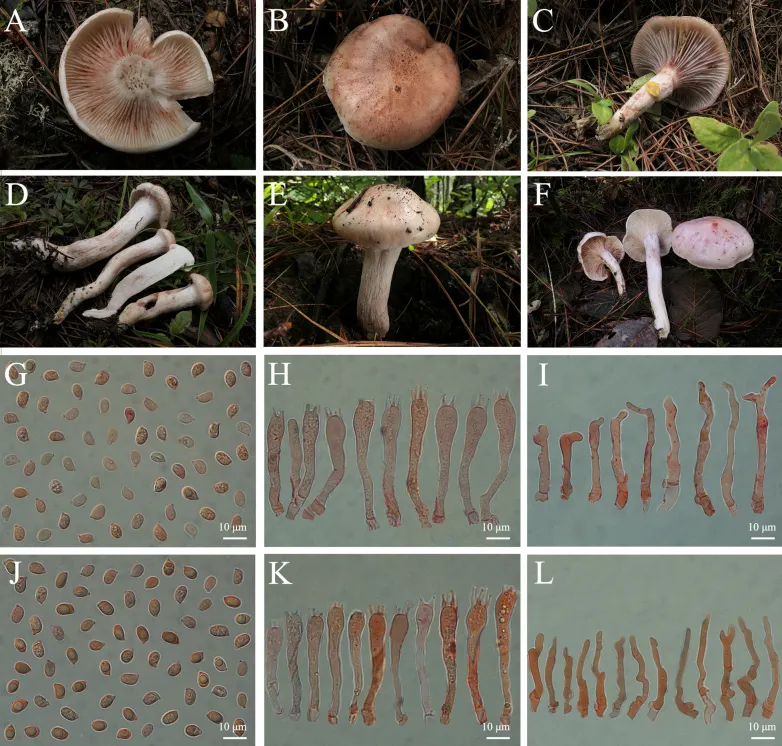
Hygrophorus fragilipurpurascens is distinguished from other species in the H. purpurascens complex by a combination of macro- and micro-morphological characters, as well as its ecological preferences. Its basidiomata are relatively slender, with a pileus 6.5–9 cm diam. and a stipe reaching up to 9 cm long and 1.5 cm diam. The pileus is dark pink to reddish-brown and the lamellae are close (55–80 full lamellae per pileus). Microscopically, it produces ovoid to ellipsoid basidiospores measuring 7–8 × 4.5–5.5 μm (Q = 1.38–1.6). An unusual micro-morphological feature observed in our study is the presence of cystidioid elements on the lamellar edges. These measure 30–54 × 3–6 μm, are thin-walled, hyaline, scattered and have apically pyriform, flexuous, irregularly or narrowly clavate shapes, occasionally with branching (Fig. 12I). Ecologically, this species occurs from solitary to gregarious in the subalpine belt (3100–3300 m), likely forming associations with Pinus (Wang et al. 2023; this study). Originally described from Sichuan, its known distribution is here extended to Yunnan Province, south-western China.

Sebagian uraian ditampilkan dalam bahasa sumber; terjemahannya belum tersedia atau belum lolos pemeriksaan.

Rujukan: [1]

Pengukuran mengikuti objek, spesimen atau kultur, dan metode yang disebutkan sumber. Baca uraian asli untuk konteks lengkap.

02 / Kehidupan

Habitat dan peran ekologis

Solitary or scattered in mixed broadleaf-conifer forests, likely associated with Pinus yunnanensis; at elevations of 3100–3300 m; fruiting from late summer to autumn (August–October).

Sebagian uraian ditampilkan dalam bahasa sumber; terjemahannya belum tersedia atau belum lolos pemeriksaan.

Rujukan: [1]

Habitat atau konteks temuan
hutan
Substrat
Informasi belum tersedia pada sumber rilis ini.
Peran atau konteks
Belum dikategorikan pada rilis ini.
Temukan hubungan serupa
03 / Siklus hidup

Reproduksi

Hygrophorus fragilipurpurascens is distinguished from other species in the H. purpurascens complex by a combination of macro- and micro-morphological characters, as well as its ecological preferences. Its basidiomata are relatively slender, with a pileus 6.5–9 cm diam. and a stipe reaching up to 9 cm long and 1.5 cm diam. The pileus is dark pink to reddish-brown and the lamellae are close (55–80 full lamellae per pileus). Microscopically, it produces ovoid to ellipsoid basidiospores measuring 7–8 × 4.5–5.5 μm (Q = 1.38–1.6). An unusual micro-morphological feature observed in our study is the presence of cystidioid elements on the lamellar edges. These measure 30–54 × 3–6 μm, are thin-walled, hyaline, scattered and have apically pyriform, flexuous, irregularly or narrowly clavate shapes, occasionally with branching (Fig. 12I).

Sebagian uraian ditampilkan dalam bahasa sumber; terjemahannya belum tersedia atau belum lolos pemeriksaan.

Rujukan: [1]

04 / Batas informasi

Catatan identitas dan cakupan

  • Nama diterima mengikuti Catalogue of Life Base2026-09-11; uraian mempertahankan konsep dan nama sumber aslinya.
  • Preserve original treatment localities, hosts and substrate scope. Materials examined describe documented specimens, not the full global range.
  • Impor dan terjemahan otomatis belum diperiksa editorial per profil. Struktur reproduktif yang disebutkan tidak membuktikan seluruh siklus hidup diketahui.
  • Pengukuran pada uraian mengikuti spesimen, kultur, dan metode sumber; angka tidak diperluas ke semua populasi.

Catatan distribusi dalam narasi mengikuti sumbernya. Dokumentasi spesimen atau foto mengikuti catatan sumber. Bukti wilayah Indonesia dan penilaian konservasi tidak disimpulkan dari gambar.

05 / Dokumentasi

Melihat dengan konteks

Macroscopic and microscopic features of Hygrophorus purpurascens complex. A–F. Basidiomata; G, J Basidiospores; H, K. Basidia; I, L. Cystidioid elements on the lamellar edges. A–C, G–I. H. fragilipurpurascens (MHKMU HT-472); D–F, J–L. H. pseudopurpurascens (D. MHKMU HHY-842; E. MHKMU MM-735; F. MHKMU NX-164).

Jenis
Pelat ilmiah
Kredit
Hong-Yan Huang, Wen-Hao Zhang, Tie-Zhi Liu, Guo-Li Zhang, Shu-Da Yang, Hai-Jiao Li, Gabriel Moreno, Li-Ping Tang
Lisensi
CC BY 4.0
Sumber media
Buka entri sumber

Gambar menunjukkan objek menurut identifikasi sumber, bukan verifikasi independen spesimen oleh Fungi. Tidak ada skala baru yang ditambahkan.

06 / Rujukan

Sumber profil

  1. [1] Taxonomic studies on Hygrophorus in China: New species and revised taxonomy — Hygrophorus fragilipurpurascensBagian sumber: PMC13294689_section_94
    Tanggal penghimpunan sumber: 2026-10-12
    Teks sumber: CC BY 4.0 · Huang HY, Zhang WH, Liu TZ, Zhang GL, Yang SD, Li HJ, Moreno G, Tang LP.
  2. [2] Catalogue of Life Base2026-09-11 — Hygrophorus fragilipurpurascensBagian sumber: ColDP NameUsage.tsv ID CB34M; accepted species; source 2073
    Tanggal penghimpunan sumber: 2026-10-12
  3. [3] Dokumentasi visual — Hygrophorus fragilipurpurascensBagian sumber: Individual media record; identification follows the source, not independent determination
    Tanggal penghimpunan sumber: 2026-10-12
    Media sumber: CC BY 4.0 · Hong-Yan Huang, Wen-Hao Zhang, Tie-Zhi Liu, Guo-Li Zhang, Shu-Da Yang, Hai-Jiao Li, Gabriel Moreno, Li-Ping Tang

Adaptasi teks: CC BY 4.0. Huang HY, Zhang WH, Liu TZ, Zhang GL, Yang SD, Li HJ, Moreno G, Tang LP. — Taxonomic studies on Hygrophorus in China: New species and revised taxonomy — Hygrophorus fragilipurpurascens

Uraian asli dan riwayat sumber

Riwayat atau halaman sumber

Ringkasan sumber

Hygrophorus fragilipurpurascens is distinguished from other species in the H. purpurascens complex by a combination of macro- and micro-morphological characters, as well as its ecological preferences. Its basidiomata are relatively slender, with a pileus 6.5–9 cm diam. and a stipe reaching up to 9 cm long and 1.5 cm diam. The pileus is dark pink to reddish-brown and the lamellae are close (55–80 full lamellae per pileus). Microscopically, it produces ovoid to ellipsoid basidiospores measuring 7–8 × 4.5–5.5 μm (Q = 1.38–1.6).

Revisi sumber

Morfologi sumber

Hygrophorus fragilipurpurascens is distinguished from other species in the H. purpurascens complex by a combination of macro- and micro-morphological characters, as well as its ecological preferences. Its basidiomata are relatively slender, with a pileus 6.5–9 cm diam. and a stipe reaching up to 9 cm long and 1.5 cm diam. The pileus is dark pink to reddish-brown and the lamellae are close (55–80 full lamellae per pileus). Microscopically, it produces ovoid to ellipsoid basidiospores measuring 7–8 × 4.5–5.5 μm (Q = 1.38–1.6). An unusual micro-morphological feature observed in our study is the presence of cystidioid elements on the lamellar edges. These measure 30–54 × 3–6 μm, are thin-walled, hyaline, scattered and have apically pyriform, flexuous, irregularly or narrowly clavate shapes, occasionally with branching (Fig. 12I). Ecologically, this species occurs from solitary to gregarious in the subalpine belt (3100–3300 m), likely forming associations with Pinus (Wang et al. 2023; this study). Originally described from Sichuan, its known distribution is here extended to Yunnan Province, south-western China.

Revisi sumber

Ekologi sumber

Solitary or scattered in mixed broadleaf-conifer forests, likely associated with Pinus yunnanensis; at elevations of 3100–3300 m; fruiting from late summer to autumn (August–October).

Revisi sumber

Struktur reproduksi sumber

Hygrophorus fragilipurpurascens is distinguished from other species in the H. purpurascens complex by a combination of macro- and micro-morphological characters, as well as its ecological preferences. Its basidiomata are relatively slender, with a pileus 6.5–9 cm diam. and a stipe reaching up to 9 cm long and 1.5 cm diam. The pileus is dark pink to reddish-brown and the lamellae are close (55–80 full lamellae per pileus). Microscopically, it produces ovoid to ellipsoid basidiospores measuring 7–8 × 4.5–5.5 μm (Q = 1.38–1.6). An unusual micro-morphological feature observed in our study is the presence of cystidioid elements on the lamellar edges. These measure 30–54 × 3–6 μm, are thin-walled, hyaline, scattered and have apically pyriform, flexuous, irregularly or narrowly clavate shapes, occasionally with branching (Fig. 12I).

Revisi sumber

Rujukan halaman ini

Fungi. Hygrophorus fragilipurpurascens. Rilis data fungi-2026-10-12-expansion-2. https://fungi-atlas.mgadib.chatgpt.site/jamur/hygrophorus-fragilipurpurascens/.

Status: impor sumber; pemeriksaan editorial per profil belum selesai. Untuk klaim biologis, gunakan rujukan pada bagian terkait dan periksa konteks sumber aslinya.