01 / Morfologi

Ciri dan struktur

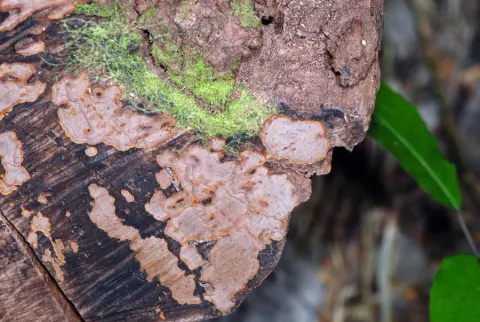
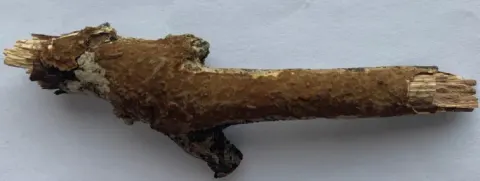
Hymenophore subpileate when umbonate-sessile, or resupinate, probably perennial, woody coriaceous, loosely attached, forming irregularly orbicular colonies 2-10 mm diameter, or merging to form linear areas 2-3 x 1-2.5 cm; pilei reduced to thickened upper edges of specimens growing vertically, naked, black, longitudinally striate, 1-1.5 mm thick; hymenial surface pallid ferruginous, or cinnamon, not creviced, even; margin usually abrupt, sometimes thinning out, crenate, concolorous, free. Context ferruginous, black next the substratum, 0.3-1 mm thick, of mainly erect hyphae embedding scattered setae and numerous large crystals; skeletal hyphae 3-4 µm diameter, walls to 1 µm thick, golden brown; generative hyphae 2.5-3 µm diameter, walls 0.2 µm thick, hyaline. Setal layer occupying the entire fructification, of numerous overlapping rows of setae sometimes arranged in irregular strata; setae subulate, some projecting to 60 µm, 65-95 x 9-12 µm, walls naked or encrusted, ferruginous, lumena narrow. Hymenial layer to 35 p deep, a close palisade of basidia and paraphyses. Basidia subclavate, 14-22 x 3.5-4 µm, bearing 2-4 spores; sterigmata slightly arcuate, slender, to 6 µm long. Paraphyses cylindrical, 8-15 x 2.5-3 µm. Spores suballantoid, 5-6.5 x 2-2.5 µm, walls smooth, hyaline, 0.1 µm thick.

Sebagian uraian ditampilkan dalam bahasa sumber; terjemahannya belum tersedia atau belum lolos pemeriksaan.

Rujukan: [1]

Pengukuran mengikuti objek, spesimen atau kultur, dan metode yang disebutkan sumber. Baca uraian asli untuk konteks lengkap.

02 / Kehidupan

Habitat dan peran ekologis

DISTRIBUTION: North America, West Indies, New Zealand. HABITAT: Living trunks associated with a pocket rot.

Sebagian uraian ditampilkan dalam bahasa sumber; terjemahannya belum tersedia atau belum lolos pemeriksaan.

Rujukan: [1]

Habitat atau konteks temuan
Informasi belum tersedia pada sumber rilis ini.
Substrat
Informasi belum tersedia pada sumber rilis ini.
Peran atau konteks
Belum dikategorikan pada rilis ini.
Temukan hubungan serupa
03 / Siklus hidup

Reproduksi

Hymenophore subpileate when umbonate-sessile, or resupinate, probably perennial, woody coriaceous, loosely attached, forming irregularly orbicular colonies 2-10 mm diameter, or merging to form linear areas 2-3 x 1-2.5 cm; pilei reduced to thickened upper edges of specimens growing vertically, naked, black, longitudinally striate, 1-1.5 mm thick; hymenial surface pallid ferruginous, or cinnamon, not creviced, even; margin usually abrupt, sometimes thinning out, crenate, concolorous, free. Context ferruginous, black next the substratum, 0.3-1 mm thick, of mainly erect hyphae embedding scattered setae and numerous large crystals; skeletal hyphae 3-4 µm diameter, walls to 1 µm thick, golden brown; generative hyphae 2.5-3 µm diameter, walls 0.2 µm thick, hyaline.

Sebagian uraian ditampilkan dalam bahasa sumber; terjemahannya belum tersedia atau belum lolos pemeriksaan.

Rujukan: [1]

Sinonim menurut acuan taksonomi rilis: Hymenochaete corticolor; Lachnocladium cervinum
04 / Batas informasi

Catatan identitas dan cakupan

  • Nama diterima mengikuti Catalogue of Life Base2026-09-11; uraian mempertahankan konsep dan nama sumber aslinya.
  • Historical description as cited by BiotaNZ. Preserve explicit New Zealand/locality, host and specimen qualifiers. Distribution is the cited source scope, not a current global range.
  • Impor dan terjemahan otomatis belum diperiksa editorial per profil. Struktur reproduktif yang disebutkan tidak membuktikan seluruh siklus hidup diketahui.
  • Pengukuran pada uraian mengikuti spesimen, kultur, dan metode sumber; angka tidak diperluas ke semua populasi.

Catatan distribusi dalam narasi mengikuti sumbernya. Dokumentasi spesimen atau foto mengikuti catatan sumber. Bukti wilayah Indonesia dan penilaian konservasi tidak disimpulkan dari gambar.

05 / Dokumentasi

Melihat dengan konteks

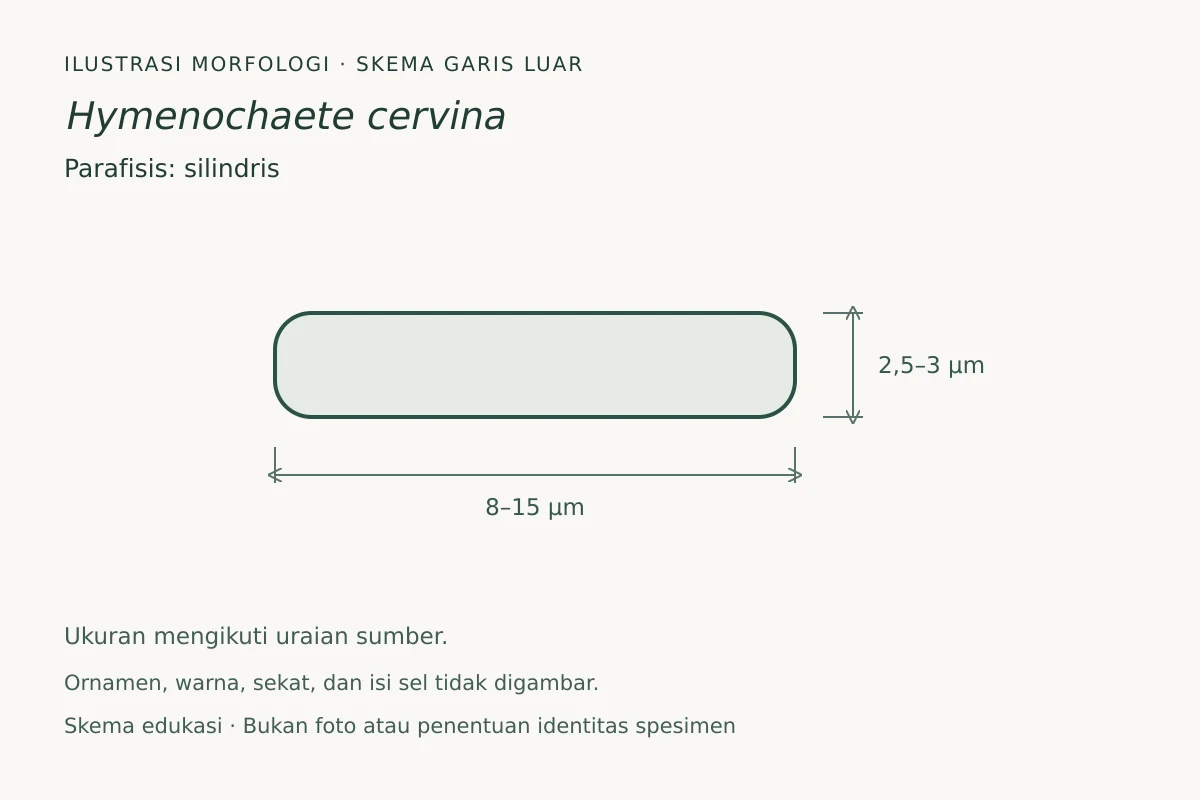
Ilustrasi skematis garis luar parafisis Hymenochaete cervina, berdasarkan uraian sumber; ukuran yang dilaporkan 8–15 × 2,5–3 µm. Proporsi disederhanakan, bukan salinan satu spesimen. Ornamen permukaan, warna, sekat, dan isi sel tidak direkonstruksi. Parafisis silindris, 8–15 × 2,5–3 µm. Seta, sterigma basidium, dan spora suballantoid merupakan bagian lain. Ornamen, warna, sekat, dan isi sel tidak digambar. Skema edukasi, bukan alat identifikasi.

Jenis
Ilustrasi skematis
Kredit
Fungi, ilustrasi orisinal (2026); fakta morfologi berdasarkan Cunningham, G.H. 1963: The Thelephoraceae of Australia and New Zealand. New Zealand Department of Scientific and Industrial Research, Bulletin. 145.
Sumber media
Buka entri sumber

Gambar menunjukkan objek menurut identifikasi sumber, bukan verifikasi independen spesimen oleh Fungi. Tidak ada skala baru yang ditambahkan.

06 / Rujukan

Sumber profil

  1. [1] Cunningham, G.H. 1963: The Thelephoraceae of Australia and New Zealand. New Zealand Department of Scientific and Industrial Research, Bulletin. 145. — Hymenochaete corticolorBagian sumber: biota:1cb0defb-36b9-11d5-9548-00d0592d548c:1cb18dda-36b9-11d5-9548-00d0592d548c
    Tanggal penghimpunan sumber: 2026-10-12
    Media sumber: CC BY 4.0 · Cunningham, G.H. 1963: The Thelephoraceae of Australia and New Zealand. New Zealand Department of Scientific and Industrial Research, Bulletin. 145.
  2. [2] Catalogue of Life Base2026-09-11 — Hymenochaete cervinaBagian sumber: ColDP NameUsage.tsv ID 3NJBN; accepted species; source 2073
    Tanggal penghimpunan sumber: 2026-10-12

Adaptasi teks: CC BY 4.0. Cunningham, G.H. 1963: The Thelephoraceae of Australia and New Zealand. New Zealand Department of Scientific and Industrial Research, Bulletin. 145. — Cunningham, G.H. 1963: The Thelephoraceae of Australia and New Zealand. New Zealand Department of Scientific and Industrial Research, Bulletin. 145. — Hymenochaete corticolor

Uraian asli dan riwayat sumber

Riwayat atau halaman sumber

Ringkasan sumber

Hymenophore subpileate when umbonate-sessile, or resupinate, probably perennial, woody coriaceous, loosely attached, forming irregularly orbicular colonies 2-10 mm diameter, or merging to form linear areas 2-3 x 1-2.5 cm; pilei reduced to thickened upper edges of specimens growing vertically, naked, black, longitudinally striate, 1-1.5 mm thick; hymenial surface pallid ferruginous, or cinnamon, not creviced, even; margin usually abrupt, sometimes thinning out, crenate, concolorous, free. Context ferruginous, black next the substratum, 0.3-1 mm thick, of mainly erect hyphae embedding scattered setae and numerous large crystals; skeletal hyphae 3-4 µm diameter, walls to 1 µm thick, golden brown; generative hyphae 2.5-3 µm diameter, walls 0.2 µm thick, hyaline.

Revisi sumber

Morfologi sumber

Hymenophore subpileate when umbonate-sessile, or resupinate, probably perennial, woody coriaceous, loosely attached, forming irregularly orbicular colonies 2-10 mm diameter, or merging to form linear areas 2-3 x 1-2.5 cm; pilei reduced to thickened upper edges of specimens growing vertically, naked, black, longitudinally striate, 1-1.5 mm thick; hymenial surface pallid ferruginous, or cinnamon, not creviced, even; margin usually abrupt, sometimes thinning out, crenate, concolorous, free. Context ferruginous, black next the substratum, 0.3-1 mm thick, of mainly erect hyphae embedding scattered setae and numerous large crystals; skeletal hyphae 3-4 µm diameter, walls to 1 µm thick, golden brown; generative hyphae 2.5-3 µm diameter, walls 0.2 µm thick, hyaline. Setal layer occupying the entire fructification, of numerous overlapping rows of setae sometimes arranged in irregular strata; setae subulate, some projecting to 60 µm, 65-95 x 9-12 µm, walls naked or encrusted, ferruginous, lumena narrow. Hymenial layer to 35 p deep, a close palisade of basidia and paraphyses. Basidia subclavate, 14-22 x 3.5-4 µm, bearing 2-4 spores; sterigmata slightly arcuate, slender, to 6 µm long. Paraphyses cylindrical, 8-15 x 2.5-3 µm. Spores suballantoid, 5-6.5 x 2-2.5 µm, walls smooth, hyaline, 0.1 µm thick.

Revisi sumber

Ekologi sumber

DISTRIBUTION: North America, West Indies, New Zealand. HABITAT: Living trunks associated with a pocket rot.

Revisi sumber

Struktur reproduksi sumber

Hymenophore subpileate when umbonate-sessile, or resupinate, probably perennial, woody coriaceous, loosely attached, forming irregularly orbicular colonies 2-10 mm diameter, or merging to form linear areas 2-3 x 1-2.5 cm; pilei reduced to thickened upper edges of specimens growing vertically, naked, black, longitudinally striate, 1-1.5 mm thick; hymenial surface pallid ferruginous, or cinnamon, not creviced, even; margin usually abrupt, sometimes thinning out, crenate, concolorous, free. Context ferruginous, black next the substratum, 0.3-1 mm thick, of mainly erect hyphae embedding scattered setae and numerous large crystals; skeletal hyphae 3-4 µm diameter, walls to 1 µm thick, golden brown; generative hyphae 2.5-3 µm diameter, walls 0.2 µm thick, hyaline.

Revisi sumber

Rujukan halaman ini

Fungi. Hymenochaete cervina. Rilis data fungi-2026-10-12-expansion-2. https://fungi-atlas.mgadib.chatgpt.site/jamur/hymenochaete-cervina/.

Status: impor sumber; pemeriksaan editorial per profil belum selesai. Untuk klaim biologis, gunakan rujukan pada bagian terkait dan periksa konteks sumber aslinya.