01 / Morfologi

Ciri dan struktur

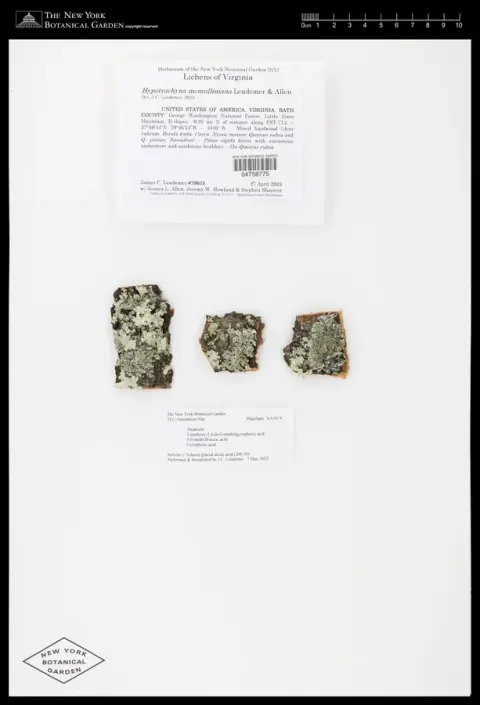
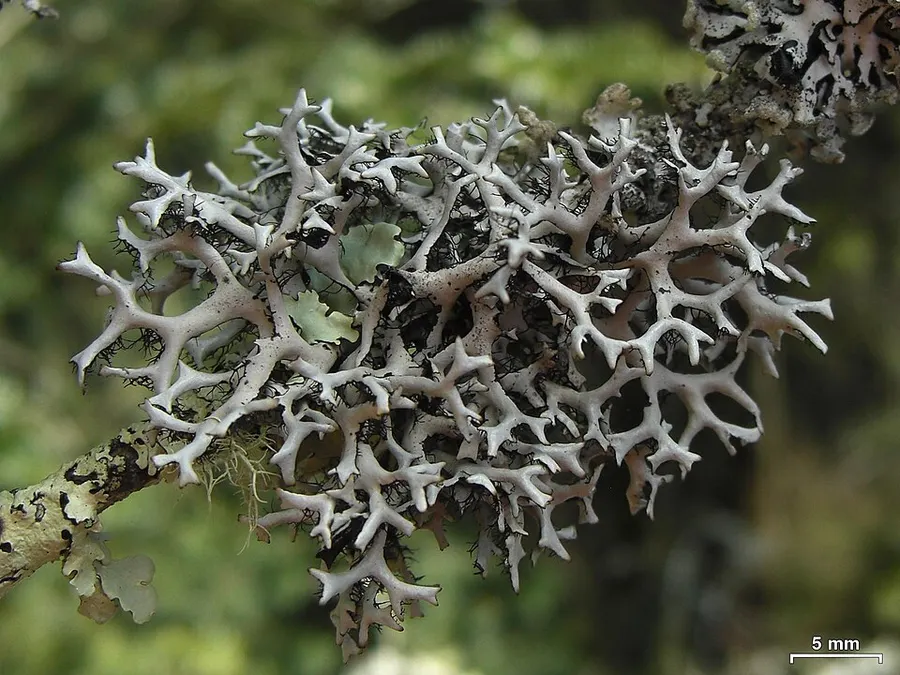
The lichen's vegetative body (thallus) measures 3 – 4 cm long, occasionally reaching 7 cm, forming foliose to somewhat tufted bushy growths that attach very loosely to the surface. Despite being a foliose lichen, H. catawbiensis has a growth pattern that makes it resemble a fruticose (bushy) form. The flattened segments () are 0.5–1 mm wide, occasionally expanding to 2 mm. These lobes branch in a regularly forking () pattern and may be flat or curled inward toward their lower surface. The lobe tips are typically squared-off (truncate) and only occasionally have . The upper surface is pale ivory or greenish-gray in color and develops specialized powdery structures called soredia that emerge through the surface, particularly at or near the lobe tips. Along the margins of the lobes are small root-like attachments called rhizines, which extend up to 1 mm in length (occasionally 2 mm) and can be simple or sparingly branched. The lower surface of the thallus is black or becomes brown-colored toward the tips of the lobes. It appears smooth or shows subtle lengthwise wrinkles, and is either bare or has only a few scattered rhizines. No fruiting bodies (apothecia) or asexual spore-producing structures (pycnidia) have been observed in this species. When tested with chemical reagents for common spot tests, the outer layer () shows K+ (yellow), while the medulla is K−, C+ (pink), and PD−. The medulla contains gyrophoric acid as a major component and protolichesterinic acid as a submajor component. If the medulla does not react with K, it will still show KC+ (pink).

Sebagian uraian ditampilkan dalam bahasa sumber; terjemahannya belum tersedia atau belum lolos pemeriksaan.

Rujukan: [1]

Pengukuran mengikuti objek, spesimen atau kultur, dan metode yang disebutkan sumber. Baca uraian asli untuk konteks lengkap.

02 / Kehidupan

Habitat dan peran ekologis

The species has a disjunct global distribution. In North America, it grows at elevations of 1650 – 2000 m in the mountains of western North Carolina and Virginia and eastern Tennessee, United States, extending north to Fundy National Park in New Brunswick, Canada. In the southern Appalachian Mountains, it is most frequently encountered at high elevations, though nowhere in its range does it occur in great abundance. It grows primarily as an epiphyte on hardwood trees, particularly Prunus, Rhododendron, Acer, and Betula, and less commonly on conifers like Abies and Picea. About 60% of known collections are from hardwoods, 25% from conifers, and 15% from rock substrates. In the Appalachians, it is commonly found growing alongside Pseudevernia cladonia and other species of Hypotrachyna. The species has also been found in east-central Mexico, and at elevations of 2050 – 3000 m in Costa Rica, Venezuela and Ecuador. In Asia, it occurs in the Hengduan Mountains of China at elevations of 2100 – 2800 m, where it commonly grows on Pinus bark, and at 3450 m in the Baliem Valley of Papua New Guinea. It has also been recorded at 3900 m in Uganda. Populations found outside North America tend to have longer and more linear thallus lobes, more abundant and somewhat longer marginal rhizines, and (in South American specimens) more abundant soralia distributed over the distal parts of the lobes, rather than being confined to the lobe tips as in Appalachian specimens.

Sebagian uraian ditampilkan dalam bahasa sumber; terjemahannya belum tersedia atau belum lolos pemeriksaan.

Rujukan: [1]

Habitat atau konteks temuan
Informasi belum tersedia pada sumber rilis ini.
Substrat
Informasi belum tersedia pada sumber rilis ini.
Peran atau konteks
Pembentuk liken
Temukan hubungan serupa
03 / Siklus hidup

Reproduksi

The upper surface is pale ivory or greenish-gray in color and develops specialized powdery structures called soredia that emerge through the surface, particularly at or near the lobe tips. Along the margins of the lobes are small root-like attachments called rhizines, which extend up to 1 mm in length (occasionally 2 mm) and can be simple or sparingly branched. The lower surface of the thallus is black or becomes brown-colored toward the tips of the lobes. It appears smooth or shows subtle lengthwise wrinkles, and is either bare or has only a few scattered rhizines. No fruiting bodies (apothecia) or asexual spore-producing structures (pycnidia) have been observed in this species.

Sebagian uraian ditampilkan dalam bahasa sumber; terjemahannya belum tersedia atau belum lolos pemeriksaan.

Rujukan: [1]

Sinonim menurut acuan taksonomi rilis: Cetrariastrum catawbiense; Everniastrum catawbiense; Parmelia catawbiensis; Parmelia sorocheila var. catawbiensis
04 / Batas informasi

Catatan identitas dan cakupan

  • Nama diterima mengikuti Catalogue of Life Base2026-09-11; uraian mempertahankan konsep dan nama sumber aslinya.
  • Original geographic, specimen and life-cycle scope retained; source import awaits individual editorial review.
  • Impor dan terjemahan otomatis belum diperiksa editorial per profil. Struktur reproduktif yang disebutkan tidak membuktikan seluruh siklus hidup diketahui.
  • Pengukuran pada uraian mengikuti spesimen, kultur, dan metode sumber; angka tidak diperluas ke semua populasi.

Catatan distribusi dalam narasi mengikuti sumbernya. Dokumentasi spesimen atau foto mengikuti catatan sumber. Bukti wilayah Indonesia dan penilaian konservasi tidak disimpulkan dari gambar.

05 / Dokumentasi

Melihat dengan konteks

Dokumentasi Hypotrachyna catawbiensis dari Wikimedia Commons. on spruce twig at high elevation, Great Smoky Mountains National Park, North Carolina - Tennessee border, 20140402 (no specimen) Identifikasi mengikuti record berkas sumber.

Jenis
Fotografi
Kredit
Jason Hollinger
Lisensi
CC BY 2.0
Sumber media
Buka entri sumber

Gambar menunjukkan objek menurut identifikasi sumber, bukan verifikasi independen spesimen oleh Fungi. Tidak ada skala baru yang ditambahkan.

06 / Rujukan

Sumber profil

  1. [1] Hypotrachyna catawbiensis — Wikipedia (en)Bagian sumber: Frozen revision 1312045208
    Tanggal penghimpunan sumber: 2026-10-12
    Teks sumber: CC BY-SA4.0 · Wikipedia contributors
  2. [2] Catalogue of Life Base2026-09-11 — Hypotrachyna catawbiensisBagian sumber: ColDP NameUsage.tsv ID 3NZS7; accepted species; source 2073
    Tanggal penghimpunan sumber: 2026-10-12
  3. [3] Dokumentasi visual — Hypotrachyna catawbiensisBagian sumber: Individual media record; identification follows the source, not independent determination
    Tanggal penghimpunan sumber: 2026-10-12
    Media sumber: CC BY 2.0 · Jason Hollinger

Adaptasi teks: CC BY-SA 4.0. Wikipedia contributors — Hypotrachyna catawbiensis — Wikipedia (en)

Uraian asli dan riwayat sumber

Riwayat atau halaman sumber

Ringkasan sumber

Hypotrachyna catawbiensis, the powder-tipped antler lichen, is a species of foliose lichen in the family Parmeliaceae. First described in 1941, it forms pale ivory to greenish-gray leaf-like growths that attach loosely to tree bark or rocks. The lichen has narrow, forking that often curl inward, and produces powdery structures called soredia for asexual reproduction. Though originally discovered in the Appalachian Mountains of the eastern United States, it has since been found across tropical and temperate regions worldwide, including Mexico, South America, East Africa, China, and Papua New Guinea.

Revisi sumber

Morfologi sumber

The lichen's vegetative body (thallus) measures 3 – 4 cm long, occasionally reaching 7 cm, forming foliose to somewhat tufted bushy growths that attach very loosely to the surface. Despite being a foliose lichen, H. catawbiensis has a growth pattern that makes it resemble a fruticose (bushy) form. The flattened segments () are 0.5–1 mm wide, occasionally expanding to 2 mm. These lobes branch in a regularly forking () pattern and may be flat or curled inward toward their lower surface. The lobe tips are typically squared-off (truncate) and only occasionally have . The upper surface is pale ivory or greenish-gray in color and develops specialized powdery structures called soredia that emerge through the surface, particularly at or near the lobe tips. Along the margins of the lobes are small root-like attachments called rhizines, which extend up to 1 mm in length (occasionally 2 mm) and can be simple or sparingly branched. The lower surface of the thallus is black or becomes brown-colored toward the tips of the lobes. It appears smooth or shows subtle lengthwise wrinkles, and is either bare or has only a few scattered rhizines. No fruiting bodies (apothecia) or asexual spore-producing structures (pycnidia) have been observed in this species. When tested with chemical reagents for common spot tests, the outer layer () shows K+ (yellow), while the medulla is K−, C+ (pink), and PD−. The medulla contains gyrophoric acid as a major component and protolichesterinic acid as a submajor component. If the medulla does not react with K, it will still show KC+ (pink).

Revisi sumber

Ekologi sumber

The species has a disjunct global distribution. In North America, it grows at elevations of 1650 – 2000 m in the mountains of western North Carolina and Virginia and eastern Tennessee, United States, extending north to Fundy National Park in New Brunswick, Canada. In the southern Appalachian Mountains, it is most frequently encountered at high elevations, though nowhere in its range does it occur in great abundance. It grows primarily as an epiphyte on hardwood trees, particularly Prunus, Rhododendron, Acer, and Betula, and less commonly on conifers like Abies and Picea. About 60% of known collections are from hardwoods, 25% from conifers, and 15% from rock substrates. In the Appalachians, it is commonly found growing alongside Pseudevernia cladonia and other species of Hypotrachyna. The species has also been found in east-central Mexico, and at elevations of 2050 – 3000 m in Costa Rica, Venezuela and Ecuador. In Asia, it occurs in the Hengduan Mountains of China at elevations of 2100 – 2800 m, where it commonly grows on Pinus bark, and at 3450 m in the Baliem Valley of Papua New Guinea. It has also been recorded at 3900 m in Uganda. Populations found outside North America tend to have longer and more linear thallus lobes, more abundant and somewhat longer marginal rhizines, and (in South American specimens) more abundant soralia distributed over the distal parts of the lobes, rather than being confined to the lobe tips as in Appalachian specimens.

Revisi sumber

Struktur reproduksi sumber

The upper surface is pale ivory or greenish-gray in color and develops specialized powdery structures called soredia that emerge through the surface, particularly at or near the lobe tips. Along the margins of the lobes are small root-like attachments called rhizines, which extend up to 1 mm in length (occasionally 2 mm) and can be simple or sparingly branched. The lower surface of the thallus is black or becomes brown-colored toward the tips of the lobes. It appears smooth or shows subtle lengthwise wrinkles, and is either bare or has only a few scattered rhizines. No fruiting bodies (apothecia) or asexual spore-producing structures (pycnidia) have been observed in this species.

Revisi sumber

Rujukan halaman ini

Fungi. Hypotrachyna catawbiensis. Rilis data fungi-2026-10-12-expansion-2. https://fungi-atlas.mgadib.chatgpt.site/jamur/hypotrachyna-catawbiensis/.

Status: impor sumber; pemeriksaan editorial per profil belum selesai. Untuk klaim biologis, gunakan rujukan pada bagian terkait dan periksa konteks sumber aslinya.