01 / Morfologi

Ciri dan struktur

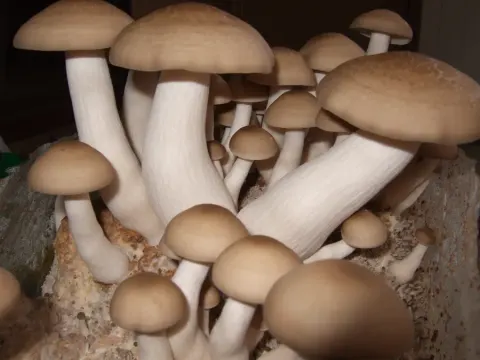
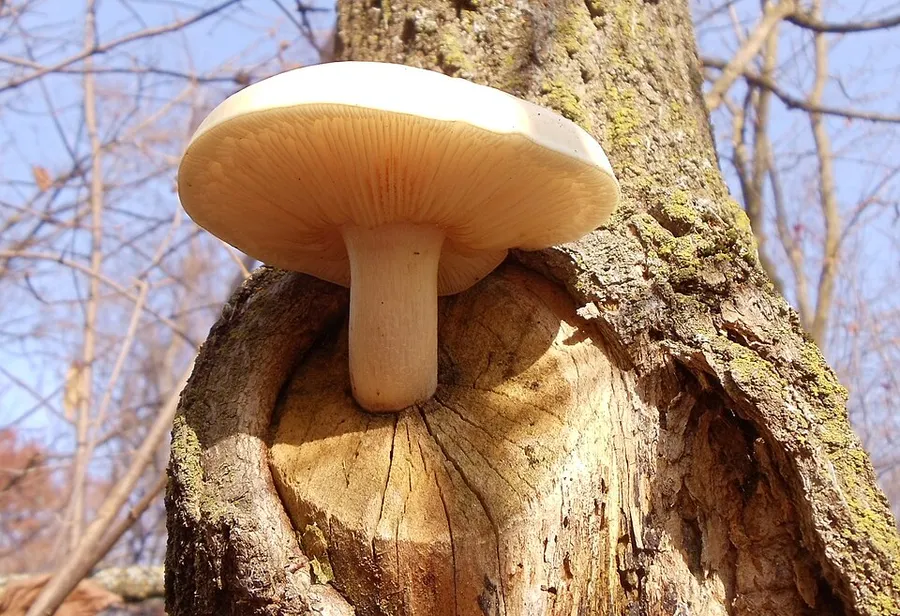
The mushrooms of Hypsizygus ulmarius appear white to cream, and are relatively uniform in color throughout. The stipe extends perpendicular from the fungus's host tree and then bends vertically to form the cap. The stipe is bare of any rings or other features. Additionally, the stipe connects almost perfectly in the center of the cap. The cap itself is usually about 6 – 15 cm in diameter, though it may be larger, and is convex with an incurved margin. Larger caps can appear to be depressed. They will be uniform and smooth, though they can become aerolate as they age. The gills are "adnate or only very slightly decurrent" in contrast with the gills of the commonly confused Pleurotus spp., which are deeply decurrent. There is conflicting data on the size of the sexual basidiospores of H. ulmarius, but the original description of the species by Redhead reports that they are usually about 5–7 micrometers in diameter. Their shape is subglobose to ellipsoidal. The spore print of this species is white to pale cream.

Sebagian uraian ditampilkan dalam bahasa sumber; terjemahannya belum tersedia atau belum lolos pemeriksaan.

Rujukan: [1]

Pengukuran mengikuti objek, spesimen atau kultur, dan metode yang disebutkan sumber. Baca uraian asli untuk konteks lengkap.

02 / Kehidupan

Habitat dan peran ekologis

The Hypsizygus ulmarius mushroom commonly grows on tree species like elm, box elder (Acer negundo), and beech, though it may be found on other trees as well. The fungus accomplishes this by using a complex suite of enzymes that dissolve both cellulose and lignin like laccase. It is not unheard of for brown-rot fungi to produce laccase, an enzyme primarily involved in the lignin degradation process, but the fungus's use of the enzyme is rather uncommon. This production of a brown rot also helps differentiate the fungus from Pleurotus spp., which are mainly white rot fungi. This species is also easily culturable on a variety of media types. It can also be grown in similar substrates as true oyster mushrooms: paper, straw, logs, etc.

Sebagian uraian ditampilkan dalam bahasa sumber; terjemahannya belum tersedia atau belum lolos pemeriksaan.

Rujukan: [1]

Habitat atau konteks temuan
Informasi belum tersedia pada sumber rilis ini.
Substrat
Informasi belum tersedia pada sumber rilis ini.
Peran atau konteks
Belum dikategorikan pada rilis ini.
Temukan hubungan serupa
03 / Siklus hidup

Reproduksi

The mushrooms of Hypsizygus ulmarius appear white to cream, and are relatively uniform in color throughout. The stipe extends perpendicular from the fungus's host tree and then bends vertically to form the cap. The stipe is bare of any rings or other features. Additionally, the stipe connects almost perfectly in the center of the cap. The cap itself is usually about 6 – 15 cm in diameter, though it may be larger, and is convex with an incurved margin. Larger caps can appear to be depressed. They will be uniform and smooth, though they can become aerolate as they age. The gills are "adnate or only very slightly decurrent" in contrast with the gills of the commonly confused Pleurotus spp., which are deeply decurrent.

Sebagian uraian ditampilkan dalam bahasa sumber; terjemahannya belum tersedia atau belum lolos pemeriksaan.

Rujukan: [1]

Sinonim menurut acuan taksonomi rilis: Agaricus coriipellis; Agaricus ulmarius; Agaricus ulmarius var. epiphegus; Clitocybe coriipellis; Gyrophila ulmaria; Lyophyllum ulmarium; Micromphale ulmarium; Pleuropus ulmarius; Pleurotus coriipellis; Pleurotus ulmarius; Pleurotus ulmarius f. burtianus; Pleurotus ulmarius f. coriipellis; Pleurotus ulmarius f. gigantean; Pleurotus ulmarius var. verticalis; Tricholoma ulmarium
04 / Batas informasi

Catatan identitas dan cakupan

  • Nama diterima mengikuti Catalogue of Life Base2026-09-11; uraian mempertahankan konsep dan nama sumber aslinya.
  • Original geographic, specimen and life-cycle scope retained; source import awaits individual editorial review.
  • Impor dan terjemahan otomatis belum diperiksa editorial per profil. Struktur reproduktif yang disebutkan tidak membuktikan seluruh siklus hidup diketahui.
  • Pengukuran pada uraian mengikuti spesimen, kultur, dan metode sumber; angka tidak diperluas ke semua populasi.

Catatan distribusi dalam narasi mengikuti sumbernya. Dokumentasi spesimen atau foto mengikuti catatan sumber. Bukti wilayah Indonesia dan penilaian konservasi tidak disimpulkan dari gambar.

05 / Dokumentasi

Melihat dengan konteks

Dokumentasi Hypsizygus ulmarius dari Wikimedia Commons. For more information about this, see the observation page at Mushroom Observer. Identifikasi mengikuti record berkas sumber.

Jenis
Fotografi
Kredit
This image was created by user Matt Welter (mattfungus) at Mushroom Observer , a source for mycological images. You can contact this user here .
Sumber media
Buka entri sumber

Gambar menunjukkan objek menurut identifikasi sumber, bukan verifikasi independen spesimen oleh Fungi. Tidak ada skala baru yang ditambahkan.

06 / Rujukan

Sumber profil

  1. [1] Hypsizygus ulmarius — Wikipedia (en)Bagian sumber: Frozen revision 1376613050
    Tanggal penghimpunan sumber: 2026-10-12
    Teks sumber: CC BY-SA4.0 · Wikipedia contributors
  2. [2] Catalogue of Life Base2026-09-11 — Hypsizygus ulmariusBagian sumber: ColDP NameUsage.tsv ID 6N53M; accepted species; source 2073
    Tanggal penghimpunan sumber: 2026-10-12
  3. [3] Dokumentasi visual — Hypsizygus ulmariusBagian sumber: Individual media record; identification follows the source, not independent determination
    Tanggal penghimpunan sumber: 2026-10-12
    Media sumber: CC BY-SA 3.0 · This image was created by user Matt Welter (mattfungus) at Mushroom Observer , a source for mycological images. You can contact this user here .

Adaptasi teks: CC BY-SA 4.0. Wikipedia contributors — Hypsizygus ulmarius — Wikipedia (en)

Uraian asli dan riwayat sumber

Riwayat atau halaman sumber

Ringkasan sumber

Hypsizygus ulmarius, commonly known as the elm oyster mushroom or less commonly as the elm leech, is a species of fungus. It has often been confused with oyster mushrooms in the Pleurotus genus but can be differentiated easily as the gills are either not decurrent or not deeply decurrent. While not quite as common as true oyster mushrooms, they have a wide range globally in temperate forests. It is an edible species. The mushrooms and vegetative hyphae of this species have been studied in recent years for their potential benefits to human health, and mycoremediation.

Revisi sumber

Morfologi sumber

The mushrooms of Hypsizygus ulmarius appear white to cream, and are relatively uniform in color throughout. The stipe extends perpendicular from the fungus's host tree and then bends vertically to form the cap. The stipe is bare of any rings or other features. Additionally, the stipe connects almost perfectly in the center of the cap. The cap itself is usually about 6 – 15 cm in diameter, though it may be larger, and is convex with an incurved margin. Larger caps can appear to be depressed. They will be uniform and smooth, though they can become aerolate as they age. The gills are "adnate or only very slightly decurrent" in contrast with the gills of the commonly confused Pleurotus spp., which are deeply decurrent. There is conflicting data on the size of the sexual basidiospores of H. ulmarius, but the original description of the species by Redhead reports that they are usually about 5–7 micrometers in diameter. Their shape is subglobose to ellipsoidal. The spore print of this species is white to pale cream.

Revisi sumber

Ekologi sumber

The Hypsizygus ulmarius mushroom commonly grows on tree species like elm, box elder (Acer negundo), and beech, though it may be found on other trees as well. The fungus accomplishes this by using a complex suite of enzymes that dissolve both cellulose and lignin like laccase. It is not unheard of for brown-rot fungi to produce laccase, an enzyme primarily involved in the lignin degradation process, but the fungus's use of the enzyme is rather uncommon. This production of a brown rot also helps differentiate the fungus from Pleurotus spp., which are mainly white rot fungi. This species is also easily culturable on a variety of media types. It can also be grown in similar substrates as true oyster mushrooms: paper, straw, logs, etc.

Revisi sumber

Struktur reproduksi sumber

The mushrooms of Hypsizygus ulmarius appear white to cream, and are relatively uniform in color throughout. The stipe extends perpendicular from the fungus's host tree and then bends vertically to form the cap. The stipe is bare of any rings or other features. Additionally, the stipe connects almost perfectly in the center of the cap. The cap itself is usually about 6 – 15 cm in diameter, though it may be larger, and is convex with an incurved margin. Larger caps can appear to be depressed. They will be uniform and smooth, though they can become aerolate as they age. The gills are "adnate or only very slightly decurrent" in contrast with the gills of the commonly confused Pleurotus spp., which are deeply decurrent.

Revisi sumber

Rujukan halaman ini

Fungi. Hypsizygus ulmarius. Rilis data fungi-2026-10-12-expansion-2. https://fungi-atlas.mgadib.chatgpt.site/jamur/hypsizygus-ulmarius/.

Status: impor sumber; pemeriksaan editorial per profil belum selesai. Untuk klaim biologis, gunakan rujukan pada bagian terkait dan periksa konteks sumber aslinya.