Ciri dan struktur
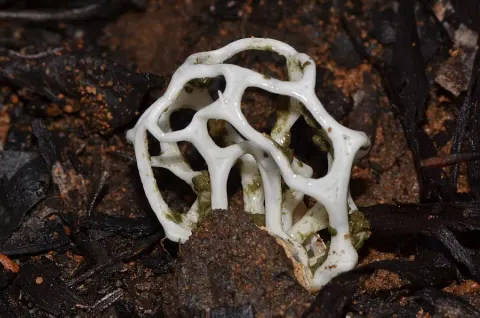
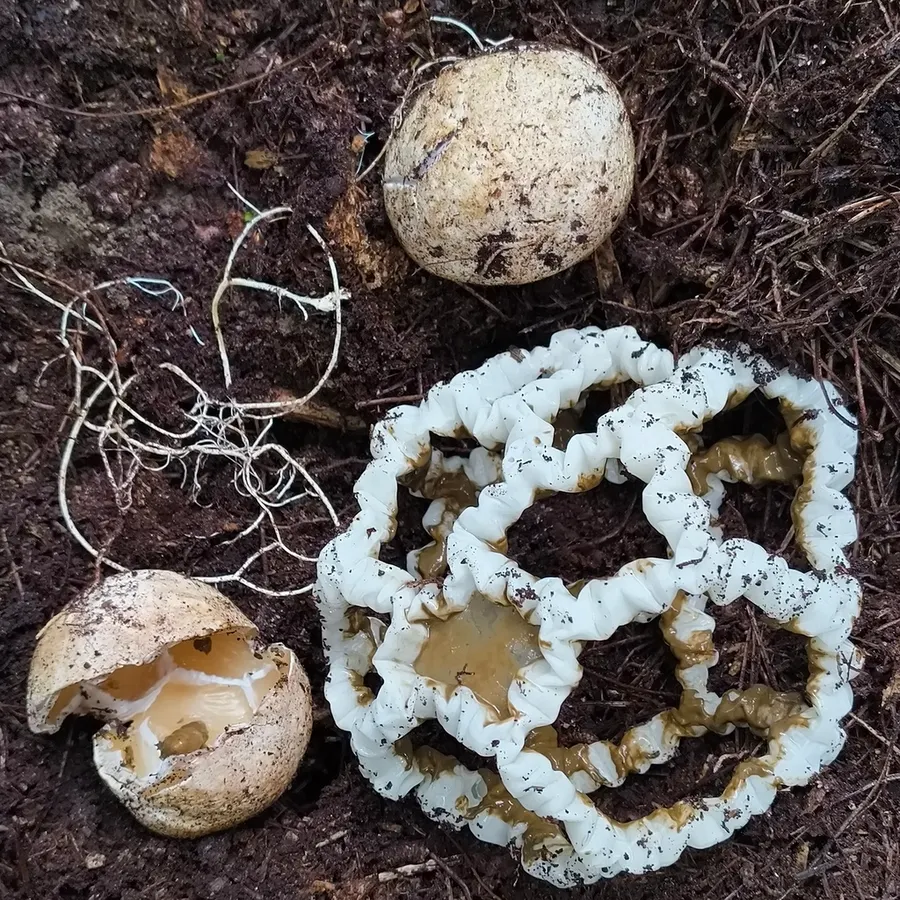
Ileodictyon cibarium grows in two distinct stages: first an "egg stage" followed by the white-net lattice stage. The developing fruiting bodies (basidiocarps), or "eggs", are white, nearly globe-shaped to obovate, and up to 7 cm in diameter. Mature fruiting bodies are white and initially globe-shaped. They are clathrate (lattice-like) and are variable in size, typically reaching 10 cm in diameter, but occasionally growing as large as 25 cm in diameter. At maturity, the fruiting body can detach from the net-like marked volva, the outer layer of the egg-like structure at the base. The mature fruiting bodies form a lattice with 10–30 polygonal meshes, which are variable in size, but are generally similar in shape, comparable to the shape of a fullerene. The arms are up to 1 cm wide and are of uniform thickness. In immature specimens, the arms are folded lengthwise while enclosed in the "egg" stage. As the fruiting body expands, these folds disappear, leaving the arms smooth. The gleba forms an olive-brown layer covering the entire inner surface of the arms. The spores are smooth and measure 4–6 × 2–2.5 µm. The different growth stages of I. cibarium were illustrated by John Buchanan.
Habitat dan peran ekologis
Ileodictyon cibarium is naturally found in Argentina, Chile, Australia, and New Zealand. There was also a possible sighting of the fungus in Brazil's Rio Grande do Norte region in 2006, but Ribeiro et al. (2022) calls this find "questionable", suggesting that further analysis is needed of the material. I. cibarium has also been introduced to East Africa and Southern England, likely through the transfer of soil. I. cibarium has been observed growing on soil in mulched garden beds, sand dunes, meadows, and in forests. The fruiting bodies of I. cibarium use flies and other insects to disperse their spores. They are attracted to the I. cibariums strong, unpleasant smell, which has been likened to faeces. As the insects walk over the sticky gleba, the spores stick to their bodies and are dispersed elsewhere. The mature fruiting bodies, when they are a basket-like structure, can sometimes roll around due to being pushed by the wind, like a tumbleweed.
- Habitat atau konteks temuan
- hutan
- Substrat
- tanah
- Peran atau konteks
- Belum dikategorikan pada rilis ini.
Reproduksi
Ileodictyon cibarium grows in two distinct stages: first an "egg stage" followed by the white-net lattice stage. The developing fruiting bodies (basidiocarps), or "eggs", are white, nearly globe-shaped to obovate, and up to 7 cm in diameter. Mature fruiting bodies are white and initially globe-shaped. They are clathrate (lattice-like) and are variable in size, typically reaching 10 cm in diameter, but occasionally growing as large as 25 cm in diameter. At maturity, the fruiting body can detach from the net-like marked volva, the outer layer of the egg-like structure at the base. The mature fruiting bodies form a lattice with 10–30 polygonal meshes, which are variable in size, but are generally similar in shape, comparable to the shape of a fullerene.
Catatan identitas dan cakupan
- Nama diterima mengikuti Catalogue of Life Base2026-09-11; uraian mempertahankan konsep dan nama sumber aslinya.
- Original geographic, specimen and life-cycle scope retained; source import awaits individual editorial review.
- Impor dan terjemahan otomatis belum diperiksa editorial per profil. Struktur reproduktif yang disebutkan tidak membuktikan seluruh siklus hidup diketahui.
- Pengukuran pada uraian mengikuti spesimen, kultur, dan metode sumber; angka tidak diperluas ke semua populasi.
Catatan distribusi dalam narasi mengikuti sumbernya. Dokumentasi spesimen atau foto mengikuti catatan sumber. Bukti wilayah Indonesia dan penilaian konservasi tidak disimpulkan dari gambar.
Melihat dengan konteks
Dokumentasi Ileodictyon cibarium menurut asosiasi foto pada record takson iNaturalist. Kredit: Zac T.. Identitas mengikuti sumber; bukan penentuan spesimen independen.
- Jenis
- Fotografi
- Kredit
- (c) Zac T., kai kurios teisės saugomos (CC BY), uploaded by Zac T.
- Lisensi
- CC BY 4.0
- Sumber media
- Buka entri sumber
Dokumentasi tambahan
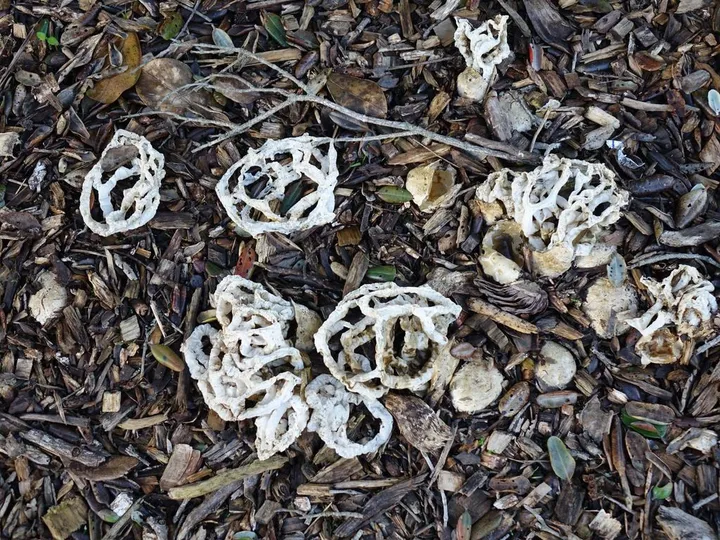
Foto yang diasosiasikan dengan Ileodictyon cibarium pada iNaturalist. Identifikasi mengikuti sumber; bukan penentuan spesimen independen.
Kredit dan penggunaan
(c) Jacqui Geux, kai kurios teisės saugomos (CC BY), uploaded by Jacqui Geux
Ukuran dan format gambar disesuaikan tanpa pemotongan, retus, atau penambahan skala. Lisensi sumber dipertahankan.
Sumber profil
- [1] Ileodictyon cibarium — Wikipedia (en)
- [2] Catalogue of Life Base2026-09-11 — Ileodictyon cibarium
- [3] Dokumentasi visual — Ileodictyon cibarium
- [4] Dokumentasi visual — Ileodictyon cibarium
Rujukan halaman ini
Fungi. Ileodictyon cibarium. Rilis data fungi-2026-10-12-expansion-2. https://fungi-atlas.mgadib.chatgpt.site/jamur/ileodictyon-cibarium/.
Status: impor sumber; pemeriksaan editorial per profil belum selesai. Untuk klaim biologis, gunakan rujukan pada bagian terkait dan periksa konteks sumber aslinya.