01 / Morfologi

Ciri dan struktur

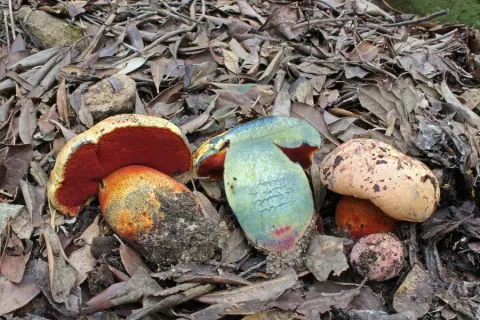
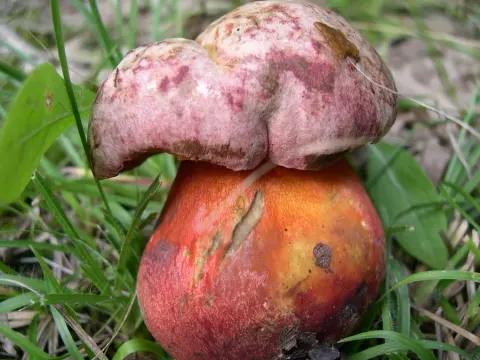
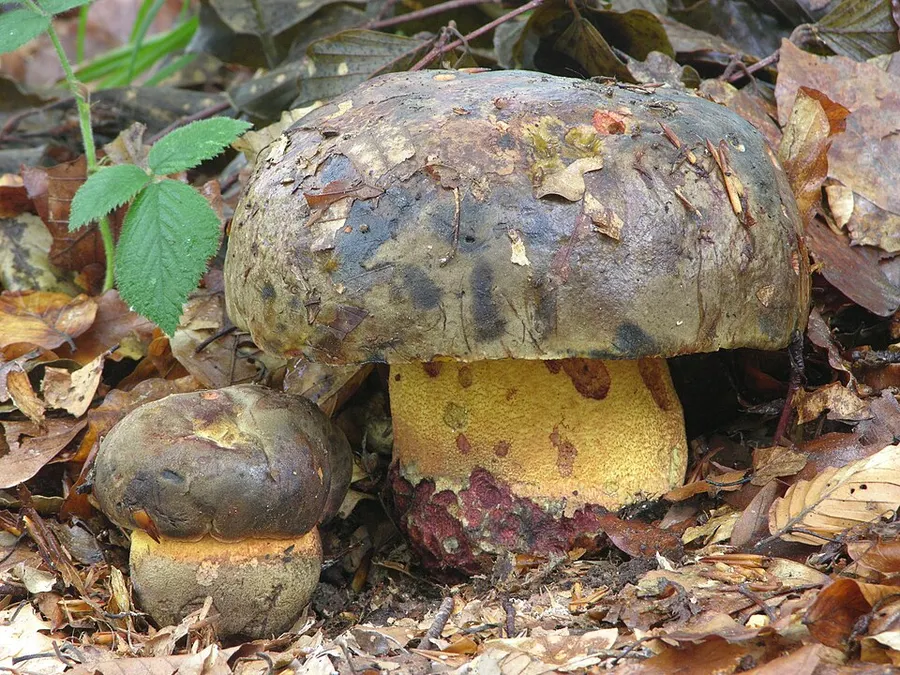
Quite heavy compared with other mushrooms of similar size, the stocky fruit body contains relatively high amounts of chitin. Holding the brawny bolete has been described as "having a stone in your hand". The cap is 6 – 20 cm in diameter. Hemispherical when young, it extends and flattens into a convex and finally a flattish shape, sometimes forming a slight depression in the centre. Initially curled downward and inward, the cap margin gradually turns outward, eventually flattening in maturity, and sometimes protruding beyond the pored undersurface. The surface texture starts slightly velvety, but becomes smoother and hairless with age; in moist weather, the cap is slightly sticky. Changing over time, the colour of the cap is initially vivid yellow or golden yellow, then ochre, then darkening in age to brown. However, if the cap cuticle is bruised, or even touched, there are sudden changes in the colour that depend on the age of the mushroom: young, yellow caps become cherry-red, while ochre-brown cap tissue bruises to reddish-purple. These colour changes soon give way to bluish or greyish tones, which, when combined, give the cap a variegated appearance. The pores on the cap underside are round and small, the sulfur-yellow colour of the pore surface becoming less intense with age. The squat stipe measures 6 – 15 cm long by 3 – 6 cm thick. Egg-shaped when young, it lengthens somewhat as the mushroom grows, but is still bulbous in maturity; a mature stipe is typically a little shorter than the diameter of the cap. It is initially roughly the same colour as the cap, but as it matures, develops a wine-red colouration near the base and a dirty brown to bluish-black colouration elsewhere.

Sebagian uraian ditampilkan dalam bahasa sumber; terjemahannya belum tersedia atau belum lolos pemeriksaan.

Rujukan: [1]

Pengukuran mengikuti objek, spesimen atau kultur, dan metode yang disebutkan sumber. Baca uraian asli untuk konteks lengkap.

02 / Kehidupan

Habitat dan peran ekologis

Imperator torosus is native to southern Europe east to the Caucasus and Israel. A mycorrhizal species, the fungus is generally associated with deciduous trees such as hornbeam (Carpinus), oak (Quercus) and beech (Fagus) in warm, dry locales, and is generally rare in Europe. Russian mycologist Anna Kiyashko has proposed it be listed on the IUCN Red List due to ongoing threats to its habitat. In the United Kingdom, it is listed as a "priority species"—a threatened species requiring conservation action under the UK Biodiversity Action Plan. Similarly, it is on the list of protected species of macrofungi in Montenegro, and Italy, where it has a highly restricted range and is considered threatened by changed forest fire intervals and habitat degradation. It appears to be relatively common in Hungary. It is found under Quercus coccifera trees in the Bar'am forest of Upper Galilee. Fruitings typically occur from July to September in calcareous (chalky) soil, with fruit bodies appearing either singly or in small groups.

Sebagian uraian ditampilkan dalam bahasa sumber; terjemahannya belum tersedia atau belum lolos pemeriksaan.

Rujukan: [1]

Habitat atau konteks temuan
hutan
Substrat
Informasi belum tersedia pada sumber rilis ini.
Peran atau konteks
Mitra tumbuhan
Temukan hubungan serupa
03 / Siklus hidup

Reproduksi

The spore print is olive-brown. The smooth oval spores measure 12–15 by 5–6 μm, and sometimes have an internal oil drop. Basidia (spore-bearing cells) are club-shaped, four-spored, and measure 22–34 by 8–9 μm. The fusiform (fuse-shaped) cystidia are colourless with oil droplets, and have dimensions of 40–50 by 7–8 μm. Cap cuticle tissue is in the form of a trichoderm, where the outermost hyphae emerge roughly parallel, like hairs, perpendicular to the cap surface. These cylindrical, interwoven hyphae contain septa.

Sebagian uraian ditampilkan dalam bahasa sumber; terjemahannya belum tersedia atau belum lolos pemeriksaan.

Rujukan: [1]

Sinonim menurut acuan taksonomi rilis: Boletus appendiculatus subsp. torosus; Boletus torosus; Boletus torosus var. gallicus; Dictyopus torosus; Suillellus torosus; Suillus torosus; Tubiporus torosus
04 / Batas informasi

Catatan identitas dan cakupan

  • Nama diterima mengikuti Catalogue of Life Base2026-09-11; uraian mempertahankan konsep dan nama sumber aslinya.
  • Original geographic, specimen and life-cycle scope retained; source import awaits individual editorial review.
  • Impor dan terjemahan otomatis belum diperiksa editorial per profil. Struktur reproduktif yang disebutkan tidak membuktikan seluruh siklus hidup diketahui.
  • Pengukuran pada uraian mengikuti spesimen, kultur, dan metode sumber; angka tidak diperluas ke semua populasi.

Catatan distribusi dalam narasi mengikuti sumbernya. Dokumentasi spesimen atau foto mengikuti catatan sumber. Bukti wilayah Indonesia dan penilaian konservasi tidak disimpulkan dari gambar.

05 / Dokumentasi

Melihat dengan konteks

Dokumentasi Imperator torosus dari Wikimedia Commons. Boletus torosus Identifikasi mengikuti record berkas sumber.

Jenis
Fotografi
Kredit
Max Danz
Sumber media
Buka entri sumber

Gambar menunjukkan objek menurut identifikasi sumber, bukan verifikasi independen spesimen oleh Fungi. Tidak ada skala baru yang ditambahkan.

06 / Rujukan

Sumber profil

  1. [1] Imperator torosus — Wikipedia (en)Bagian sumber: Frozen revision 1347455710
    Tanggal penghimpunan sumber: 2026-10-12
    Teks sumber: CC BY-SA4.0 · Wikipedia contributors
  2. [2] Catalogue of Life Base2026-09-11 — Imperator torosusBagian sumber: ColDP NameUsage.tsv ID 3PKSH; accepted species; source 2073
    Tanggal penghimpunan sumber: 2026-10-12
  3. [3] Dokumentasi visual — Imperator torosusBagian sumber: Individual media record; identification follows the source, not independent determination
    Tanggal penghimpunan sumber: 2026-10-12
    Media sumber: CC BY-SA 3.0 · Max Danz

Adaptasi teks: CC BY-SA 4.0. Wikipedia contributors — Imperator torosus — Wikipedia (en)

Uraian asli dan riwayat sumber

Riwayat atau halaman sumber

Ringkasan sumber

Imperator torosus, commonly known as the brawny bolete, is a species of bolete fungus in the family Boletaceae. It is native to southern Europe east to the Caucasus and Israel. It is generally associated with deciduous trees such as hornbeam, oak and beech in warm, dry locales. Although generally rare in Europe, it appears to be relatively common in Hungary. Appearing in summer and autumn on chalky soils, the stocky fruit bodies have an ochre cap up to 20 cm (8 in) across, yellow pores on the cap underside, and a wine-red to brown or blackish stipe up to 6 – 15 cm long by 3 – 6 cm wide.

Revisi sumber

Morfologi sumber

Quite heavy compared with other mushrooms of similar size, the stocky fruit body contains relatively high amounts of chitin. Holding the brawny bolete has been described as "having a stone in your hand". The cap is 6 – 20 cm in diameter. Hemispherical when young, it extends and flattens into a convex and finally a flattish shape, sometimes forming a slight depression in the centre. Initially curled downward and inward, the cap margin gradually turns outward, eventually flattening in maturity, and sometimes protruding beyond the pored undersurface. The surface texture starts slightly velvety, but becomes smoother and hairless with age; in moist weather, the cap is slightly sticky. Changing over time, the colour of the cap is initially vivid yellow or golden yellow, then ochre, then darkening in age to brown. However, if the cap cuticle is bruised, or even touched, there are sudden changes in the colour that depend on the age of the mushroom: young, yellow caps become cherry-red, while ochre-brown cap tissue bruises to reddish-purple. These colour changes soon give way to bluish or greyish tones, which, when combined, give the cap a variegated appearance. The pores on the cap underside are round and small, the sulfur-yellow colour of the pore surface becoming less intense with age. The squat stipe measures 6 – 15 cm long by 3 – 6 cm thick. Egg-shaped when young, it lengthens somewhat as the mushroom grows, but is still bulbous in maturity; a mature stipe is typically a little shorter than the diameter of the cap. It is initially roughly the same colour as the cap, but as it matures, develops a wine-red colouration near the base and a dirty brown to bluish-black colouration elsewhere.

Revisi sumber

Ekologi sumber

Imperator torosus is native to southern Europe east to the Caucasus and Israel. A mycorrhizal species, the fungus is generally associated with deciduous trees such as hornbeam (Carpinus), oak (Quercus) and beech (Fagus) in warm, dry locales, and is generally rare in Europe. Russian mycologist Anna Kiyashko has proposed it be listed on the IUCN Red List due to ongoing threats to its habitat. In the United Kingdom, it is listed as a "priority species"—a threatened species requiring conservation action under the UK Biodiversity Action Plan. Similarly, it is on the list of protected species of macrofungi in Montenegro, and Italy, where it has a highly restricted range and is considered threatened by changed forest fire intervals and habitat degradation. It appears to be relatively common in Hungary. It is found under Quercus coccifera trees in the Bar'am forest of Upper Galilee. Fruitings typically occur from July to September in calcareous (chalky) soil, with fruit bodies appearing either singly or in small groups.

Revisi sumber

Struktur reproduksi sumber

The spore print is olive-brown. The smooth oval spores measure 12–15 by 5–6 μm, and sometimes have an internal oil drop. Basidia (spore-bearing cells) are club-shaped, four-spored, and measure 22–34 by 8–9 μm. The fusiform (fuse-shaped) cystidia are colourless with oil droplets, and have dimensions of 40–50 by 7–8 μm. Cap cuticle tissue is in the form of a trichoderm, where the outermost hyphae emerge roughly parallel, like hairs, perpendicular to the cap surface. These cylindrical, interwoven hyphae contain septa.

Revisi sumber

Rujukan halaman ini

Fungi. Imperator torosus. Rilis data fungi-2026-10-12-expansion-2. https://fungi-atlas.mgadib.chatgpt.site/jamur/imperator-torosus/.

Status: impor sumber; pemeriksaan editorial per profil belum selesai. Untuk klaim biologis, gunakan rujukan pada bagian terkait dan periksa konteks sumber aslinya.