01 / Morfologi

Ciri dan struktur

Spider hosts covered by dense greyish-brown mycelium (199C–D). Sexual morph: Stromata non-stipitate. Perithecia growing in subiculum, aggregated in clusters, superficial, obpyriform, 850–1100 × 300–400 µm, ostiole pale brown. Asci cylindrical, 8-spored, 520–700 µm long, 4–6 µm broad, with cap 2–6 µm thick. Ascospores hyaline, whole ascospores with septate part-spores alternately connected with thread-like structures, three-terminal cells on each end with six alternating pairs of cells and filament, eighteen cells per ascospore, up to 680 µm long, each cell narrowly fusiform, 10–20 × 1–2 µm, filiform regions, 30–50 × 0.2–0.8 µm. Asexual morph: Synnemata arising from the mycelial mat, numerous, greyish-brown, cylindrical to clavate, erect up to 800 µm long, 30–100 µm broad. Conidiogenous cells producing at the upper part of synnemata, mostly monophialidic or some polyphialidic. Phialides cylindrical, (7)10–15(16) × 2–4(5) µm, tapering into a distinct neck, (1)1.5–3.5(5) × 1–1.5 µm. Conidia hyaline, fusiform, cylindrical, (3)8.5–10.5(12) × 1–3 µm. Colonies on OA attaining a diam. of (12)14–15 mm in 21 days, cottony with high mycelium density, white, reverse pale orange (165D), poor sporulation. Phialides arising from aerial hyphae, solitary, awl-shaped, lecanicillium-like, 20–40 × 1–2 µm. Conidia in chains, hyaline, fusiform, cylindrical, smooth, (3)7.5–10.5(12) × (1.5)2–2.5(3) µm. Colonies on PDA attaining a diam. of 8–10 mm in 21 days, cottony with high mycelium density in the middle of colonies, mycelium with low density around the margin of colonies, pale orange, reverse moderate orange (167D), poor sporulation.

Sebagian uraian ditampilkan dalam bahasa sumber; terjemahannya belum tersedia atau belum lolos pemeriksaan.

Rujukan: [1]

Pengukuran mengikuti objek, spesimen atau kultur, dan metode yang disebutkan sumber. Baca uraian asli untuk konteks lengkap.

02 / Kehidupan

Habitat dan peran ekologis

Spiders (Araneae, Thomisidae, Diaea cf. dorsata). Specimens were found on the underside of dicot leaves of forest plants.

Sebagian uraian ditampilkan dalam bahasa sumber; terjemahannya belum tersedia atau belum lolos pemeriksaan.

Rujukan: [1]

Habitat atau konteks temuan
hutan
Substrat
Informasi belum tersedia pada sumber rilis ini.
Peran atau konteks
Belum dikategorikan pada rilis ini.
Temukan hubungan serupa
03 / Siklus hidup

Reproduksi

Spider hosts covered by dense greyish-brown mycelium (199C–D). Sexual morph: Stromata non-stipitate. Perithecia growing in subiculum, aggregated in clusters, superficial, obpyriform, 850–1100 × 300–400 µm, ostiole pale brown. Asci cylindrical, 8-spored, 520–700 µm long, 4–6 µm broad, with cap 2–6 µm thick. Ascospores hyaline, whole ascospores with septate part-spores alternately connected with thread-like structures, three-terminal cells on each end with six alternating pairs of cells and filament, eighteen cells per ascospore, up to 680 µm long, each cell narrowly fusiform, 10–20 × 1–2 µm, filiform regions, 30–50 × 0.2–0.8 µm. Asexual morph: Synnemata arising from the mycelial mat, numerous, greyish-brown, cylindrical to clavate, erect up to 800 µm long, 30–100 µm broad.

Sebagian uraian ditampilkan dalam bahasa sumber; terjemahannya belum tersedia atau belum lolos pemeriksaan.

Rujukan: [1]

04 / Batas informasi

Catatan identitas dan cakupan

  • Nama diterima mengikuti Catalogue of Life Base2026-09-11; uraian mempertahankan konsep dan nama sumber aslinya.
  • Preserve original treatment localities, hosts and substrate scope. Materials examined describe documented specimens, not the full global range.
  • Impor dan terjemahan otomatis belum diperiksa editorial per profil. Struktur reproduktif yang disebutkan tidak membuktikan seluruh siklus hidup diketahui.
  • Pengukuran pada uraian mengikuti spesimen, kultur, dan metode sumber; angka tidak diperluas ke semua populasi.

Catatan distribusi dalam narasi mengikuti sumbernya. Dokumentasi spesimen atau foto mengikuti catatan sumber. Bukti wilayah Indonesia dan penilaian konservasi tidak disimpulkan dari gambar.

05 / Dokumentasi

Melihat dengan konteks

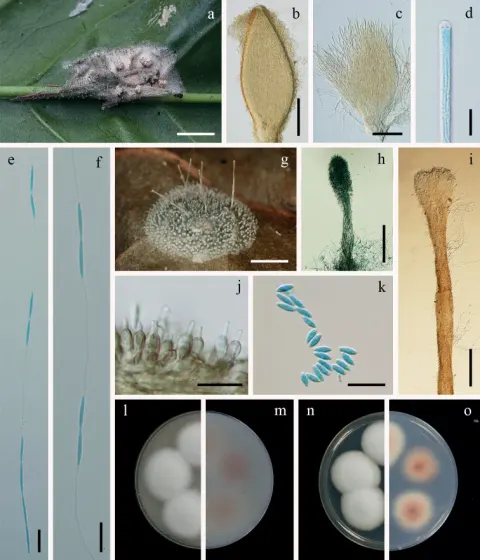
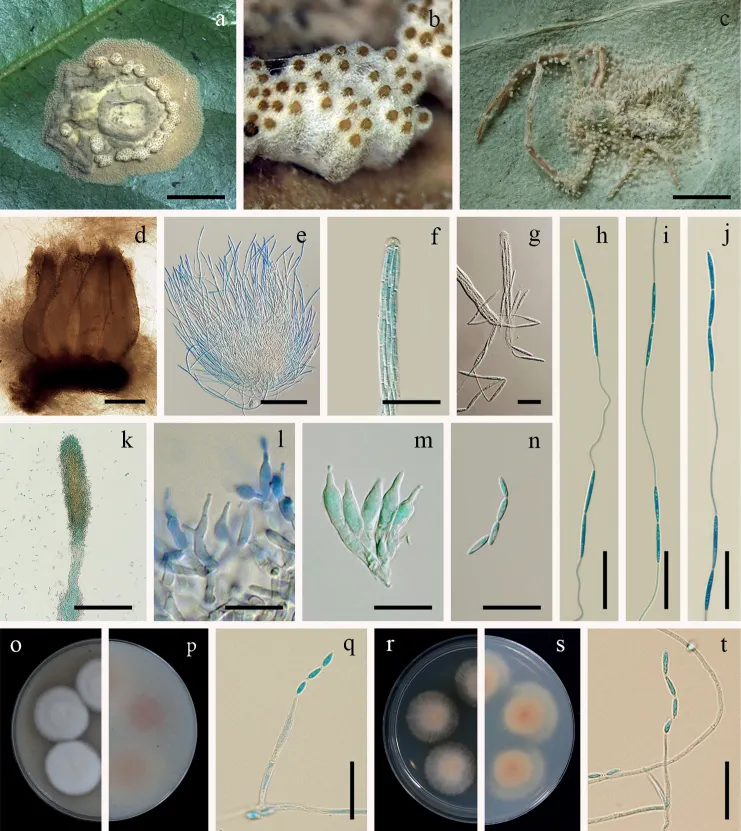
Jenniferia thomisidarum a fungus on a spider (BBH 29502) b perithecia c fungus on a spider (BBH 30660) d perithecia e asci f, g ascus tip h–j whole ascospores with septate part-spores alternately connected with thread-like structures k synnema with conidiogenous cells l, m phialides n conidia o, p colonies on OA at 21 days (o obverse, p reverse) q phialide with conidia on OA r, s colonies on PDA at 21 days (r obverse, s reverse) t phialide with conidia on PDA. Scale bars: 2 mm (a, c); 300 µm (d); 200 µm (e); 100 µm (k); 10 µm (f, g, l, m, n); 20 µm (h, i, j, q, t).

Jenis
Pelat ilmiah
Kredit
Suchada Mongkolsamrit, Wasana Noisripoom, Kanoksri Tasanathai, Noppol Kobmoo, Donnaya Thanakitpipattana, Artit Khonsanit, Booppa Petcharad, Baramee Sakolrak, Winanda Himaman
Lisensi
CC BY 4.0
Sumber media
Buka entri sumber

Gambar menunjukkan objek menurut identifikasi sumber, bukan verifikasi independen spesimen oleh Fungi. Tidak ada skala baru yang ditambahkan.

06 / Rujukan

Sumber profil

  1. [1] Comprehensive treatise of Hevansia and three new genera Jenniferia, Parahevansia and Polystromomyces on spiders in Cordycipitaceae from Thailand — Jenniferia thomisidarumBagian sumber: PMC9849099_section_58
    Tanggal penghimpunan sumber: 2026-10-12
    Teks sumber: CC BY 4.0 · Mongkolsamrit S, Noisripoom W, Tasanathai K, Kobmoo N, Thanakitpipattana D, Khonsanit A, Petcharad B, Sakolrak B, Himaman W.
  2. [2] Catalogue of Life Base2026-09-11 — Jenniferia thomisidarumBagian sumber: ColDP NameUsage.tsv ID B2QDC; accepted species; source 2073
    Tanggal penghimpunan sumber: 2026-10-12
  3. [3] Dokumentasi visual — Jenniferia thomisidarumBagian sumber: Individual media record; identification follows the source, not independent determination
    Tanggal penghimpunan sumber: 2026-10-12
    Media sumber: CC BY 4.0 · Suchada Mongkolsamrit, Wasana Noisripoom, Kanoksri Tasanathai, Noppol Kobmoo, Donnaya Thanakitpipattana, Artit Khonsanit, Booppa Petcharad, Baramee Sakolrak, Winanda Himaman

Adaptasi teks: CC BY 4.0. Mongkolsamrit S, Noisripoom W, Tasanathai K, Kobmoo N, Thanakitpipattana D, Khonsanit A, Petcharad B, Sakolrak B, Himaman W. — Comprehensive treatise of Hevansia and three new genera Jenniferia, Parahevansia and Polystromomyces on spiders in Cordycipitaceae from Thailand — Jenniferia thomisidarum

Uraian asli dan riwayat sumber

Riwayat atau halaman sumber

Ringkasan sumber

Spider hosts covered by dense greyish-brown mycelium (199C–D). Sexual morph: Stromata non-stipitate. Perithecia growing in subiculum, aggregated in clusters, superficial, obpyriform, 850–1100 × 300–400 µm, ostiole pale brown. Asci cylindrical, 8-spored, 520–700 µm long, 4–6 µm broad, with cap 2–6 µm thick. Ascospores hyaline, whole ascospores with septate part-spores alternately connected with thread-like structures, three-terminal cells on each end with six alternating pairs of cells and filament, eighteen cells per ascospore, up to 680 µm long, each cell narrowly fusiform, 10–20 × 1–2 µm, filiform regions, 30–50 × 0.2–0.8 µm.

Revisi sumber

Morfologi sumber

Spider hosts covered by dense greyish-brown mycelium (199C–D). Sexual morph: Stromata non-stipitate. Perithecia growing in subiculum, aggregated in clusters, superficial, obpyriform, 850–1100 × 300–400 µm, ostiole pale brown. Asci cylindrical, 8-spored, 520–700 µm long, 4–6 µm broad, with cap 2–6 µm thick. Ascospores hyaline, whole ascospores with septate part-spores alternately connected with thread-like structures, three-terminal cells on each end with six alternating pairs of cells and filament, eighteen cells per ascospore, up to 680 µm long, each cell narrowly fusiform, 10–20 × 1–2 µm, filiform regions, 30–50 × 0.2–0.8 µm. Asexual morph: Synnemata arising from the mycelial mat, numerous, greyish-brown, cylindrical to clavate, erect up to 800 µm long, 30–100 µm broad. Conidiogenous cells producing at the upper part of synnemata, mostly monophialidic or some polyphialidic. Phialides cylindrical, (7)10–15(16) × 2–4(5) µm, tapering into a distinct neck, (1)1.5–3.5(5) × 1–1.5 µm. Conidia hyaline, fusiform, cylindrical, (3)8.5–10.5(12) × 1–3 µm. Colonies on OA attaining a diam. of (12)14–15 mm in 21 days, cottony with high mycelium density, white, reverse pale orange (165D), poor sporulation. Phialides arising from aerial hyphae, solitary, awl-shaped, lecanicillium-like, 20–40 × 1–2 µm. Conidia in chains, hyaline, fusiform, cylindrical, smooth, (3)7.5–10.5(12) × (1.5)2–2.5(3) µm. Colonies on PDA attaining a diam. of 8–10 mm in 21 days, cottony with high mycelium density in the middle of colonies, mycelium with low density around the margin of colonies, pale orange, reverse moderate orange (167D), poor sporulation.

Revisi sumber

Ekologi sumber

Spiders (Araneae, Thomisidae, Diaea cf. dorsata). Specimens were found on the underside of dicot leaves of forest plants.

Revisi sumber

Struktur reproduksi sumber

Spider hosts covered by dense greyish-brown mycelium (199C–D). Sexual morph: Stromata non-stipitate. Perithecia growing in subiculum, aggregated in clusters, superficial, obpyriform, 850–1100 × 300–400 µm, ostiole pale brown. Asci cylindrical, 8-spored, 520–700 µm long, 4–6 µm broad, with cap 2–6 µm thick. Ascospores hyaline, whole ascospores with septate part-spores alternately connected with thread-like structures, three-terminal cells on each end with six alternating pairs of cells and filament, eighteen cells per ascospore, up to 680 µm long, each cell narrowly fusiform, 10–20 × 1–2 µm, filiform regions, 30–50 × 0.2–0.8 µm. Asexual morph: Synnemata arising from the mycelial mat, numerous, greyish-brown, cylindrical to clavate, erect up to 800 µm long, 30–100 µm broad.

Revisi sumber

Rujukan halaman ini

Fungi. Jenniferia thomisidarum. Rilis data fungi-2026-10-12-expansion-2. https://fungi-atlas.mgadib.chatgpt.site/jamur/jenniferia-thomisidarum/.

Status: impor sumber; pemeriksaan editorial per profil belum selesai. Untuk klaim biologis, gunakan rujukan pada bagian terkait dan periksa konteks sumber aslinya.