01 / Morfologi

Ciri dan struktur

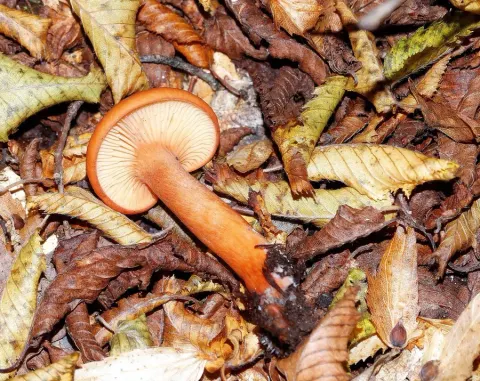
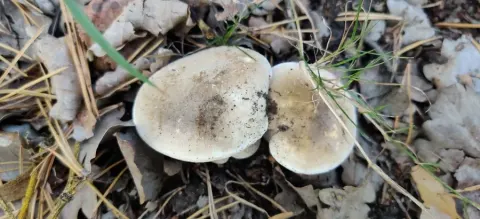
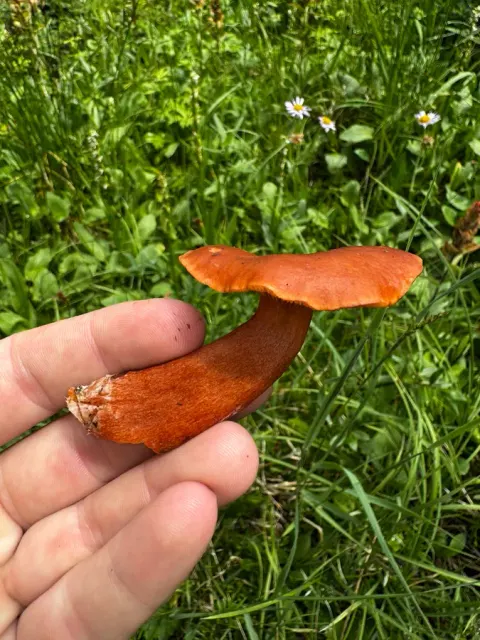
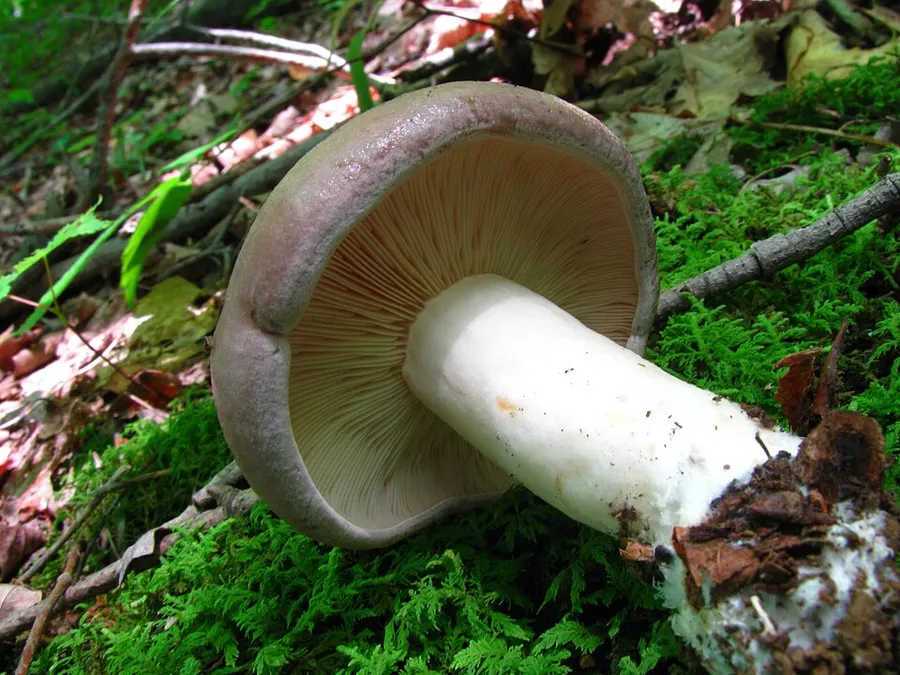
The cap is 4–20 cm wide, and initially convex to broadly convex before flattening out with a depressed center. The cap margin is curved inward, and often remains that way into maturity. The cap surface is covered with fine soft hairs when young, but later becomes smooth; it is slimy and sticky when wet. The color of the cap ranges from lilac-brown when young, fading to lilac-tan or pale lilac-gray and eventually to pale tan or pinkish-buff at the center. The gills are attached to slightly decurrent (extending somewhat down the length of the stem), broad, and closely packed together. They are cream-colored when young, and later develop pinkish tones near the margin. In maturity, they become flushed with brownish-orange. The color stains buff to olive-brown to dark brown when bruised. The stem is 3–15 cm long by 1–5 cm thick, and nearly equal in width throughout or tapering downward. Its surface may be slimy or dry, depending on the moisture in the environment. It is whitish, but in age becomes spotted with brownish stains. The flesh is firm, and white to buff. Its odor is not distinctive, while its taste is mild or slowly becomes slightly acrid. The latex is creamy-white on initial exposure, and stains the gills grayish-brown to dark brown or olive-brown; its taste is mild or slowly becomes slightly acrid. Older fruit bodies tend to have less abundant and weaker-tasting latex. The spore print is yellowish to pinkish-buff. The edibility of L. argillaceifolius is unknown. The cap surface will turn yellow to orange when a drop of dilute potassium hydroxide is applied. The spores are roughly spherical to broadly elliptical, and measure 7–11 by 7–8 μm.

Sebagian uraian ditampilkan dalam bahasa sumber; terjemahannya belum tersedia atau belum lolos pemeriksaan.

Rujukan: [1]

Pengukuran mengikuti objek, spesimen atau kultur, dan metode yang disebutkan sumber. Baca uraian asli untuk konteks lengkap.

02 / Kehidupan

Habitat dan peran ekologis

Spesies ini ditemukan dari timur Canada south hingga Florida, dan barat hingga Minnesota and Texas.

Rujukan: [1]

Habitat atau konteks temuan
Informasi belum tersedia pada sumber rilis ini.
Substrat
Informasi belum tersedia pada sumber rilis ini.
Peran atau konteks
Belum dikategorikan pada rilis ini.
Temukan hubungan serupa
03 / Siklus hidup

Reproduksi

The stem is 3–15 cm long by 1–5 cm thick, and nearly equal in width throughout or tapering downward. Its surface may be slimy or dry, depending on the moisture in the environment. It is whitish, but in age becomes spotted with brownish stains. The flesh is firm, and white to buff. Its odor is not distinctive, while its taste is mild or slowly becomes slightly acrid. The latex is creamy-white on initial exposure, and stains the gills grayish-brown to dark brown or olive-brown; its taste is mild or slowly becomes slightly acrid. Older fruit bodies tend to have less abundant and weaker-tasting latex. The spore print is yellowish to pinkish-buff. The edibility of L. argillaceifolius is unknown. The cap surface will turn yellow to orange when a drop of dilute potassium hydroxide is applied.

Sebagian uraian ditampilkan dalam bahasa sumber; terjemahannya belum tersedia atau belum lolos pemeriksaan.

Rujukan: [1]

Sinonim menurut acuan taksonomi rilis: Lactarius argillaceifolius var. dissimilis; Lactarius argillaceifolius var. megacarpus
04 / Batas informasi

Catatan identitas dan cakupan

  • Nama diterima mengikuti Catalogue of Life Base2026-09-11; uraian mempertahankan konsep dan nama sumber aslinya.
  • Original geographic, specimen and life-cycle scope retained; source import awaits individual editorial review.
  • Impor dan terjemahan otomatis belum diperiksa editorial per profil. Struktur reproduktif yang disebutkan tidak membuktikan seluruh siklus hidup diketahui.
  • Pengukuran pada uraian mengikuti spesimen, kultur, dan metode sumber; angka tidak diperluas ke semua populasi.

Catatan distribusi dalam narasi mengikuti sumbernya. Dokumentasi spesimen atau foto mengikuti catatan sumber. Bukti wilayah Indonesia dan penilaian konservasi tidak disimpulkan dari gambar.

05 / Dokumentasi

Melihat dengan konteks

Dokumentasi Lactarius argillaceifolius dari Wikimedia Commons. The milk mushroom Lactarius argillaceifolius var. argillaceifolius . Specimen photographed in Strouds Run State Park, Athens, Ohio, USA. Identifikasi mengikuti record berkas sumber.

Jenis
Fotografi
Kredit
This image was created by user Dan Molter (shroomydan) at Mushroom Observer , a source for mycological images. You can contact this user here .
Sumber media
Buka entri sumber

Gambar menunjukkan objek menurut identifikasi sumber, bukan verifikasi independen spesimen oleh Fungi. Tidak ada skala baru yang ditambahkan.

06 / Rujukan

Sumber profil

  1. [1] Lactarius argillaceifolius — Wikipedia (en)Bagian sumber: Frozen revision 1363038673
    Tanggal penghimpunan sumber: 2026-10-12
    Teks sumber: CC BY-SA4.0 · Wikipedia contributors
  2. [2] Catalogue of Life Base2026-09-11 — Lactarius argillaceifoliusBagian sumber: ColDP NameUsage.tsv ID 3RRLW; accepted species; source 2073
    Tanggal penghimpunan sumber: 2026-10-12
  3. [3] Dokumentasi visual — Lactarius argillaceifoliusBagian sumber: Individual media record; identification follows the source, not independent determination
    Tanggal penghimpunan sumber: 2026-10-12
    Media sumber: CC BY-SA 3.0 · This image was created by user Dan Molter (shroomydan) at Mushroom Observer , a source for mycological images. You can contact this user here .

Adaptasi teks: CC BY-SA 4.0. Wikipedia contributors — Lactarius argillaceifolius — Wikipedia (en)

Uraian asli dan riwayat sumber

Riwayat atau halaman sumber

Ringkasan sumber

Lactarius argillaceifolius is a species of fungus in the family Russulaceae. The mushrooms have convex to flattened drab lilac-colored caps that are up to 18 cm wide. The cream-colored gills are closely spaced together and extend slightly down the length of the stem, which is up to 9 cm long by 3.5 cm thick. The mushroom produces an off-white latex when injured that stains the tissue brownish. The variety megacarpus, with caps up to 27 cm wide, occurs under coast live oak and tanoak in the Pacific Coast states and Baja California.

Revisi sumber

Morfologi sumber

The cap is 4–20 cm wide, and initially convex to broadly convex before flattening out with a depressed center. The cap margin is curved inward, and often remains that way into maturity. The cap surface is covered with fine soft hairs when young, but later becomes smooth; it is slimy and sticky when wet. The color of the cap ranges from lilac-brown when young, fading to lilac-tan or pale lilac-gray and eventually to pale tan or pinkish-buff at the center. The gills are attached to slightly decurrent (extending somewhat down the length of the stem), broad, and closely packed together. They are cream-colored when young, and later develop pinkish tones near the margin. In maturity, they become flushed with brownish-orange. The color stains buff to olive-brown to dark brown when bruised. The stem is 3–15 cm long by 1–5 cm thick, and nearly equal in width throughout or tapering downward. Its surface may be slimy or dry, depending on the moisture in the environment. It is whitish, but in age becomes spotted with brownish stains. The flesh is firm, and white to buff. Its odor is not distinctive, while its taste is mild or slowly becomes slightly acrid. The latex is creamy-white on initial exposure, and stains the gills grayish-brown to dark brown or olive-brown; its taste is mild or slowly becomes slightly acrid. Older fruit bodies tend to have less abundant and weaker-tasting latex. The spore print is yellowish to pinkish-buff. The edibility of L. argillaceifolius is unknown. The cap surface will turn yellow to orange when a drop of dilute potassium hydroxide is applied. The spores are roughly spherical to broadly elliptical, and measure 7–11 by 7–8 μm.

Revisi sumber

Ekologi sumber

This species is found from eastern Canada south to Florida, and west to Minnesota and Texas.

Revisi sumber

Struktur reproduksi sumber

The stem is 3–15 cm long by 1–5 cm thick, and nearly equal in width throughout or tapering downward. Its surface may be slimy or dry, depending on the moisture in the environment. It is whitish, but in age becomes spotted with brownish stains. The flesh is firm, and white to buff. Its odor is not distinctive, while its taste is mild or slowly becomes slightly acrid. The latex is creamy-white on initial exposure, and stains the gills grayish-brown to dark brown or olive-brown; its taste is mild or slowly becomes slightly acrid. Older fruit bodies tend to have less abundant and weaker-tasting latex. The spore print is yellowish to pinkish-buff. The edibility of L. argillaceifolius is unknown. The cap surface will turn yellow to orange when a drop of dilute potassium hydroxide is applied.

Revisi sumber

Rujukan halaman ini

Fungi. Lactarius argillaceifolius. Rilis data fungi-2026-10-12-expansion-2. https://fungi-atlas.mgadib.chatgpt.site/jamur/lactarius-argillaceifolius/.

Status: impor sumber; pemeriksaan editorial per profil belum selesai. Untuk klaim biologis, gunakan rujukan pada bagian terkait dan periksa konteks sumber aslinya.