Ciri dan struktur
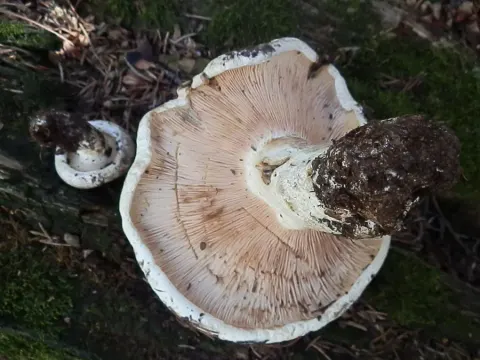
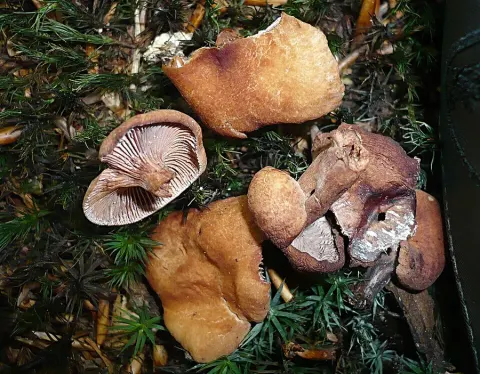
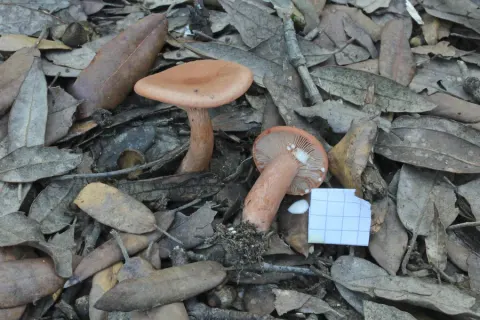
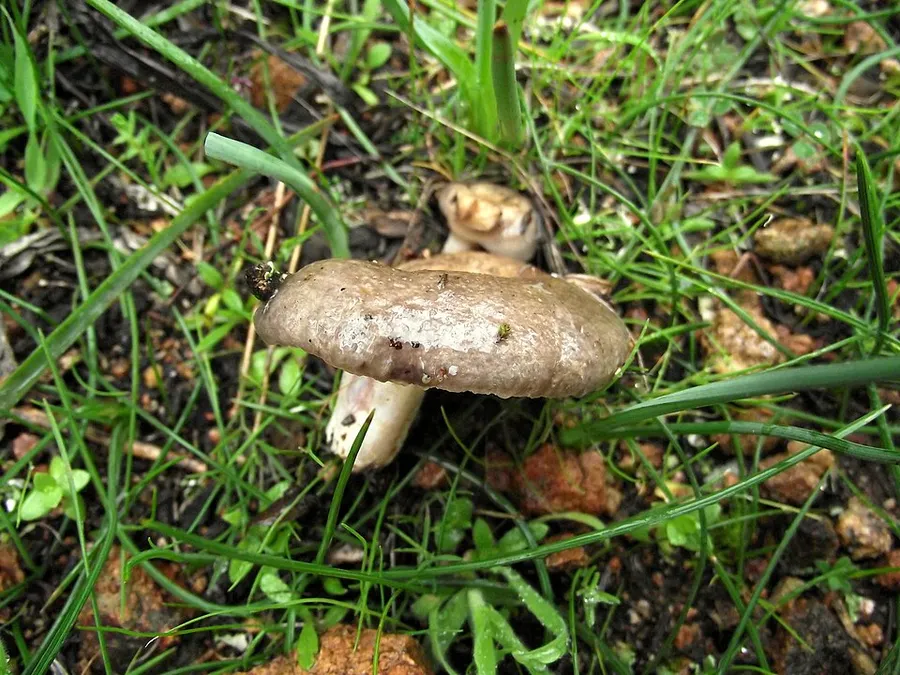
Fruit bodies of L. cistophilus are modest in size, with caps 2–5 cm in diameter. The cap is initially convex before flattening and becoming distinctly funnel‑shaped, the margin remaining involute when young. Its surface is finely hairy and somewhat viscid, showing a grey‑violet to dirty brownish‑violet hue that often fades to ochre at the centre with age. The crowded gills (lamellae) are adnate to slightly decurrent, starting pale cream and turning buff. The stipe measures 2–4 cm long by 0.7–1.5 cm wide, is cylindrical to club‑shaped, hollow and silky, white overall but sometimes faintly ochre‑tinted at the base, and bears a delicate, transient white ring. The flesh is white—slightly ochre at the stipe base—with a mild taste and only a faint odour. Under the microscope, spores are amyloid, 7.5––8.5 by 4.5–5.5 μm with an interrupted reticulum, and the gill faces bear large, bottle‑shaped cystidia.
Habitat dan peran ekologis
Lactarius cistophilus is known from Mediterranean maquis and garrigue, where it forms ectomycorrhizal partnerships with Cistus shrubs on well‑drained, often siliceous soils. At the time of its original description, it had been recorded primarily in the Provence region of southern France, though Bon suggested that further field surveys in similar western Mediterranean habitats may reveal a broader range. It has since also been reported from Italy, and Spain.
- Habitat atau konteks temuan
- Informasi belum tersedia pada sumber rilis ini.
- Substrat
- Informasi belum tersedia pada sumber rilis ini.
- Peran atau konteks
- Mitra tumbuhan
Reproduksi
Fruit bodies of L. cistophilus are modest in size, with caps 2–5 cm in diameter. The cap is initially convex before flattening and becoming distinctly funnel‑shaped, the margin remaining involute when young. Its surface is finely hairy and somewhat viscid, showing a grey‑violet to dirty brownish‑violet hue that often fades to ochre at the centre with age. The crowded gills (lamellae) are adnate to slightly decurrent, starting pale cream and turning buff. The stipe measures 2–4 cm long by 0.7–1.5 cm wide, is cylindrical to club‑shaped, hollow and silky, white overall but sometimes faintly ochre‑tinted at the base, and bears a delicate, transient white ring. The flesh is white—slightly ochre at the stipe base—with a mild taste and only a faint odour.
Catatan identitas dan cakupan
- Nama diterima mengikuti Catalogue of Life Base2026-09-11; uraian mempertahankan konsep dan nama sumber aslinya.
- Original geographic, specimen and life-cycle scope retained; source import awaits individual editorial review.
- Impor dan terjemahan otomatis belum diperiksa editorial per profil. Struktur reproduktif yang disebutkan tidak membuktikan seluruh siklus hidup diketahui.
- Pengukuran pada uraian mengikuti spesimen, kultur, dan metode sumber; angka tidak diperluas ke semua populasi.
Catatan distribusi dalam narasi mengikuti sumbernya. Dokumentasi spesimen atau foto mengikuti catatan sumber. Bukti wilayah Indonesia dan penilaian konservasi tidak disimpulkan dari gambar.
Melihat dengan konteks
Dokumentasi Lactarius cistophilus dari Wikimedia Commons. A fruitbody of the milkcap mushroom Lactarius cistophilus Bon. Photographed in Villaggio dei gigli, Sardinia, Italy. Identifikasi mengikuti record berkas sumber.
- Jenis
- Fotografi
- Kredit
- Davide Puddu
- Lisensi
- CC BY-SA 3.0
- Sumber media
- Buka entri sumber
Sumber profil
- [1] Lactarius cistophilus — Wikipedia (en)
- [2] Catalogue of Life Base2026-09-11 — Lactarius cistophilus
- [3] Dokumentasi visual — Lactarius cistophilus
Rujukan halaman ini
Fungi. Lactarius cistophilus. Rilis data fungi-2026-10-12-expansion-2. https://fungi-atlas.mgadib.chatgpt.site/jamur/lactarius-cistophilus/.
Status: impor sumber; pemeriksaan editorial per profil belum selesai. Untuk klaim biologis, gunakan rujukan pada bagian terkait dan periksa konteks sumber aslinya.