Ciri dan struktur
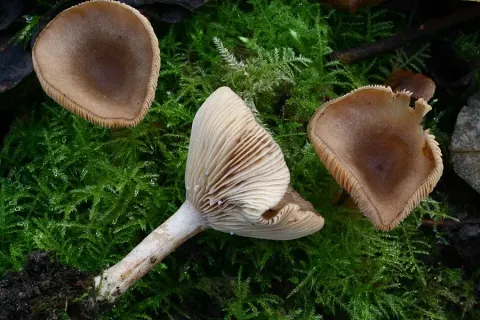
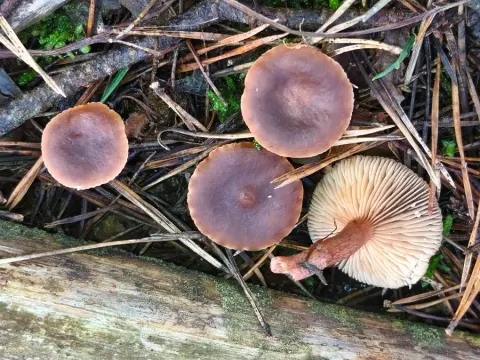
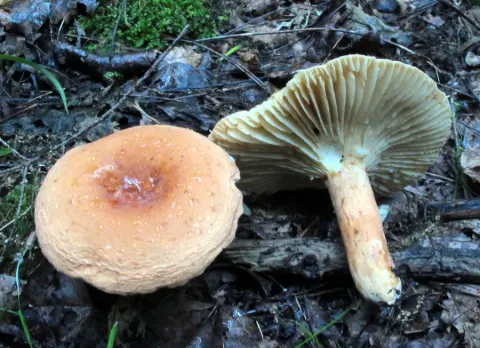
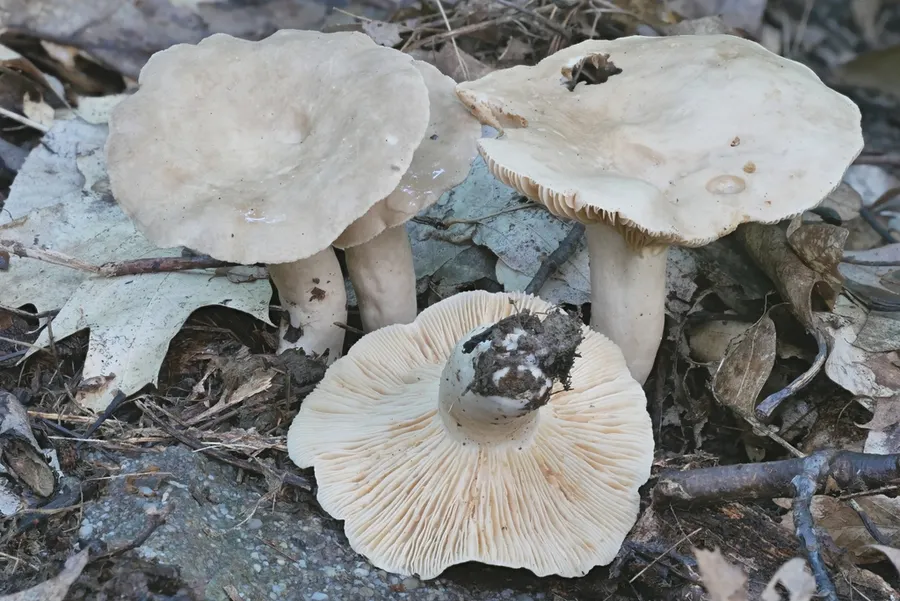
The cap is 3 – 10 cm wide, broadly convex to nearly plane, sometimes shallowly depressed. The margin (cap edge) is irregular, often wavy, and lobed or ribbed. The cap surface is dry, unpolished, azonate, usually becoming somewhat wrinkled with age, pale dingy yellow-brown to whitish overall, with a smoky tinge, sometimes with tawny olive, pinkish buff, or dull brown areas. The gills are attached to subdecurrent (running slightly down the length of the stem), narrow, crowded together, whitish, becoming dingy yellow-buff, staining reddish when bruised. The stem is 4 – 11 cm long, 6 – 15 mm thick, nearly equal, dry, dull, stuffed, colored like the cap, whitish towards the base, staining reddish, but more slowly than the gills. The flesh is pale white, staining reddish-salmon when cut. Its odor is not distinctive, but the taste is variable: quickly acrid then mild then slowly staining acrid, or very slowly faintly acrid. The latex is white on exposure, unchanging, staining tissues reddish. The spore print is pinkish-buff. The edibility is unknown. The spores are 6–8 by 6–8 μm, spherical or nearly so, ornamented with ridges that form a partial reticulum, prominences up to 1.5 μm high, hyaline (translucent), amyloid. The cap cuticle is a palisade of cylindrical to club-shaped cells.
Habitat dan peran ekologis
The fruit bodies of L. fumosus grow solitary, scattered, or in groups on the ground in woods from July–October. Jamur ini tersebar luas di Amerika Utara timur, dan juga telah dilaporkan dari Kanada barat. Frekuensi kedatangannya digambarkan sebagai sesekali. Daerahnya membentang dari selatan ke barat laut Meksiko, di mana ia ditemukan terkait dengan Liquidambar, Magnolia, Acer, dan Quercus species.
- Habitat atau konteks temuan
- Informasi belum tersedia pada sumber rilis ini.
- Substrat
- tanah
- Peran atau konteks
- Belum dikategorikan pada rilis ini.
Reproduksi
The cap is 3 – 10 cm wide, broadly convex to nearly plane, sometimes shallowly depressed. The margin (cap edge) is irregular, often wavy, and lobed or ribbed. The cap surface is dry, unpolished, azonate, usually becoming somewhat wrinkled with age, pale dingy yellow-brown to whitish overall, with a smoky tinge, sometimes with tawny olive, pinkish buff, or dull brown areas. The gills are attached to subdecurrent (running slightly down the length of the stem), narrow, crowded together, whitish, becoming dingy yellow-buff, staining reddish when bruised. The stem is 4 – 11 cm long, 6 – 15 mm thick, nearly equal, dry, dull, stuffed, colored like the cap, whitish towards the base, staining reddish, but more slowly than the gills.
Catatan identitas dan cakupan
- Nama diterima mengikuti Catalogue of Life Base2026-09-11; uraian mempertahankan konsep dan nama sumber aslinya.
- Original geographic, specimen and life-cycle scope retained; source import awaits individual editorial review.
- Impor dan terjemahan otomatis belum diperiksa editorial per profil. Struktur reproduktif yang disebutkan tidak membuktikan seluruh siklus hidup diketahui.
- Pengukuran pada uraian mengikuti spesimen, kultur, dan metode sumber; angka tidak diperluas ke semua populasi.
Catatan distribusi dalam narasi mengikuti sumbernya. Dokumentasi spesimen atau foto mengikuti catatan sumber. Bukti wilayah Indonesia dan penilaian konservasi tidak disimpulkan dari gambar.
Melihat dengan konteks
Dokumentasi Lactarius fumosus menurut asosiasi foto pada record takson iNaturalist. Kredit: Garrett Taylor. Identitas mengikuti sumber; bukan penentuan spesimen independen.
- Jenis
- Fotografi
- Kredit
- no rights reserved, uploaded by Garrett Taylor
- Lisensi
- CC0 1.0
- Sumber media
- Buka entri sumber
Sumber profil
- [1] Lactarius fumosus — Wikipedia (en)
- [2] Catalogue of Life Base2026-09-11 — Lactarius fumosus
- [3] Dokumentasi visual — Lactarius fumosus
Rujukan halaman ini
Fungi. Lactarius fumosus. Rilis data fungi-2026-10-12-expansion-2. https://fungi-atlas.mgadib.chatgpt.site/jamur/lactarius-fumosus/.
Status: impor sumber; pemeriksaan editorial per profil belum selesai. Untuk klaim biologis, gunakan rujukan pada bagian terkait dan periksa konteks sumber aslinya.