01 / Morfologi

Ciri dan struktur

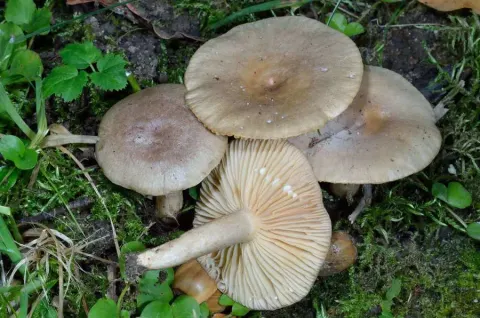
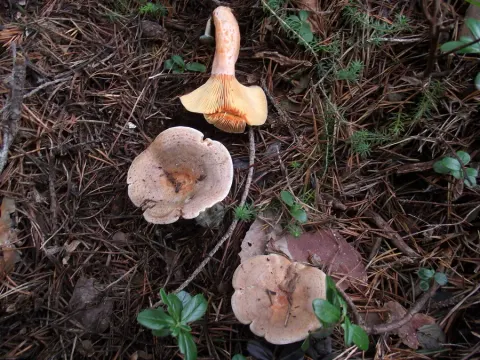
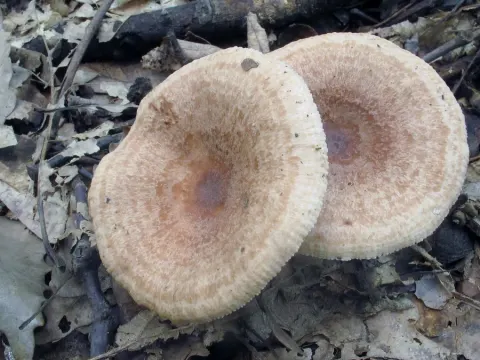
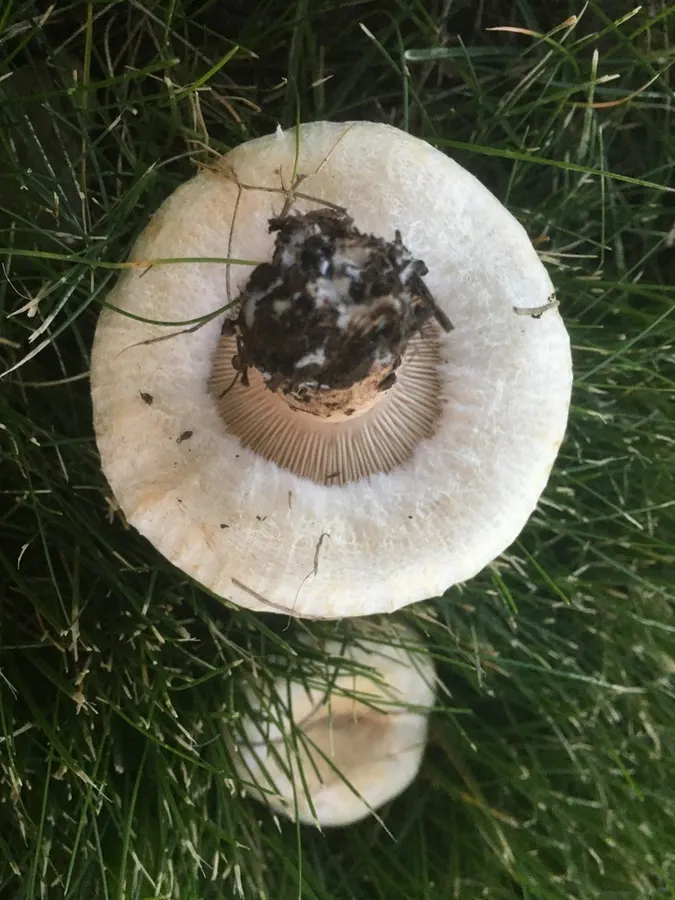
The cap is 2.5 – 10 cm wide, obtuse to convex, becoming broadly convex with a depressed center. The margin (cap edge) is rolled inward and bearded with coarse white hairs when young. The cap surface is dry and fibrillose except for the center, which is sticky and smooth when fresh, azonate, white to cream, becoming reddish-orange to vinaceous (red wine-colored) on the disc with age. The gills are attached to slightly decurrent, crowded, seldom forked, whitish to pale yellow with pinkish tinges, slowly staining brownish ochraceous when bruised. The stem is 2 – 6.5 cm long, 6 – 13 mm thick, nearly equal or tapered downward, silky, becoming hollow with age, whitish when young, becoming ochraceous from the base up when older, apex usually tinged pinkish, often with a white basal mycelium. The flesh is firm and whitish; the odor is faintly like geraniums or sometimes pungent, and taste is acrid. The latex is white upon exposure, unchanging, not staining tissues, taste acrid. The spore print is cream with a pinkish tint. The edibility of Lactarius pubescens has been described as unknown, and even edible. The spores are 6–8.5 by 5–6.5 μm, elliptic, ornamented with warts and ridges that sometimes form a partial reticulum, prominences up to 1.5 μm high, hyaline (translucent), and amyloid. The cap cuticle is a layer of thin-walled hyphae.

Sebagian uraian ditampilkan dalam bahasa sumber; terjemahannya belum tersedia atau belum lolos pemeriksaan.

Rujukan: [1]

Pengukuran mengikuti objek, spesimen atau kultur, dan metode yang disebutkan sumber. Baca uraian asli untuk konteks lengkap.

02 / Kehidupan

Habitat dan peran ekologis

The fruit bodies of L. pubescens are found scattered or in groups on the ground in wet areas under birch and other hardwoods from August to October. Jamur ini umum di seluruh Amerika Utara yang sedang Europe and telah dilaporkan dari Amerika Timur, Pasifik Barat Laut, Arizona, California, Colorado, Idaho, dan Kanada Barat; frekuensi kedatangannya kadang-kadang. Hal ini juga ditemukan di Greenland, dan dilaporkan untuk pertama kalinya di Roma, Italia, pada 1997.

Sebagian uraian ditampilkan dalam bahasa sumber; terjemahannya belum tersedia atau belum lolos pemeriksaan.

Rujukan: [1]

Habitat atau konteks temuan
Informasi belum tersedia pada sumber rilis ini.
Substrat
tanah
Peran atau konteks
Belum dikategorikan pada rilis ini.
Temukan hubungan serupa
03 / Siklus hidup

Reproduksi

The stem is 2 – 6.5 cm long, 6 – 13 mm thick, nearly equal or tapered downward, silky, becoming hollow with age, whitish when young, becoming ochraceous from the base up when older, apex usually tinged pinkish, often with a white basal mycelium. The flesh is firm and whitish; the odor is faintly like geraniums or sometimes pungent, and taste is acrid. The latex is white upon exposure, unchanging, not staining tissues, taste acrid. The spore print is cream with a pinkish tint. The edibility of Lactarius pubescens has been described as unknown, and even edible. The spores are 6–8.5 by 5–6.5 μm, elliptic, ornamented with warts and ridges that sometimes form a partial reticulum, prominences up to 1.5 μm high, hyaline (translucent), and amyloid.

Sebagian uraian ditampilkan dalam bahasa sumber; terjemahannya belum tersedia atau belum lolos pemeriksaan.

Rujukan: [1]

Sinonim menurut acuan taksonomi rilis: Lactarius betulae; Lactarius blumii f. betularum; Lactarius controversus var. pubescens; Lactarius pubescens var. betulae; Lactarius pubescens var. betularum; Lactarius torminosus subsp. pubescens; Lactarius torminosus var. pubescens; Lactifluus pubescens; Mycena pubescens
04 / Batas informasi

Catatan identitas dan cakupan

  • Nama diterima mengikuti Catalogue of Life Base2026-09-11; uraian mempertahankan konsep dan nama sumber aslinya.
  • Original geographic, specimen and life-cycle scope retained; source import awaits individual editorial review.
  • Impor dan terjemahan otomatis belum diperiksa editorial per profil. Struktur reproduktif yang disebutkan tidak membuktikan seluruh siklus hidup diketahui.
  • Pengukuran pada uraian mengikuti spesimen, kultur, dan metode sumber; angka tidak diperluas ke semua populasi.

Catatan distribusi dalam narasi mengikuti sumbernya. Dokumentasi spesimen atau foto mengikuti catatan sumber. Bukti wilayah Indonesia dan penilaian konservasi tidak disimpulkan dari gambar.

05 / Dokumentasi

Melihat dengan konteks

Dokumentasi Lactarius pubescens menurut asosiasi foto pada record takson iNaturalist. Kredit: Mike Dechter. Identitas mengikuti sumber; bukan penentuan spesimen independen.

Jenis
Fotografi
Kredit
(c) Mike Dechter, some rights reserved (CC BY), uploaded by Mike Dechter
Lisensi
CC BY 4.0
Sumber media
Buka entri sumber

Gambar menunjukkan objek menurut identifikasi sumber, bukan verifikasi independen spesimen oleh Fungi. Tidak ada skala baru yang ditambahkan.

06 / Rujukan

Sumber profil

  1. [1] Lactarius pubescens — Wikipedia (en)Bagian sumber: Frozen revision 1363893246
    Tanggal penghimpunan sumber: 2026-10-12
    Teks sumber: CC BY-SA4.0 · Wikipedia contributors
  2. [2] Catalogue of Life Base2026-09-11 — Lactarius pubescensBagian sumber: ColDP NameUsage.tsv ID 6NSPQ; accepted species; source 2073
    Tanggal penghimpunan sumber: 2026-10-12
  3. [3] Dokumentasi visual — Lactarius pubescensBagian sumber: Individual media record; identification follows the source, not independent determination
    Tanggal penghimpunan sumber: 2026-10-12
    Media sumber: CC BY 4.0 · (c) Mike Dechter, some rights reserved (CC BY), uploaded by Mike Dechter

Adaptasi teks: CC BY-SA 4.0. Wikipedia contributors — Lactarius pubescens — Wikipedia (en)

Uraian asli dan riwayat sumber

Riwayat atau halaman sumber

Ringkasan sumber

Lactarius pubescens, commonly known as the downy milk cap, is a species of fungus in the family Russulaceae. It is a medium to large agaric with a creamy-buff, hairy cap, whitish gills and short stout stem. The fungus has a cosmopolitan distribution, and grows solitarily or in scattered groups on sandy soil under or near birch. In Russia, is consumed after prolonged boiling followed by a marinating process. However it is reported to have caused gastro-intestinal upsets. Therefore, its consumption should not be recommended and this species considered toxic.

Revisi sumber

Morfologi sumber

The cap is 2.5 – 10 cm wide, obtuse to convex, becoming broadly convex with a depressed center. The margin (cap edge) is rolled inward and bearded with coarse white hairs when young. The cap surface is dry and fibrillose except for the center, which is sticky and smooth when fresh, azonate, white to cream, becoming reddish-orange to vinaceous (red wine-colored) on the disc with age. The gills are attached to slightly decurrent, crowded, seldom forked, whitish to pale yellow with pinkish tinges, slowly staining brownish ochraceous when bruised. The stem is 2 – 6.5 cm long, 6 – 13 mm thick, nearly equal or tapered downward, silky, becoming hollow with age, whitish when young, becoming ochraceous from the base up when older, apex usually tinged pinkish, often with a white basal mycelium. The flesh is firm and whitish; the odor is faintly like geraniums or sometimes pungent, and taste is acrid. The latex is white upon exposure, unchanging, not staining tissues, taste acrid. The spore print is cream with a pinkish tint. The edibility of Lactarius pubescens has been described as unknown, and even edible. The spores are 6–8.5 by 5–6.5 μm, elliptic, ornamented with warts and ridges that sometimes form a partial reticulum, prominences up to 1.5 μm high, hyaline (translucent), and amyloid. The cap cuticle is a layer of thin-walled hyphae.

Revisi sumber

Ekologi sumber

The fruit bodies of L. pubescens are found scattered or in groups on the ground in wet areas under birch and other hardwoods from August to October. The fungus is common all over temperate Europe and has been reported from eastern North America, the Pacific Northwest, Arizona, California, Colorado, Idaho, and western Canada; its frequency of appearance is occasional. It is also found in Greenland, and was reported for the first time in Rome, Italy, in 1997.

Revisi sumber

Struktur reproduksi sumber

The stem is 2 – 6.5 cm long, 6 – 13 mm thick, nearly equal or tapered downward, silky, becoming hollow with age, whitish when young, becoming ochraceous from the base up when older, apex usually tinged pinkish, often with a white basal mycelium. The flesh is firm and whitish; the odor is faintly like geraniums or sometimes pungent, and taste is acrid. The latex is white upon exposure, unchanging, not staining tissues, taste acrid. The spore print is cream with a pinkish tint. The edibility of Lactarius pubescens has been described as unknown, and even edible. The spores are 6–8.5 by 5–6.5 μm, elliptic, ornamented with warts and ridges that sometimes form a partial reticulum, prominences up to 1.5 μm high, hyaline (translucent), and amyloid.

Revisi sumber

Rujukan halaman ini

Fungi. Lactarius pubescens. Rilis data fungi-2026-10-12-expansion-2. https://fungi-atlas.mgadib.chatgpt.site/jamur/lactarius-pubescens/.

Status: impor sumber; pemeriksaan editorial per profil belum selesai. Untuk klaim biologis, gunakan rujukan pada bagian terkait dan periksa konteks sumber aslinya.