01 / Morfologi

Ciri dan struktur

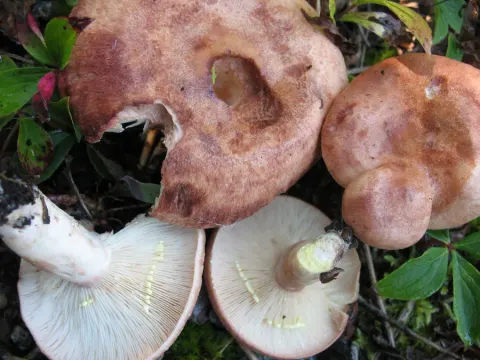
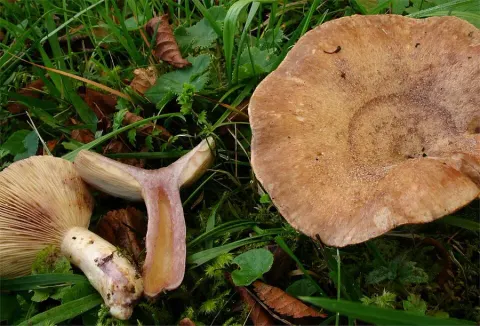
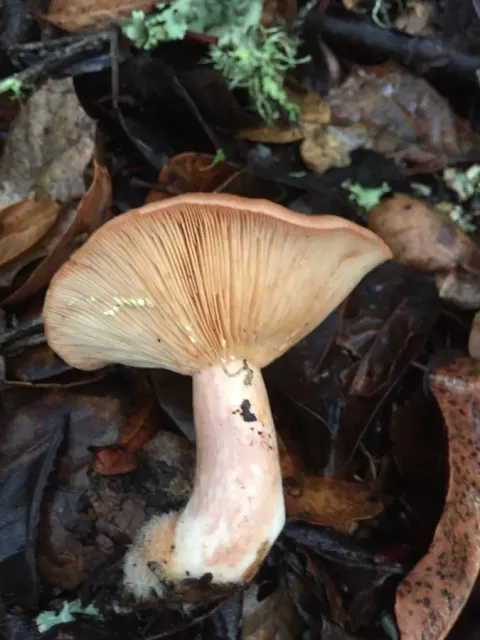
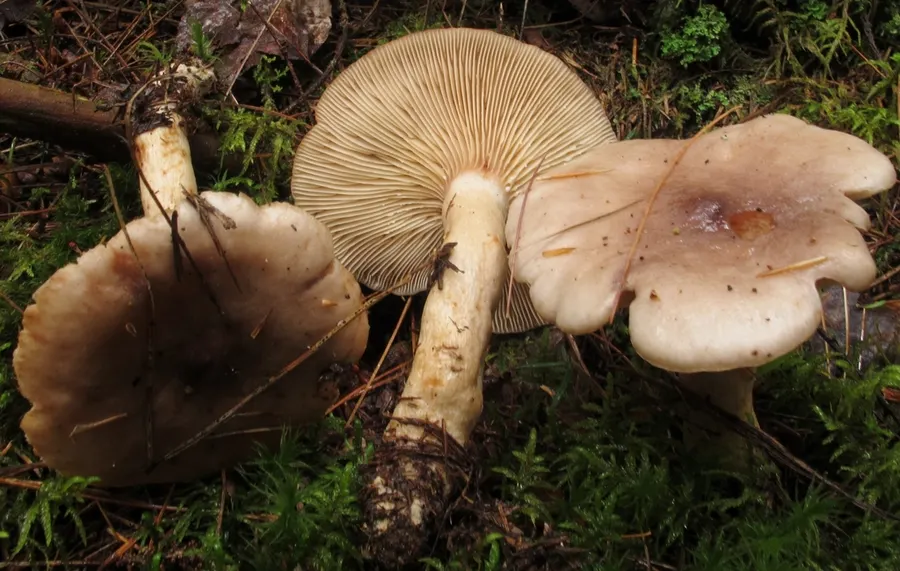
Lactarius vietus typically has a cap of 2.5 to 7.5 cm across, with a flattened-convex shape. At times, the cap becomes widely funnel-shaped, and sometimes features a broad or pointed umbo, The gills produce white milk, The mushroom flesh will slowly stain a greyish colour if a drop of FeSO4 solution is applied to it as a chemical colour test. The spore print is typically a creamy white, with a slight salmon tinge, In shape, the spores are elliptic, with a moderately well-developed network of ridges, measuring between 8 and 9.5 by 6.5 to 7.5 micrometres (μm). The pleurocystidia (cystidia on the face of the gills) are shaped like narrow spindles, typically measuring between 40 and 75 μm long, but sometimes reaching 86 μm in length, by 6 and 11 μm wide at the widest point. The cheilocystidia (cystidia on the edge of the gills) are leaf or spindle shaped, measuring between 30 and 52 μm long by 4 to 7 μm wide. The basidia are four-spored and club-shaped, measuring between 36 and 42 μm in length by 8 and 12 μm wide.

Sebagian uraian ditampilkan dalam bahasa sumber; terjemahannya belum tersedia atau belum lolos pemeriksaan.

Rujukan: [1]

Pengukuran mengikuti objek, spesimen atau kultur, dan metode yang disebutkan sumber. Baca uraian asli untuk konteks lengkap.

02 / Kehidupan

Habitat dan peran ekologis

Lactarius vietus cukup umum, dan dapat ditemukan tumbuh di daerah lembab di bawah pohon pada musim gugur, Ia membentuk hubungan ektomikoriza dengan pohon di bawahnya tumbuh. It can also be found growing on rotting wood or other hard surfaces; specimens have been observed on both conifer and hardwood logs. Ini biasanya spesimen yang lebih kecil, dan mungkin mereka mewakili varietas kerdil. Mushrooms can kadang tumbuh dalam jumlah besar, tetapi mereka juga dapat ditemukan tumbuh dalam kelompok yang ketat, atau bersendirian ketika tumbuh di luar musim. Jerman, dan Turki utara; di Amerika Utara, telah tercatat sebagai umum di Canada and baik Amerika Serikat utara dan selatan; di Asia utara, ditemukan di daerah-daerah di dekat kedua Oka River and dan Angara tengah River in Siberia; dan di Asia timur, telah dikumpulkan di Cina.

Sebagian uraian ditampilkan dalam bahasa sumber; terjemahannya belum tersedia atau belum lolos pemeriksaan.

Rujukan: [1]

Habitat atau konteks temuan
Informasi belum tersedia pada sumber rilis ini.
Substrat
kayu
Peran atau konteks
Mitra tumbuhan
Temukan hubungan serupa
03 / Siklus hidup

Reproduksi

The spore print is typically a creamy white, with a slight salmon tinge, In shape, the spores are elliptic, with a moderately well-developed network of ridges, measuring between 8 and 9.5 by 6.5 to 7.5 micrometres (μm). The pleurocystidia (cystidia on the face of the gills) are shaped like narrow spindles, typically measuring between 40 and 75 μm long, but sometimes reaching 86 μm in length, by 6 and 11 μm wide at the widest point. The cheilocystidia (cystidia on the edge of the gills) are leaf or spindle shaped, measuring between 30 and 52 μm long by 4 to 7 μm wide. The basidia are four-spored and club-shaped, measuring between 36 and 42 μm in length by 8 and 12 μm wide.

Sebagian uraian ditampilkan dalam bahasa sumber; terjemahannya belum tersedia atau belum lolos pemeriksaan.

Rujukan: [1]

Sinonim menurut acuan taksonomi rilis: Agaricus vietus; Galorrheus vietus; Lactarius paludestris; Lactarius vietus f. decolorans; Lactarius vietus var. paludestris; Lactifluus paludestris; Lactifluus vietus
04 / Batas informasi

Catatan identitas dan cakupan

  • Nama diterima mengikuti Catalogue of Life Base2026-09-11; uraian mempertahankan konsep dan nama sumber aslinya.
  • Original geographic, specimen and life-cycle scope retained; source import awaits individual editorial review.
  • Impor dan terjemahan otomatis belum diperiksa editorial per profil. Struktur reproduktif yang disebutkan tidak membuktikan seluruh siklus hidup diketahui.
  • Pengukuran pada uraian mengikuti spesimen, kultur, dan metode sumber; angka tidak diperluas ke semua populasi.

Catatan distribusi dalam narasi mengikuti sumbernya. Dokumentasi spesimen atau foto mengikuti catatan sumber. Bukti wilayah Indonesia dan penilaian konservasi tidak disimpulkan dari gambar.

05 / Dokumentasi

Melihat dengan konteks

Dokumentasi Lactarius vietus menurut asosiasi foto pada record takson iNaturalist. Kredit: mycowalt. Identitas mengikuti sumber; bukan penentuan spesimen independen.

Jenis
Fotografi
Kredit
(c) mycowalt, some rights reserved (CC BY-SA), uploaded by mycowalt
Sumber media
Buka entri sumber

Gambar menunjukkan objek menurut identifikasi sumber, bukan verifikasi independen spesimen oleh Fungi. Tidak ada skala baru yang ditambahkan.

06 / Rujukan

Sumber profil

  1. [1] Lactarius vietus — Wikipedia (en)Bagian sumber: Frozen revision 1243179431
    Tanggal penghimpunan sumber: 2026-10-12
    Teks sumber: CC BY-SA4.0 · Wikipedia contributors
  2. [2] Catalogue of Life Base2026-09-11 — Lactarius vietusBagian sumber: ColDP NameUsage.tsv ID 3RSCX; accepted species; source 2073
    Tanggal penghimpunan sumber: 2026-10-12
  3. [3] Dokumentasi visual — Lactarius vietusBagian sumber: Individual media record; identification follows the source, not independent determination
    Tanggal penghimpunan sumber: 2026-10-12
    Media sumber: CC BY-SA 4.0 · (c) mycowalt, some rights reserved (CC BY-SA), uploaded by mycowalt

Adaptasi teks: CC BY-SA 4.0. Wikipedia contributors — Lactarius vietus — Wikipedia (en)

Uraian asli dan riwayat sumber

Riwayat atau halaman sumber

Ringkasan sumber

Lactarius vietus (commonly known as the grey milkcap) is a species of fungus in the family Russulaceae, first described by Elias Magnus Fries. It produces moderately sized and brittle mushrooms, which grow on the forest floor or on rotting wood. The flattened-convex cap can vary in shape, sometimes forming the shape of a wide funnel. It is typically grey, but the colour varies. The species has crowded, light-coloured gills, which produce white milk. The spore print is typically whitish, but also varies considerably.

Revisi sumber

Morfologi sumber

Lactarius vietus typically has a cap of 2.5 to 7.5 cm across, with a flattened-convex shape. At times, the cap becomes widely funnel-shaped, and sometimes features a broad or pointed umbo, The gills produce white milk, The mushroom flesh will slowly stain a greyish colour if a drop of FeSO4 solution is applied to it as a chemical colour test. The spore print is typically a creamy white, with a slight salmon tinge, In shape, the spores are elliptic, with a moderately well-developed network of ridges, measuring between 8 and 9.5 by 6.5 to 7.5 micrometres (μm). The pleurocystidia (cystidia on the face of the gills) are shaped like narrow spindles, typically measuring between 40 and 75 μm long, but sometimes reaching 86 μm in length, by 6 and 11 μm wide at the widest point. The cheilocystidia (cystidia on the edge of the gills) are leaf or spindle shaped, measuring between 30 and 52 μm long by 4 to 7 μm wide. The basidia are four-spored and club-shaped, measuring between 36 and 42 μm in length by 8 and 12 μm wide.

Revisi sumber

Ekologi sumber

Lactarius vietus is fairly common, and can be found growing in moist areas under trees in autumn, It forms an ectomycorrhizal relationship with the trees under which it grows. It can also be found growing on rotting wood or other hard surfaces; specimens have been observed on both conifer and hardwood logs. These are typically smaller specimens, and it is possible that they represent a dwarf variety. Mushrooms can sometimes grow in large numbers, but they can also be found growing in tight clumps, or solitarily when growing out of season. Germany, and northern Turkey; in North America, it has been recorded as common in Canada and both the northern and southern United States; in northern Asia, it was found in regions near both the Oka River and the central Angara River in Siberia; and in eastern Asia, it has been collected in China.

Revisi sumber

Struktur reproduksi sumber

The spore print is typically a creamy white, with a slight salmon tinge, In shape, the spores are elliptic, with a moderately well-developed network of ridges, measuring between 8 and 9.5 by 6.5 to 7.5 micrometres (μm). The pleurocystidia (cystidia on the face of the gills) are shaped like narrow spindles, typically measuring between 40 and 75 μm long, but sometimes reaching 86 μm in length, by 6 and 11 μm wide at the widest point. The cheilocystidia (cystidia on the edge of the gills) are leaf or spindle shaped, measuring between 30 and 52 μm long by 4 to 7 μm wide. The basidia are four-spored and club-shaped, measuring between 36 and 42 μm in length by 8 and 12 μm wide.

Revisi sumber

Rujukan halaman ini

Fungi. Lactarius vietus. Rilis data fungi-2026-10-12-expansion-2. https://fungi-atlas.mgadib.chatgpt.site/jamur/lactarius-vietus/.

Status: impor sumber; pemeriksaan editorial per profil belum selesai. Untuk klaim biologis, gunakan rujukan pada bagian terkait dan periksa konteks sumber aslinya.