Ciri dan struktur
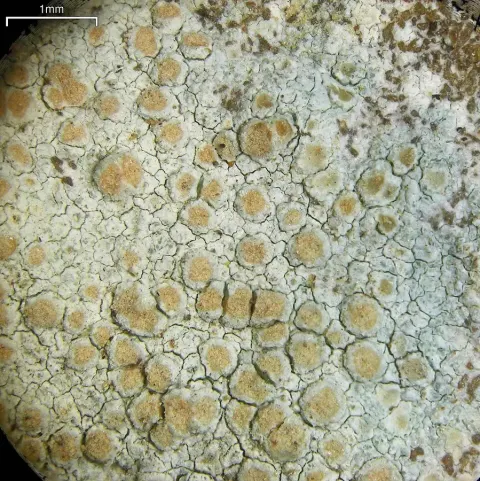
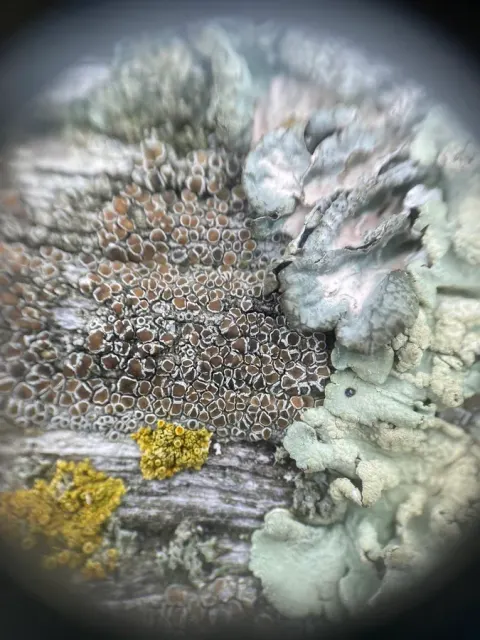
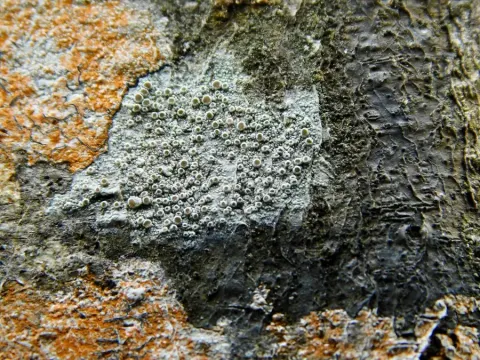
Lecanora baekdudaeganensis differs from L. imshaugii by a darker thallus (bluish, olivish, or pale brownish gray vs. greenish or yellowish gray), brownish disc (vs. reddish brown disc), K-insoluble granules on the surface of epihymenium (vs. absence of granules), shorter hypothecium (15–25 μm vs. 50–75 μm), and the presence of oil droplets in the apothecial section. Thallus corticolous, crustose, without lobes, continuous or cracked, rimose to areolate or verruculose, usually rounded or irregular, bluish gray in the beginning (margin) and olivish– or pale brownish–gray when mature (center), not pruinose, 30–70 mm diam., 100–170 μm thick; cortex hyaline to pale yellow or pale brown, 5–10 μm thick; medulla 20–75 μm thick; photobiont coccoid, forming a distinct algal layer, 45–80 μm thick, cells globose, 8.5–17 × 8–15 μm. Prothallus absent. Apothecia abundant, rounded, smaller and scattered around the margin and larger and aggregated in the center, constricted at the base, 0.2–1.6 mm diam. Disc flat to slightly concave, not pruinose, brown to dark brown from the beginning, 270–430 μm thick; margin persistent, prominent, generally entire or slightly flexuous, some a little crenulate when old, concolorous to thallus. Amphithecium well-developed, with numerous small crystals in both algal-containing and cortical parts (allophana -type) not dissolving in K, 60–100 μm thick laterally, 110–130 μm thick basally; amphithecial cortex distinct, 7–12 μm thick. Parathecium hyaline, indistinct in water, 15–25 μm thick in I. Epihymenium pale yellowish brown to pale brown, with small granules on the surface not dissolving in K, pigment slightly paler in K but not diluted, without oil droplets, 5–15 μm high.
Habitat dan peran ekologis
The species occurs on the bark of Quercus mongolica and Q. dentata which are the most dominant tree species on the mountain. This species is currently known from four different sites on the mountain.
- Habitat atau konteks temuan
- Informasi belum tersedia pada sumber rilis ini.
- Substrat
- Informasi belum tersedia pada sumber rilis ini.
- Peran atau konteks
- Pembentuk liken
Reproduksi
Thallus corticolous, crustose, without lobes, continuous or cracked, rimose to areolate or verruculose, usually rounded or irregular, bluish gray in the beginning (margin) and olivish– or pale brownish–gray when mature (center), not pruinose, 30–70 mm diam., 100–170 μm thick; cortex hyaline to pale yellow or pale brown, 5–10 μm thick; medulla 20–75 μm thick; photobiont coccoid, forming a distinct algal layer, 45–80 μm thick, cells globose, 8.5–17 × 8–15 μm. Prothallus absent. Apothecia abundant, rounded, smaller and scattered around the margin and larger and aggregated in the center, constricted at the base, 0.2–1.6 mm diam. Disc flat to slightly concave, not pruinose, brown to dark brown from the beginning, 270–430 μm thick; margin persistent, prominent, generally entire or slightly flexuous, some a little crenulate when old, concolorous to thallus.
Catatan identitas dan cakupan
- Nama diterima mengikuti Catalogue of Life Base2026-09-11; uraian mempertahankan konsep dan nama sumber aslinya.
- Preserve original treatment localities, hosts and substrate scope. Materials examined describe documented specimens, not the full global range.
- Impor dan terjemahan otomatis belum diperiksa editorial per profil. Struktur reproduktif yang disebutkan tidak membuktikan seluruh siklus hidup diketahui.
- Pengukuran pada uraian mengikuti spesimen, kultur, dan metode sumber; angka tidak diperluas ke semua populasi.
Catatan distribusi dalam narasi mengikuti sumbernya. Dokumentasi spesimen atau foto mengikuti catatan sumber. Bukti wilayah Indonesia dan penilaian konservasi tidak disimpulkan dari gambar.
Melihat dengan konteks
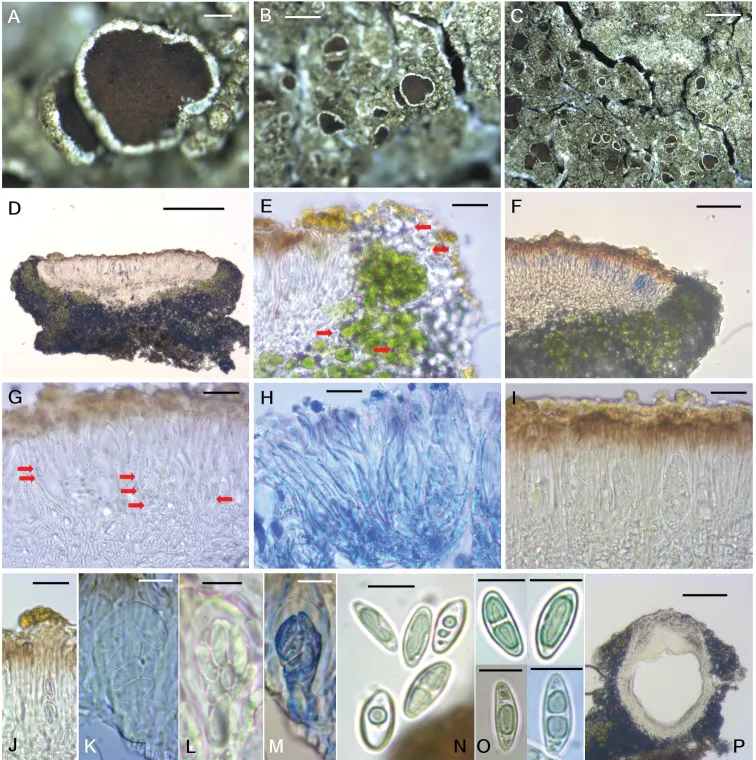
Lecanora baekdudaeganensis (BDNA -L-0000065, holotype) in morphology. A–C Habitus with dark thallus and epruinose apothecia D sessile apothecia with constricted base in section. Hypothecial base closed by medulla of amphithecium E well-developed amphithecium with small calcium oxalate crystals (red arrows) not dissolving in KOH F apothecial section in Iodine. I– reaction in the beginning then turning slowly to blue or purple–blue hymenium G oil droplets (red arrows) present in the apothecial section H anastomosing paraphyses shown in Lactophenol cotton blue I asci in hymenium J epihymenium with yellowish granules not dissolving in KOH K–M 8-spored, clavate asci (M in Lactophenol cotton blue) N, O ellipsoid ascospores in diverse development stages. Spores biguttulate in the beginning then having a long oil drop by assembly of guttules when mature P old pycnidia without pycnocodidia. Scale bars: 200 μm (A, D), 2 mm (B, C), 20 μm (E, G–J), 50 μm (F), 10 μm (K–O), 100 μm (P).
- Jenis
- Pelat ilmiah
- Kredit
- Beeyoung Gun Lee, Jae-Seoun Hur
- Lisensi
- CC BY 4.0
- Sumber media
- Buka entri sumber
Sumber profil
- [1] A new lichenized fungus, Lecanora baekdudaeganensis, from South Korea, with a taxonomic key for Korean Lecanora species — Lecanora baekdudaeganensis
- [2] Catalogue of Life Base2026-09-11 — Lecanora baekdudaeganensis
- [3] Dokumentasi visual — Lecanora baekdudaeganensis
Rujukan halaman ini
Fungi. Lecanora baekdudaeganensis. Rilis data fungi-2026-10-12-expansion-2. https://fungi-atlas.mgadib.chatgpt.site/jamur/lecanora-baekdudaeganensis/.
Status: impor sumber; pemeriksaan editorial per profil belum selesai. Untuk klaim biologis, gunakan rujukan pada bagian terkait dan periksa konteks sumber aslinya.