Ciri dan struktur
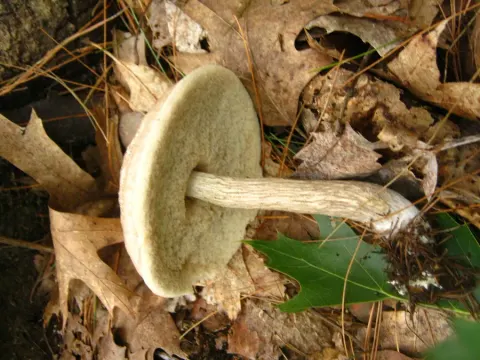
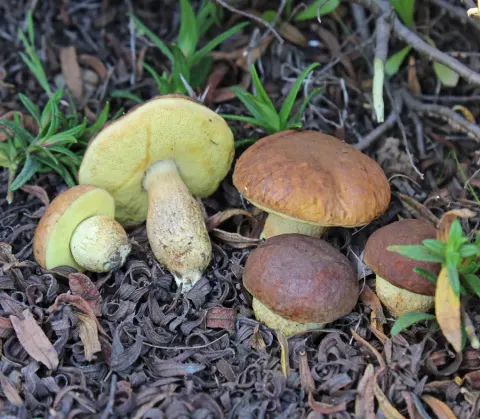
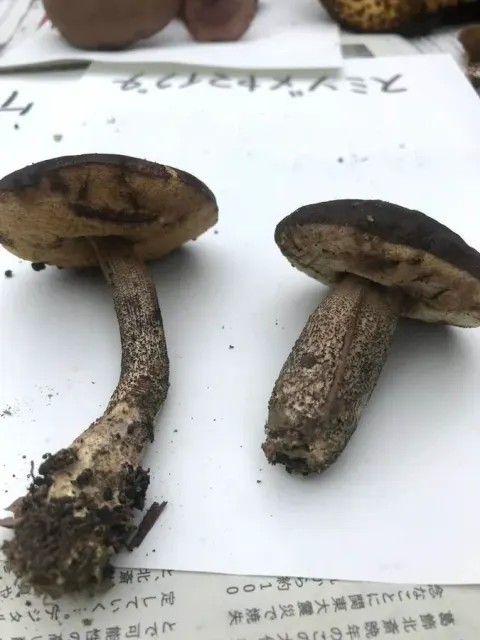
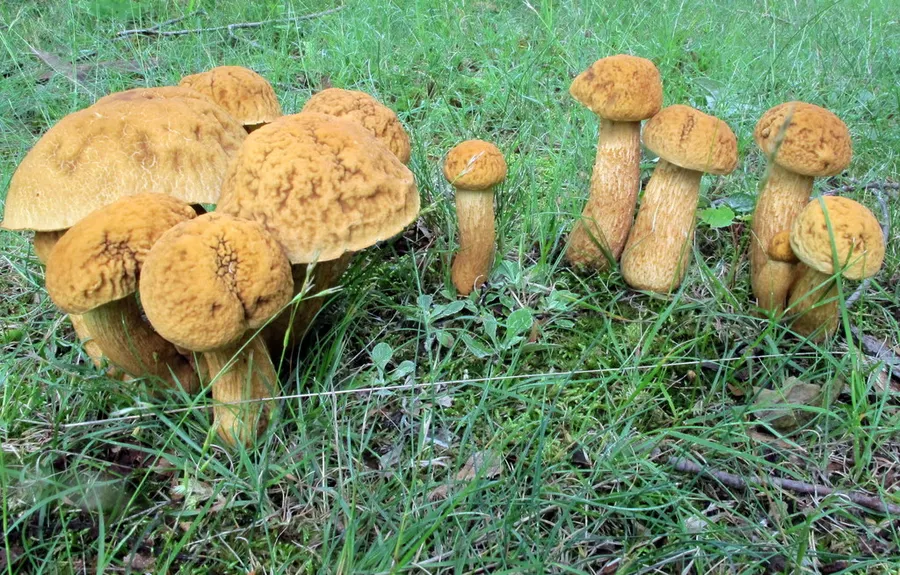
The convex cap measures 5 – 15 cm wide. Its color is orange-yellow, aging to yellow-brown. The cap margin has a narrow flap of sterile tissue. The surface of the cap is dry, with wrinkles and pits at maturity. It often becomes cracked in age, and the whitish flesh underneath shows through. The cap tends to undergo significant color changes throughout its development—first bright yellow, then dark brown, then finally pale tan—which may make it difficult to identify in the field. The flesh is white to pale yellow, and it stains reddish to burgundy when cut or bruised. This staining is most prominent at the junction of the cap and the stipe. Further exposure over the course of 20–60 minutes results in the flesh becoming grayish to blackish. The flesh has no distinctive door or taste. The pore surface is initially dull yellow, and sometimes ages to dingy olive-brown. Unlike many other boletes, it does not turn blue when bruised, although it may have natural blue-green stains. The pores are circular, measuring less than 1 mm, while the tubes extend to 8–14 mm deep. The stipe measures 3 – 10 cm long by 1 – 3 cm thick. It is nearly equal in length throughout or tapered from the top to base. Its color is pale yellow to brownish underneath the pale brown scabers that darken in age. The spore print color ranges from brown to olive-brown. Spores are spindle shaped, measuring 15–19 long by 5–6 μm. They have a smooth surface, and are inamyloid (i.e., not staining with Melzer's reagent). The cap flesh is bilateral and inamyloid. The cystidia on the pores are present as conspicuous pleuro- and cheilocystidia.
Habitat dan peran ekologis
Leccinellum rugosiceps is an ectomycorrhizal fungus that associates with oak. In eastern North America, pin oak (Quercus palustris) is a frequent host. The bolete fruits singly or in groups in forests, shaded lawns, and often found in areas disturbed by human activity, such as pathsides and picnic areas. Fruiting typically occurs from July to September. A Chinese study evaluating the concentrations of heavy metals in boletes found that in L. rugosiceps fruitbodies, the levels of cadmium, zinc, copper, and mercury exceeded that of national safety standards for edible fungi. The bolete is found from eastern Canada south to Florida and Mississippi, west to Michigan in the United States. The distribution extends south to Mexico, Costa Rica, and Colombia. It is one of several boletes that have a north to south clinal trend. In Asia, the species has been reported from India, Korea, China, and Taiwan. Taiwanese specimens tend to have slightly smaller spores (10–16 by 4–5 μm) than those from mainland China or from America.
- Habitat atau konteks temuan
- hutan
- Substrat
- Informasi belum tersedia pada sumber rilis ini.
- Peran atau konteks
- Mitra tumbuhan
Reproduksi
The spore print color ranges from brown to olive-brown. Spores are spindle shaped, measuring 15–19 long by 5–6 μm. They have a smooth surface, and are inamyloid (i.e., not staining with Melzer's reagent). The cap flesh is bilateral and inamyloid. The cystidia on the pores are present as conspicuous pleuro- and cheilocystidia. The cap cuticle is present as a hymeniform layer. Clamp connections are absent.
Catatan identitas dan cakupan
- Nama diterima mengikuti Catalogue of Life Base2026-09-11; uraian mempertahankan konsep dan nama sumber aslinya.
- Original geographic, specimen and life-cycle scope retained; source import awaits individual editorial review.
- Impor dan terjemahan otomatis belum diperiksa editorial per profil. Struktur reproduktif yang disebutkan tidak membuktikan seluruh siklus hidup diketahui.
- Pengukuran pada uraian mengikuti spesimen, kultur, dan metode sumber; angka tidak diperluas ke semua populasi.
Catatan distribusi dalam narasi mengikuti sumbernya. Dokumentasi spesimen atau foto mengikuti catatan sumber. Bukti wilayah Indonesia dan penilaian konservasi tidak disimpulkan dari gambar.
Melihat dengan konteks
Dokumentasi Leccinellum rugosiceps menurut asosiasi foto pada record takson iNaturalist. Kredit: mycowalt. Identitas mengikuti sumber; bukan penentuan spesimen independen.
- Jenis
- Fotografi
- Kredit
- (c) mycowalt, some rights reserved (CC BY-SA), uploaded by mycowalt
- Lisensi
- CC BY-SA 4.0
- Sumber media
- Buka entri sumber
Dokumentasi tambahan
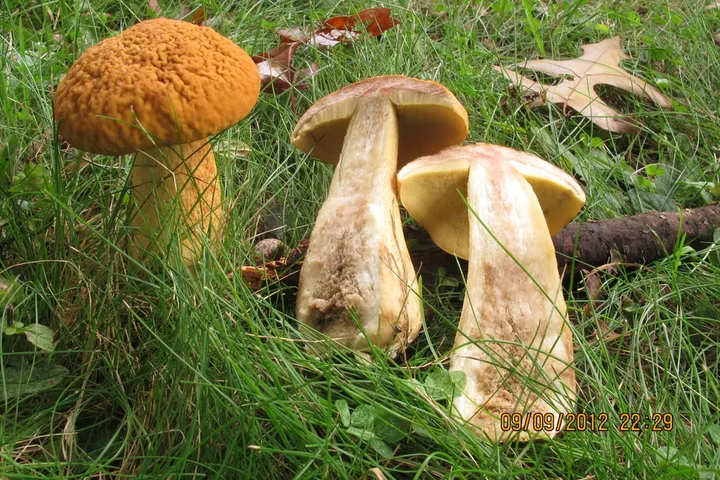
Foto yang diasosiasikan dengan Leccinellum rugosiceps pada iNaturalist. Identifikasi mengikuti sumber; bukan penentuan spesimen independen.
Kredit dan penggunaan
(c) mycowalt, some rights reserved (CC BY-SA), uploaded by mycowalt
Ukuran dan format gambar disesuaikan tanpa pemotongan, retus, atau penambahan skala. Lisensi sumber dipertahankan.
Sumber profil
- [1] Leccinellum rugosiceps — Wikipedia (en)
- [2] Catalogue of Life Base2026-09-11 — Leccinellum rugosiceps
- [3] Dokumentasi visual — Leccinellum rugosiceps
- [4] Dokumentasi visual — Leccinellum rugosiceps
Rujukan halaman ini
Fungi. Leccinellum rugosiceps. Rilis data fungi-2026-10-12-expansion-2. https://fungi-atlas.mgadib.chatgpt.site/jamur/leccinellum-rugosiceps/.
Status: impor sumber; pemeriksaan editorial per profil belum selesai. Untuk klaim biologis, gunakan rujukan pada bagian terkait dan periksa konteks sumber aslinya.