01 / Morfologi

Ciri dan struktur

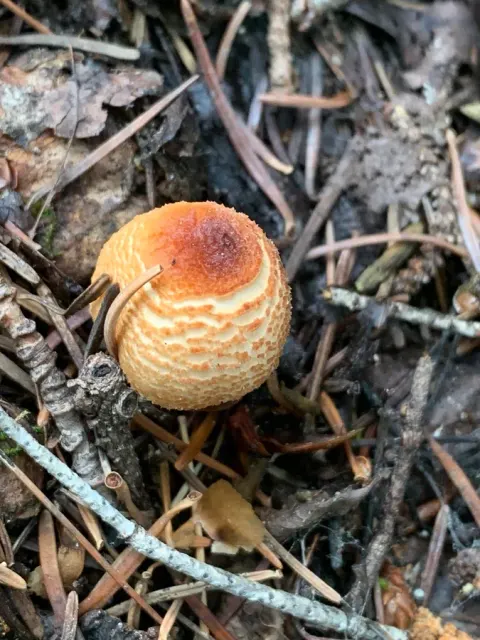
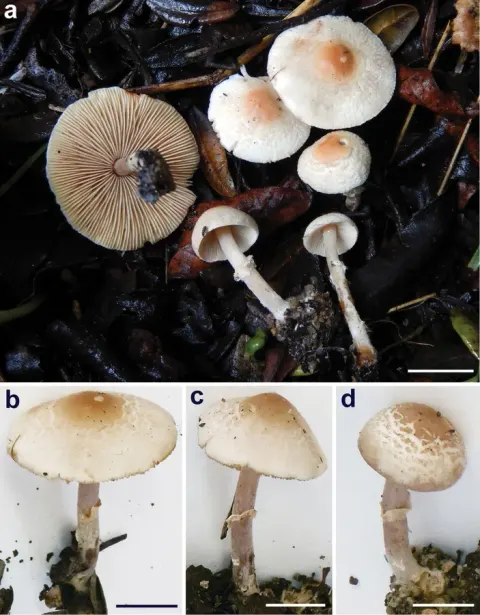
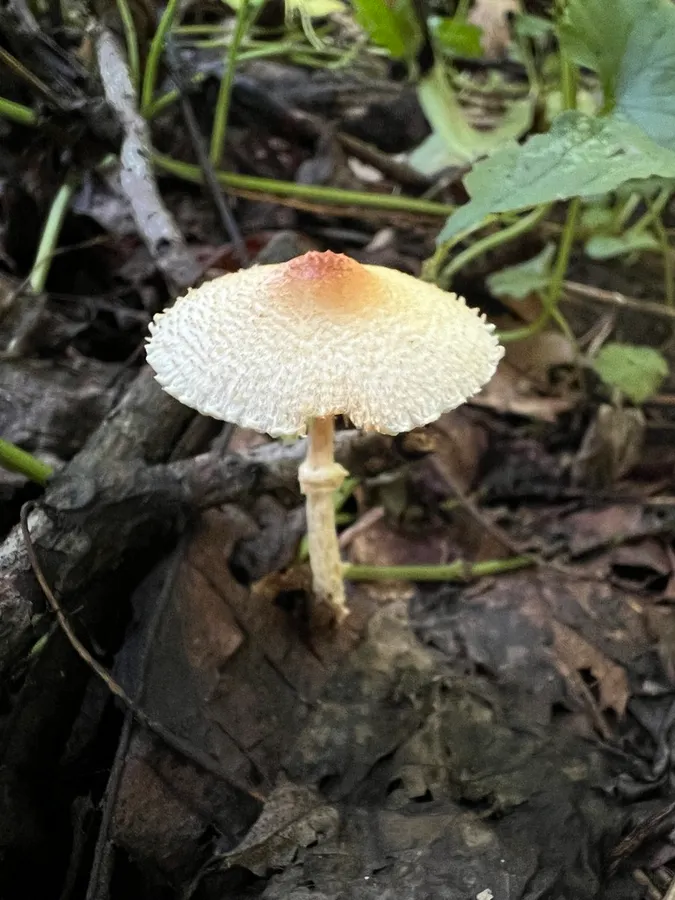
The fruit bodies have plano-convex caps that frequently have a small umbo, and a diameter of 3.2 – 4 cm. The cap margin is initially curved downward before straightening out in maturity, when it typically becomes eroded. The center of the cap is brown and velutinous, and often forms sparse scales that expose the yellowish flesh underneath. The gills are free from attachment to the stem, and somewhat crowded together. Their color is initially yellowish-buff to orange-pink, and they frequently discolor reddish near the cap margin. The yellowish stem measures 3.6 – 5.4 cm long by 2.5–3 mm thick at the top; it gradually thickens approaching the base, and is sometimes bulbous or club-shaped, up to 5 mm wide. The partial veil that covers the young developing gills is left as a loose ring zone on the stem. The spore print is pink. Spores are smooth, oblong to amygdaliform (almond shaped) in profile view, spindle-shaped in frontal view, and measure 8.8–9.5–11.3 by 4.4–4.9–5.4 μm. The basidia (spore-bearing cells) are club-shaped to somewhat cylindrical, four-spored, and have dimensions of 22–27–32 by 8–9–11 μm. Cheilocystidia (cystidia on the gill edge) are club-shaped to somewhat cylindrical, and measure 13–19–29 by 6.0–7.5–11 μm. The cap cuticle comprises a trichoderm (with hyphae arranged roughly parallel, perpendicular to the cap surface) of hyphae measuring 117–188–345 by 7–9–11 μm. These slightly yellow-brown hyphae have tips that are obtuse to somewhat acute, and arise from short and cylindrical bases. Clamp connections are present in the hyphae of all tissues.

Sebagian uraian ditampilkan dalam bahasa sumber; terjemahannya belum tersedia atau belum lolos pemeriksaan.

Rujukan: [1]

Pengukuran mengikuti objek, spesimen atau kultur, dan metode yang disebutkan sumber. Baca uraian asli untuk konteks lengkap.

02 / Kehidupan

Habitat dan peran ekologis

Fruit bodies of Lepiota maculans grow in groups on the ground in grass at the edge of deciduous forests. The mushroom has been reported only from the US states Tennessee, Indiana and Missouri.

Sebagian uraian ditampilkan dalam bahasa sumber; terjemahannya belum tersedia atau belum lolos pemeriksaan.

Rujukan: [1]

Habitat atau konteks temuan
hutan
Substrat
tanah
Peran atau konteks
Belum dikategorikan pada rilis ini.
Temukan hubungan serupa
03 / Siklus hidup

Reproduksi

The spore print is pink. Spores are smooth, oblong to amygdaliform (almond shaped) in profile view, spindle-shaped in frontal view, and measure 8.8–9.5–11.3 by 4.4–4.9–5.4 μm. The basidia (spore-bearing cells) are club-shaped to somewhat cylindrical, four-spored, and have dimensions of 22–27–32 by 8–9–11 μm. Cheilocystidia (cystidia on the gill edge) are club-shaped to somewhat cylindrical, and measure 13–19–29 by 6.0–7.5–11 μm. The cap cuticle comprises a trichoderm (with hyphae arranged roughly parallel, perpendicular to the cap surface) of hyphae measuring 117–188–345 by 7–9–11 μm. These slightly yellow-brown hyphae have tips that are obtuse to somewhat acute, and arise from short and cylindrical bases.

Sebagian uraian ditampilkan dalam bahasa sumber; terjemahannya belum tersedia atau belum lolos pemeriksaan.

Rujukan: [1]

04 / Batas informasi

Catatan identitas dan cakupan

  • Nama diterima mengikuti Catalogue of Life Base2026-09-11; uraian mempertahankan konsep dan nama sumber aslinya.
  • Original geographic, specimen and life-cycle scope retained; source import awaits individual editorial review.
  • Impor dan terjemahan otomatis belum diperiksa editorial per profil. Struktur reproduktif yang disebutkan tidak membuktikan seluruh siklus hidup diketahui.
  • Pengukuran pada uraian mengikuti spesimen, kultur, dan metode sumber; angka tidak diperluas ke semua populasi.

Catatan distribusi dalam narasi mengikuti sumbernya. Dokumentasi spesimen atau foto mengikuti catatan sumber. Bukti wilayah Indonesia dan penilaian konservasi tidak disimpulkan dari gambar.

05 / Dokumentasi

Melihat dengan konteks

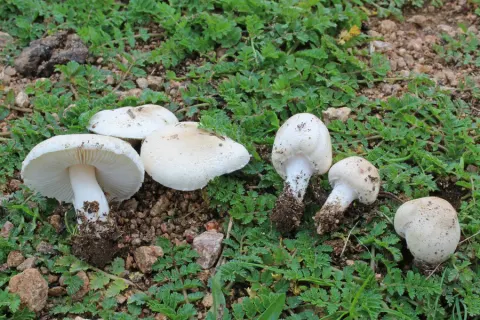
Dokumentasi Lepiota maculans menurut asosiasi foto pada record takson iNaturalist. Kredit: Brian C. Hunt. Identitas mengikuti sumber; bukan penentuan spesimen independen.

Jenis
Fotografi
Kredit
(c) Brian C. Hunt, some rights reserved (CC BY), uploaded by Brian C. Hunt
Lisensi
CC BY 4.0
Sumber media
Buka entri sumber

Gambar menunjukkan objek menurut identifikasi sumber, bukan verifikasi independen spesimen oleh Fungi. Tidak ada skala baru yang ditambahkan.

06 / Rujukan

Sumber profil

  1. [1] Lepiota maculans — Wikipedia (en)Bagian sumber: Frozen revision 1293429244
    Tanggal penghimpunan sumber: 2026-10-12
    Teks sumber: CC BY-SA4.0 · Wikipedia contributors
  2. [2] Catalogue of Life Base2026-09-11 — Lepiota maculansBagian sumber: ColDP NameUsage.tsv ID 6PCWP; accepted species; source 2073
    Tanggal penghimpunan sumber: 2026-10-12
  3. [3] Dokumentasi visual — Lepiota maculansBagian sumber: Individual media record; identification follows the source, not independent determination
    Tanggal penghimpunan sumber: 2026-10-12
    Media sumber: CC BY 4.0 · (c) Brian C. Hunt, some rights reserved (CC BY), uploaded by Brian C. Hunt

Adaptasi teks: CC BY-SA 4.0. Wikipedia contributors — Lepiota maculans — Wikipedia (en)

Uraian asli dan riwayat sumber

Riwayat atau halaman sumber

Ringkasan sumber

Lepiota maculans is a rare species of agaric fungus in the family Agaricaceae. It was originally collected in Missouri, and then 105 years later in eastern Tennessee and 118 years later in southern Indiana . It is the only member of Lepiota known to have a pink spore print instead of the usual white or cream color. The fruit bodies have caps up to 4 cm in diameter, with brownish, sparsely scaled centers. The gills are closely spaced, not attached to the stipe, and discolor reddish at the edges.

Revisi sumber

Morfologi sumber

The fruit bodies have plano-convex caps that frequently have a small umbo, and a diameter of 3.2 – 4 cm. The cap margin is initially curved downward before straightening out in maturity, when it typically becomes eroded. The center of the cap is brown and velutinous, and often forms sparse scales that expose the yellowish flesh underneath. The gills are free from attachment to the stem, and somewhat crowded together. Their color is initially yellowish-buff to orange-pink, and they frequently discolor reddish near the cap margin. The yellowish stem measures 3.6 – 5.4 cm long by 2.5–3 mm thick at the top; it gradually thickens approaching the base, and is sometimes bulbous or club-shaped, up to 5 mm wide. The partial veil that covers the young developing gills is left as a loose ring zone on the stem. The spore print is pink. Spores are smooth, oblong to amygdaliform (almond shaped) in profile view, spindle-shaped in frontal view, and measure 8.8–9.5–11.3 by 4.4–4.9–5.4 μm. The basidia (spore-bearing cells) are club-shaped to somewhat cylindrical, four-spored, and have dimensions of 22–27–32 by 8–9–11 μm. Cheilocystidia (cystidia on the gill edge) are club-shaped to somewhat cylindrical, and measure 13–19–29 by 6.0–7.5–11 μm. The cap cuticle comprises a trichoderm (with hyphae arranged roughly parallel, perpendicular to the cap surface) of hyphae measuring 117–188–345 by 7–9–11 μm. These slightly yellow-brown hyphae have tips that are obtuse to somewhat acute, and arise from short and cylindrical bases. Clamp connections are present in the hyphae of all tissues.

Revisi sumber

Ekologi sumber

Fruit bodies of Lepiota maculans grow in groups on the ground in grass at the edge of deciduous forests. The mushroom has been reported only from the US states Tennessee, Indiana and Missouri.

Revisi sumber

Struktur reproduksi sumber

The spore print is pink. Spores are smooth, oblong to amygdaliform (almond shaped) in profile view, spindle-shaped in frontal view, and measure 8.8–9.5–11.3 by 4.4–4.9–5.4 μm. The basidia (spore-bearing cells) are club-shaped to somewhat cylindrical, four-spored, and have dimensions of 22–27–32 by 8–9–11 μm. Cheilocystidia (cystidia on the gill edge) are club-shaped to somewhat cylindrical, and measure 13–19–29 by 6.0–7.5–11 μm. The cap cuticle comprises a trichoderm (with hyphae arranged roughly parallel, perpendicular to the cap surface) of hyphae measuring 117–188–345 by 7–9–11 μm. These slightly yellow-brown hyphae have tips that are obtuse to somewhat acute, and arise from short and cylindrical bases.

Revisi sumber

Rujukan halaman ini

Fungi. Lepiota maculans. Rilis data fungi-2026-10-12-expansion-2. https://fungi-atlas.mgadib.chatgpt.site/jamur/lepiota-maculans/.

Status: impor sumber; pemeriksaan editorial per profil belum selesai. Untuk klaim biologis, gunakan rujukan pada bagian terkait dan periksa konteks sumber aslinya.