01 / Morfologi

Ciri dan struktur

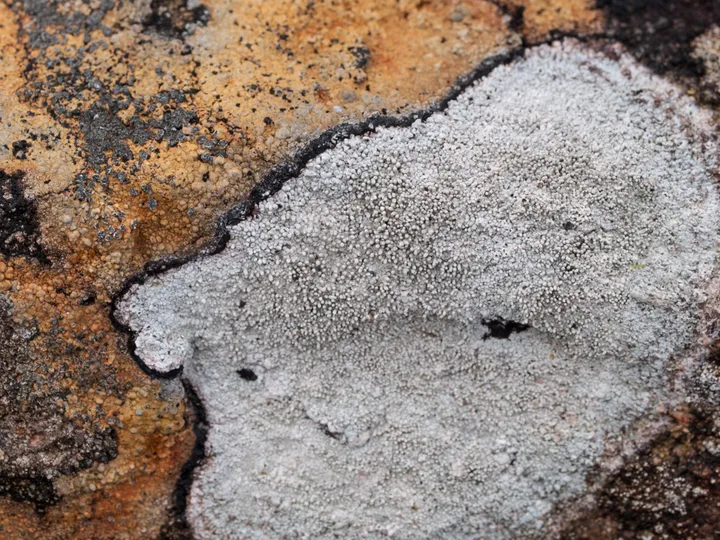
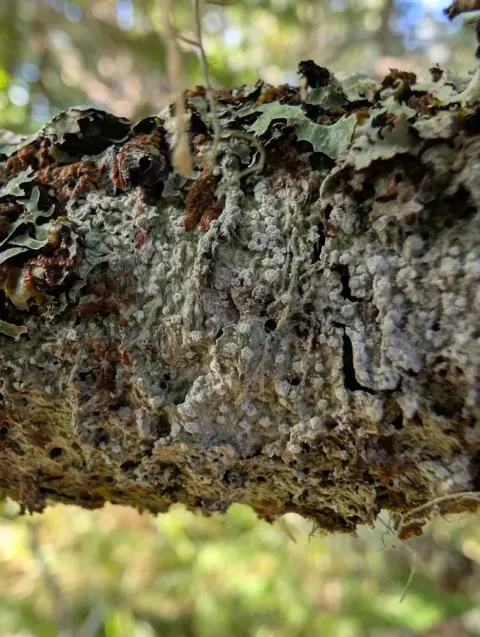
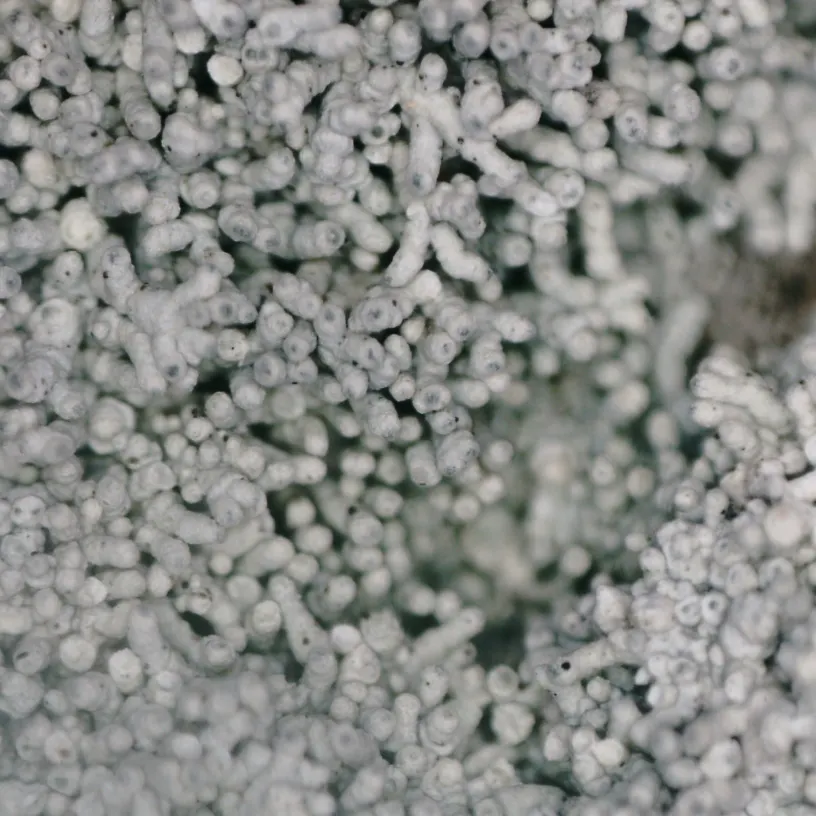
Lepra corallina forms a thick, crustose thallus that is pure white to pale or dark grey. The thallus is usually continuous but often cracked into small, irregular plates (-), and is bordered by a conspicuous white prothallus. It is characteristically covered by abundant isidia, 0.1–0.3 mm in diameter, which begin as simple cylindrical outgrowths and often become more branched and coral-like. These isidia are mostly erect or more or less lying flat on the surface, and may form a dense layer that obscures much of the underlying thallus. Fresh thalli of Lepra corallina are greyish white, but older parts often become more or less reddish with age, apparently reflecting variation in the concentration of thamnolic acid. Fertile structures are rare. When present, they form wart-like swellings 1.5–2 mm in diameter that are strongly constricted at the base and often have an uneven or warted upper surface. Each of these warts contains a small group of apothecia, typically 2–4 but occasionally up to 11. The apothecial discs are relatively small (0.3–0.5 mm across), flat to slightly convex, pale to dark brown, and often faintly dusted with a white pruina. The asci in these apothecia usually contain two large ascospores, measuring 80–140 μm (occasionally up to 230 μm) × 40–80 μm, with a wall 2–3 μm thick that lacks any obvious zoning or striation. In standard chemical spot tests (used to identify lichen substances) the thallus is C−, reacts K+ (yellow to yellow-orange), KC+ (yellow), and Pd+ (yellow-red), and is UV−. The main lichen substance detected is thamnolic acid.

Sebagian uraian ditampilkan dalam bahasa sumber; terjemahannya belum tersedia atau belum lolos pemeriksaan.

Rujukan: [1]

Pengukuran mengikuti objek, spesimen atau kultur, dan metode yang disebutkan sumber. Baca uraian asli untuk konteks lengkap.

02 / Kehidupan

Habitat dan peran ekologis

Lepra corallina grows mainly on steep to vertical faces of hard, lime-free siliceous rock, from coastal outcrops to alpine elevations. It has been characterized as a Holarctic species of boreal to temperate, montane to alpine regions, widespread in the Alps—especially in wetter districts—though becoming sparser farther south in Italy. In Scotland, the species is described as widespread on basalt outcrops along the west coast. At Killundine near Lochaline in Argyll, it forms thick crusts on basalt at around 120 m elevation, incorporating small grains of the underlying rock into its thallus. At the Lecht mines in north-east Scotland it colonizes spoil tips of manganese–iron ore. Because the workings date from the early nineteenth century, the present thalli are at most about 180 years old, showing that the species can establish and persist on recently exposed, metal-rich substrates. In Norway, Lepra corallina forms part of crustose lichen communities on hard siliceous bedrock, showing a marked preference for steep to vertical, carbonate-free faces where it occurs alongside species such as Ophioparma ventosa and Rhizocarpon geographicum. A study of a coastal community at Vingen in western Norway found it to be one of the common crustose lichens on Devonian sandstone from sea level to steep mountain ledges.

Sebagian uraian ditampilkan dalam bahasa sumber; terjemahannya belum tersedia atau belum lolos pemeriksaan.

Rujukan: [1]

Habitat atau konteks temuan
Informasi belum tersedia pada sumber rilis ini.
Substrat
Informasi belum tersedia pada sumber rilis ini.
Peran atau konteks
Pembentuk liken
Temukan hubungan serupa
03 / Siklus hidup

Reproduksi

Lepra corallina forms a thick, crustose thallus that is pure white to pale or dark grey. The thallus is usually continuous but often cracked into small, irregular plates (-), and is bordered by a conspicuous white prothallus. It is characteristically covered by abundant isidia, 0.1–0.3 mm in diameter, which begin as simple cylindrical outgrowths and often become more branched and coral-like. These isidia are mostly erect or more or less lying flat on the surface, and may form a dense layer that obscures much of the underlying thallus. Fresh thalli of Lepra corallina are greyish white, but older parts often become more or less reddish with age, apparently reflecting variation in the concentration of thamnolic acid.

Sebagian uraian ditampilkan dalam bahasa sumber; terjemahannya belum tersedia atau belum lolos pemeriksaan.

Rujukan: [1]

Sinonim menurut acuan taksonomi rilis: Isidium corallinum; Isidium paradoxum; Lecanora glaucoma var. corallina; Lecanora rimosa f. corallina; Lecanora sordida var. corallina; Lichen corallinus; Lichen variolarius; Marfloraea corallina; Parmelia glaucoma var. corallinus; Parmelia rimosa f. corallina; Parmelia sordida f. corallina; Parmelia sordida var. corallina; Pertusaria chionea; Pertusaria corallina; Pertusaria dealbata f. corallina; Pertusaria ocellata var. corallina; Pertusaria syncarpa var. corallina; Porophora chionea; Stereocaulon corallinum; Urceolaria corallina; Variolaria corallina; Zeora rimosa f. corallina
04 / Batas informasi

Catatan identitas dan cakupan

  • Nama diterima mengikuti Catalogue of Life Base2026-09-11; uraian mempertahankan konsep dan nama sumber aslinya.
  • Original geographic, specimen and life-cycle scope retained; source import awaits individual editorial review.
  • Impor dan terjemahan otomatis belum diperiksa editorial per profil. Struktur reproduktif yang disebutkan tidak membuktikan seluruh siklus hidup diketahui.
  • Pengukuran pada uraian mengikuti spesimen, kultur, dan metode sumber; angka tidak diperluas ke semua populasi.

Catatan distribusi dalam narasi mengikuti sumbernya. Dokumentasi spesimen atau foto mengikuti catatan sumber. Bukti wilayah Indonesia dan penilaian konservasi tidak disimpulkan dari gambar.

05 / Dokumentasi

Melihat dengan konteks

Dokumentasi Lepra corallina menurut asosiasi foto pada record takson iNaturalist. Kredit: Vesa Oikonen. Identitas mengikuti sumber; bukan penentuan spesimen independen.

Jenis
Fotografi
Kredit
no rights reserved, uploaded by Vesa Oikonen
Lisensi
CC0 1.0
Sumber media
Buka entri sumber

Gambar menunjukkan objek menurut identifikasi sumber, bukan verifikasi independen spesimen oleh Fungi. Tidak ada skala baru yang ditambahkan.

Dokumentasi tambahan

06 / Rujukan

Sumber profil

  1. [1] Lepra corallina — Wikipedia (en)Bagian sumber: Frozen revision 1376718383
    Tanggal penghimpunan sumber: 2026-10-12
    Teks sumber: CC BY-SA4.0 · Wikipedia contributors
  2. [2] Catalogue of Life Base2026-09-11 — Lepra corallinaBagian sumber: ColDP NameUsage.tsv ID 3TGBV; accepted species; source 2073
    Tanggal penghimpunan sumber: 2026-10-12
  3. [3] Dokumentasi visual — Lepra corallinaBagian sumber: Identitas mengikuti sumber dokumentasi; bukan penentuan spesimen independen.
    Tanggal penghimpunan sumber: 2026-10-17
    Media sumber: CC0 1.0 · no rights reserved, uploaded by Vesa Oikonen
  4. [4] Dokumentasi visual — Lepra corallinaBagian sumber: Identitas mengikuti sumber dokumentasi; bukan penentuan spesimen independen.
    Tanggal penghimpunan sumber: 2026-10-17
    Teks sumber: CC BY 4.0 · (c) Tim Johnson, some rights reserved (CC BY), uploaded by Tim Johnson

Adaptasi teks: CC BY-SA 4.0. Wikipedia contributors — Lepra corallina — Wikipedia (en)

Uraian asli dan riwayat sumber

Riwayat atau halaman sumber

Ringkasan sumber

Lepra corallina is a species of saxicolous (rock-dwelling) crustose lichen in the family Pertusariaceae. First described by Carl Linnaeus in 1767 as Lichen corallinus, it was long known as Pertusaria corallina until molecular studies showed that Pertusaria in its traditional sense was not a natural group; the species was transferred to Lepra in 2016. The lichen forms a thick whitish to grey crust on acidic, lime-free rocks and is characterized by abundant coral-like isidia that often cover much of the surface.

Revisi sumber

Morfologi sumber

Lepra corallina forms a thick, crustose thallus that is pure white to pale or dark grey. The thallus is usually continuous but often cracked into small, irregular plates (-), and is bordered by a conspicuous white prothallus. It is characteristically covered by abundant isidia, 0.1–0.3 mm in diameter, which begin as simple cylindrical outgrowths and often become more branched and coral-like. These isidia are mostly erect or more or less lying flat on the surface, and may form a dense layer that obscures much of the underlying thallus. Fresh thalli of Lepra corallina are greyish white, but older parts often become more or less reddish with age, apparently reflecting variation in the concentration of thamnolic acid. Fertile structures are rare. When present, they form wart-like swellings 1.5–2 mm in diameter that are strongly constricted at the base and often have an uneven or warted upper surface. Each of these warts contains a small group of apothecia, typically 2–4 but occasionally up to 11. The apothecial discs are relatively small (0.3–0.5 mm across), flat to slightly convex, pale to dark brown, and often faintly dusted with a white pruina. The asci in these apothecia usually contain two large ascospores, measuring 80–140 μm (occasionally up to 230 μm) × 40–80 μm, with a wall 2–3 μm thick that lacks any obvious zoning or striation. In standard chemical spot tests (used to identify lichen substances) the thallus is C−, reacts K+ (yellow to yellow-orange), KC+ (yellow), and Pd+ (yellow-red), and is UV−. The main lichen substance detected is thamnolic acid.

Revisi sumber

Ekologi sumber

Lepra corallina grows mainly on steep to vertical faces of hard, lime-free siliceous rock, from coastal outcrops to alpine elevations. It has been characterized as a Holarctic species of boreal to temperate, montane to alpine regions, widespread in the Alps—especially in wetter districts—though becoming sparser farther south in Italy. In Scotland, the species is described as widespread on basalt outcrops along the west coast. At Killundine near Lochaline in Argyll, it forms thick crusts on basalt at around 120 m elevation, incorporating small grains of the underlying rock into its thallus. At the Lecht mines in north-east Scotland it colonizes spoil tips of manganese–iron ore. Because the workings date from the early nineteenth century, the present thalli are at most about 180 years old, showing that the species can establish and persist on recently exposed, metal-rich substrates. In Norway, Lepra corallina forms part of crustose lichen communities on hard siliceous bedrock, showing a marked preference for steep to vertical, carbonate-free faces where it occurs alongside species such as Ophioparma ventosa and Rhizocarpon geographicum. A study of a coastal community at Vingen in western Norway found it to be one of the common crustose lichens on Devonian sandstone from sea level to steep mountain ledges.

Revisi sumber

Struktur reproduksi sumber

Lepra corallina forms a thick, crustose thallus that is pure white to pale or dark grey. The thallus is usually continuous but often cracked into small, irregular plates (-), and is bordered by a conspicuous white prothallus. It is characteristically covered by abundant isidia, 0.1–0.3 mm in diameter, which begin as simple cylindrical outgrowths and often become more branched and coral-like. These isidia are mostly erect or more or less lying flat on the surface, and may form a dense layer that obscures much of the underlying thallus. Fresh thalli of Lepra corallina are greyish white, but older parts often become more or less reddish with age, apparently reflecting variation in the concentration of thamnolic acid.

Revisi sumber

Rujukan halaman ini

Fungi. Lepra corallina. Rilis data fungi-2026-10-12-expansion-2. https://fungi-atlas.mgadib.chatgpt.site/jamur/lepra-corallina/.

Status: impor sumber; pemeriksaan editorial per profil belum selesai. Untuk klaim biologis, gunakan rujukan pada bagian terkait dan periksa konteks sumber aslinya.