01 / Morfologi

Ciri dan struktur

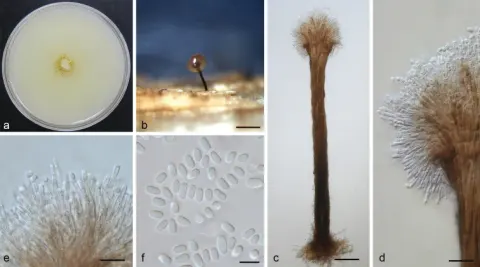
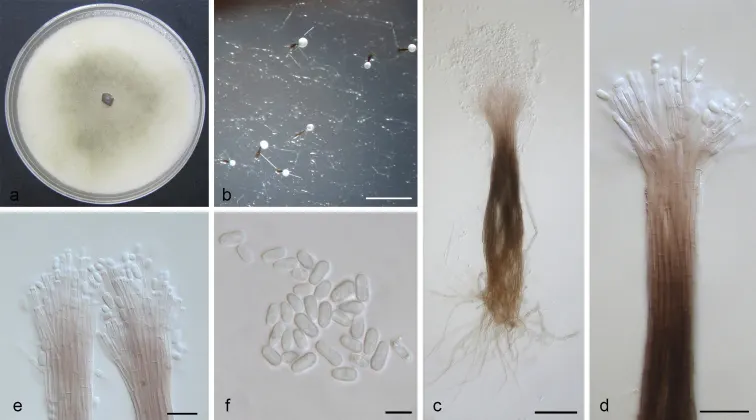
Sexual state not observed. Conidiophores macronematous, synnematous, 200–350 μm including conidiogenous apparatus, synnemata frequently swollen at the base, frequently wider at the stipe, brown to light brown, expanding branches at the apex, (15–)35–45(–70) μm in width. Conidiogenous cells discrete, terminal, percurrent and phialidic proliferation, hyaline, cylindrical,(10–)14–17(–19) × 2–3 μm. Conidia hyaline, one-celled, cylindrical to obovoid, (5.1–)6.5–7.8(–10.5) × 2.1–3.5 μm. Cultural characteristics: Colonies on OA, hyaline at first, later becoming olivaceous in the center, hyphae hyaline, appressed and immersed, aerial mycelium frequently present on wood tissue, synnemata abundant in WA cultures, Optimal growth temperature on MEA is 25 °C with radial growth rate 6.0 (± 0.5) mm/d, growth slightly reduced at 10 °C and 35 °C.

Sebagian uraian ditampilkan dalam bahasa sumber; terjemahannya belum tersedia atau belum lolos pemeriksaan.

Rujukan: [1]

Pengukuran mengikuti objek, spesimen atau kultur, dan metode yang disebutkan sumber. Baca uraian asli untuk konteks lengkap.

02 / Kehidupan

Habitat dan peran ekologis

Spain. Note: Isolates of L. rhizoidum from pine-infesting bark beetles in Spain were initially identified as L. olivaceum based on ITS sequences by Romon et al. (2007). Our data showed them to be distinct from that species. This species produced more abundant and longer rhizoids than others in the complex. Other Material examined: SPAIN, Morga, from Pinus radiata infested by Ips sexdentatus, July. 2004, P. Romon & X.D. Zhou, (culture: CMW 22811); Morga, from P. radiata infested by Hylurgops palliatus, July. 2004, P. Romon & X.D. Zhou, (culture: CMW 22812).

Sebagian uraian ditampilkan dalam bahasa sumber; terjemahannya belum tersedia atau belum lolos pemeriksaan.

Rujukan: [1]

Habitat atau konteks temuan
kultur yang didokumentasikan
Substrat
Informasi belum tersedia pada sumber rilis ini.
Peran atau konteks
Belum dikategorikan pada rilis ini.
Temukan hubungan serupa
03 / Siklus hidup

Reproduksi

Sexual state not observed. Conidiophores macronematous, synnematous, 200–350 μm including conidiogenous apparatus, synnemata frequently swollen at the base, frequently wider at the stipe, brown to light brown, expanding branches at the apex, (15–)35–45(–70) μm in width. Conidiogenous cells discrete, terminal, percurrent and phialidic proliferation, hyaline, cylindrical,(10–)14–17(–19) × 2–3 μm. Conidia hyaline, one-celled, cylindrical to obovoid, (5.1–)6.5–7.8(–10.5) × 2.1–3.5 μm. Cultural characteristics: Colonies on OA, hyaline at first, later becoming olivaceous in the center, hyphae hyaline, appressed and immersed, aerial mycelium frequently present on wood tissue, synnemata abundant in WA cultures, Optimal growth temperature on MEA is 25 °C with radial growth rate 6.0 (± 0.5) mm/d, growth slightly reduced at 10 °C and 35 °C.

Sebagian uraian ditampilkan dalam bahasa sumber; terjemahannya belum tersedia atau belum lolos pemeriksaan.

Rujukan: [1]

04 / Batas informasi

Catatan identitas dan cakupan

  • Nama diterima mengikuti Catalogue of Life Base2026-09-11; uraian mempertahankan konsep dan nama sumber aslinya.
  • Preserve original treatment localities, hosts and substrate scope. Materials examined describe documented specimens, not the full global range.
  • Impor dan terjemahan otomatis belum diperiksa editorial per profil. Struktur reproduktif yang disebutkan tidak membuktikan seluruh siklus hidup diketahui.
  • Pengukuran pada uraian mengikuti spesimen, kultur, dan metode sumber; angka tidak diperluas ke semua populasi.

Catatan distribusi dalam narasi mengikuti sumbernya. Dokumentasi spesimen atau foto mengikuti catatan sumber. Bukti wilayah Indonesia dan penilaian konservasi tidak disimpulkan dari gambar.

05 / Dokumentasi

Melihat dengan konteks

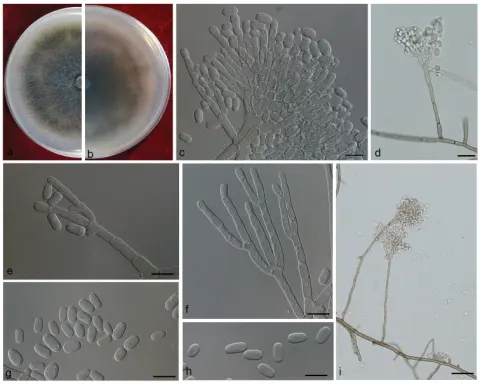
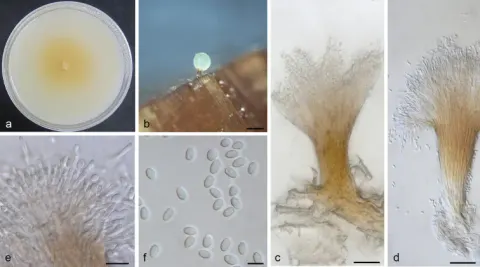
Leptographium rhizoidum sp. nov. (CMW 22809). a fourteen-days old culture on OA with black background b synnematous asexual state on wood tissue on WA c conidiophore d conidiogenous apparatus e conidiogenous cells f conidia. Scale bars: 200 μm (b), 50 μm (c), 20 μm (d), 10 μm (e), 5 μm (f).

Jenis
Pelat ilmiah
Kredit
Mingliang Yin, Michael J. Wingfield, Xudong Zhou, Riikka Linnakoski, Z. Wilhelm de Beer
Lisensi
CC BY 4.0
Sumber media
Buka entri sumber

Gambar menunjukkan objek menurut identifikasi sumber, bukan verifikasi independen spesimen oleh Fungi. Tidak ada skala baru yang ditambahkan.

06 / Rujukan

Sumber profil

  1. [1] Taxonomy and phylogeny of the Leptographium olivaceum complex (Ophiostomatales, Ascomycota), including descriptions of six new species from China and Europe — Leptographium rhizoidumBagian sumber: PMC6898192_section_80
    Tanggal penghimpunan sumber: 2026-10-12
    Teks sumber: CC BY 4.0 · Yin M, Wingfield MJ, Zhou X, Linnakoski R, de Beer ZW.
  2. [2] Catalogue of Life Base2026-09-11 — Leptographium rhizoidumBagian sumber: ColDP NameUsage.tsv ID 3TQDK; accepted species; source 2073
    Tanggal penghimpunan sumber: 2026-10-12
  3. [3] Dokumentasi visual — Leptographium rhizoidumBagian sumber: Individual media record; identification follows the source, not independent determination
    Tanggal penghimpunan sumber: 2026-10-12
    Media sumber: CC BY 4.0 · Mingliang Yin, Michael J. Wingfield, Xudong Zhou, Riikka Linnakoski, Z. Wilhelm de Beer

Adaptasi teks: CC BY 4.0. Yin M, Wingfield MJ, Zhou X, Linnakoski R, de Beer ZW. — Taxonomy and phylogeny of the Leptographium olivaceum complex (Ophiostomatales, Ascomycota), including descriptions of six new species from China and Europe — Leptographium rhizoidum

Uraian asli dan riwayat sumber

Riwayat atau halaman sumber

Ringkasan sumber

Sexual state not observed. Conidiophores macronematous, synnematous, 200–350 μm including conidiogenous apparatus, synnemata frequently swollen at the base, frequently wider at the stipe, brown to light brown, expanding branches at the apex, (15–)35–45(–70) μm in width. Conidiogenous cells discrete, terminal, percurrent and phialidic proliferation, hyaline, cylindrical,(10–)14–17(–19) × 2–3 μm. Conidia hyaline, one-celled, cylindrical to obovoid, (5.1–)6.5–7.8(–10.5) × 2.1–3.5 μm. Cultural characteristics: Colonies on OA, hyaline at first, later becoming olivaceous in the center, hyphae hyaline, appressed and immersed, aerial mycelium frequently present on wood tissue, synnemata abundant in WA cultures, Optimal growth temperature on MEA is 25 °C with radial growth rate 6.0 (± 0.5) mm/d, growth slightly reduced at 10 °C and 35 °C.

Revisi sumber

Morfologi sumber

Sexual state not observed. Conidiophores macronematous, synnematous, 200–350 μm including conidiogenous apparatus, synnemata frequently swollen at the base, frequently wider at the stipe, brown to light brown, expanding branches at the apex, (15–)35–45(–70) μm in width. Conidiogenous cells discrete, terminal, percurrent and phialidic proliferation, hyaline, cylindrical,(10–)14–17(–19) × 2–3 μm. Conidia hyaline, one-celled, cylindrical to obovoid, (5.1–)6.5–7.8(–10.5) × 2.1–3.5 μm. Cultural characteristics: Colonies on OA, hyaline at first, later becoming olivaceous in the center, hyphae hyaline, appressed and immersed, aerial mycelium frequently present on wood tissue, synnemata abundant in WA cultures, Optimal growth temperature on MEA is 25 °C with radial growth rate 6.0 (± 0.5) mm/d, growth slightly reduced at 10 °C and 35 °C.

Revisi sumber

Ekologi sumber

Spain. Note: Isolates of L. rhizoidum from pine-infesting bark beetles in Spain were initially identified as L. olivaceum based on ITS sequences by Romon et al. (2007). Our data showed them to be distinct from that species. This species produced more abundant and longer rhizoids than others in the complex. Other Material examined: SPAIN, Morga, from Pinus radiata infested by Ips sexdentatus, July. 2004, P. Romon & X.D. Zhou, (culture: CMW 22811); Morga, from P. radiata infested by Hylurgops palliatus, July. 2004, P. Romon & X.D. Zhou, (culture: CMW 22812).

Revisi sumber

Struktur reproduksi sumber

Sexual state not observed. Conidiophores macronematous, synnematous, 200–350 μm including conidiogenous apparatus, synnemata frequently swollen at the base, frequently wider at the stipe, brown to light brown, expanding branches at the apex, (15–)35–45(–70) μm in width. Conidiogenous cells discrete, terminal, percurrent and phialidic proliferation, hyaline, cylindrical,(10–)14–17(–19) × 2–3 μm. Conidia hyaline, one-celled, cylindrical to obovoid, (5.1–)6.5–7.8(–10.5) × 2.1–3.5 μm. Cultural characteristics: Colonies on OA, hyaline at first, later becoming olivaceous in the center, hyphae hyaline, appressed and immersed, aerial mycelium frequently present on wood tissue, synnemata abundant in WA cultures, Optimal growth temperature on MEA is 25 °C with radial growth rate 6.0 (± 0.5) mm/d, growth slightly reduced at 10 °C and 35 °C.

Revisi sumber

Rujukan halaman ini

Fungi. Leptographium rhizoidum. Rilis data fungi-2026-10-12-expansion-2. https://fungi-atlas.mgadib.chatgpt.site/jamur/leptographium-rhizoidum/.

Status: impor sumber; pemeriksaan editorial per profil belum selesai. Untuk klaim biologis, gunakan rujukan pada bagian terkait dan periksa konteks sumber aslinya.