Ciri dan struktur
Strictly anaerobic fungus with determinate, monocentric thallus with single terminal sporangium of varying shape and size and uniflagellate zoospores. The clade is defined by the sequences accession numbers MH468765 (ITS1, 5.8S, ITS2 complete) and MH468763 (LSU, partial sequence). The most genetically similar genus is Anaeromyces, which is defined as forming a polycentric thallus (Breton et al. 1990.FEMS Microbiol. Lett. 58, p.177), in contrast to the monocentric Liebetanzomyces. A strict anaerobic fungus, isolated from the rumen of a goat. In roll tubes of cellobiose agar medium, the fungus forms medium to large circular colonies (0.5–2 mm diam.). In liquid cellobiose medium, the fungal thalli attach to the sides and bottom of glass bottles. Monocentric thallus development, producing a single terminal sporangium per thallus. Also, the fungus produces few pseudo-intercalary sporangia but only on soluble substrates. An extensive anucleate rhizoidal system without constrictions is formed. The sporangia vary in size (10–90 µm wide, 10–75 µm long), shape (globose, ellipsoid, clavate, ovoid, elongate or irregular) and sometimes bear papillae. The sporangium is borne on variable length sporangiophore (15–80 µm), sometimes forming an eggcup-like structure below the sporangium or showing cyst-like structure. Zoospores are produced abundantly, mostly uniflagellate, rarely biflagellate, spherical (5–6 µm in diameter) in size and flagellum of 15–20 µm in length. The zoospores may germinate either endogenously or exogenously. The clade is defined by the sequences accession numbers MH468765 (ITS1, 5.8S, ITS2 complete) and MH468763 (LSU, partial sequence).
Habitat dan peran ekologis
Strictly anaerobic fungus with determinate, monocentric thallus with single terminal sporangium of varying shape and size and uniflagellate zoospores. The clade is defined by the sequences accession numbers MH468765 (ITS1, 5.8S, ITS2 complete) and MH468763 (LSU, partial sequence). The most genetically similar genus is Anaeromyces, which is defined as forming a polycentric thallus (Breton et al. 1990.FEMS Microbiol. Lett. 58, p.177), in contrast to the monocentric Liebetanzomyces. A strict anaerobic fungus, isolated from the rumen of a goat. In roll tubes of cellobiose agar medium, the fungus forms medium to large circular colonies (0.5–2 mm diam.). In liquid cellobiose medium, the fungal thalli attach to the sides and bottom of glass bottles. Monocentric thallus development, producing a single terminal sporangium per thallus. Also, the fungus produces few pseudo-intercalary sporangia but only on soluble substrates. An extensive anucleate rhizoidal system without constrictions is formed. The sporangia vary in size (10–90 µm wide, 10–75 µm long), shape (globose, ellipsoid, clavate, ovoid, elongate or irregular) and sometimes bear papillae. The sporangium is borne on variable length sporangiophore (15–80 µm), sometimes forming an eggcup-like structure below the sporangium or showing cyst-like structure.
- Habitat atau konteks temuan
- kultur yang didokumentasikan
- Substrat
- Informasi belum tersedia pada sumber rilis ini.
- Peran atau konteks
- Pembentuk liken
Reproduksi
Strictly anaerobic fungus with determinate, monocentric thallus with single terminal sporangium of varying shape and size and uniflagellate zoospores. The clade is defined by the sequences accession numbers MH468765 (ITS1, 5.8S, ITS2 complete) and MH468763 (LSU, partial sequence). The most genetically similar genus is Anaeromyces, which is defined as forming a polycentric thallus (Breton et al. 1990.FEMS Microbiol. Lett. 58, p.177), in contrast to the monocentric Liebetanzomyces. A strict anaerobic fungus, isolated from the rumen of a goat. In roll tubes of cellobiose agar medium, the fungus forms medium to large circular colonies (0.5–2 mm diam.). In liquid cellobiose medium, the fungal thalli attach to the sides and bottom of glass bottles.
Catatan identitas dan cakupan
- Nama diterima mengikuti Catalogue of Life Base2026-09-11; uraian mempertahankan konsep dan nama sumber aslinya.
- Preserve original treatment localities, hosts and substrate scope. Materials examined describe documented specimens, not the full global range.
- Impor dan terjemahan otomatis belum diperiksa editorial per profil. Struktur reproduktif yang disebutkan tidak membuktikan seluruh siklus hidup diketahui.
- Pengukuran pada uraian mengikuti spesimen, kultur, dan metode sumber; angka tidak diperluas ke semua populasi.
Catatan distribusi dalam narasi mengikuti sumbernya. Dokumentasi spesimen atau foto mengikuti catatan sumber. Bukti wilayah Indonesia dan penilaian konservasi tidak disimpulkan dari gambar.
Melihat dengan konteks
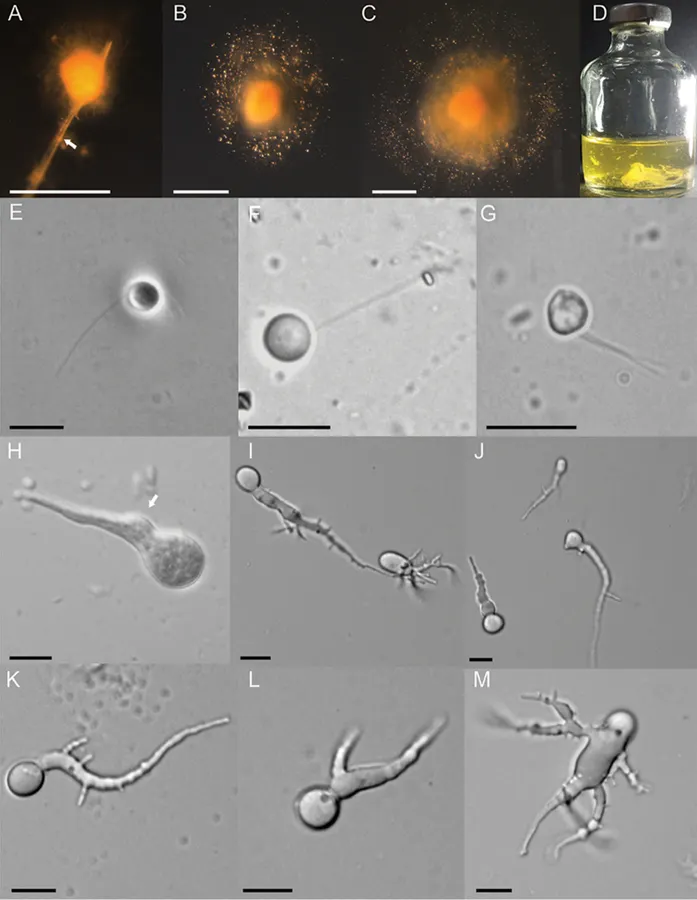
Macroscopic and microscopic features of Liebetanzomyces polymorphus. Colony morphology on agar roll tubes (A–C), showing the development of a colony attached (A) to a straw particle (arrowed), dense growth in the centre surrounded by numerous sporangia and zoospores (B–C) causing expansion of colony size. Growth in liquid medium showing a biofilm-like growth (D). Zoospores are spherical and Uniflagellate (E–F) or biflagellate (G). Germinating zoospore (H) showing a zoospore cyst (arrowed), presence and absence of sporangiophore indicating the endogenous and exogenous type of sporangial development (I) and different shapes of sporangia (I, J). Early stages of thallus development showing a single (K), bifurcated (L) and multifurcated (M) rhizoidal system. Scale bar: 1 mm (A–C); 10 µM (E–M).
- Jenis
- Pelat ilmiah
- Kredit
- Akshay Joshi, Vikram B. Lanjekar, Prashant K. Dhakephalkar, Tony M. Callaghan, Gareth W. Griffith, Sumit Singh Dagar
- Lisensi
- CC BY 4.0
- Sumber media
- Buka entri sumber
Dokumentasi tambahan
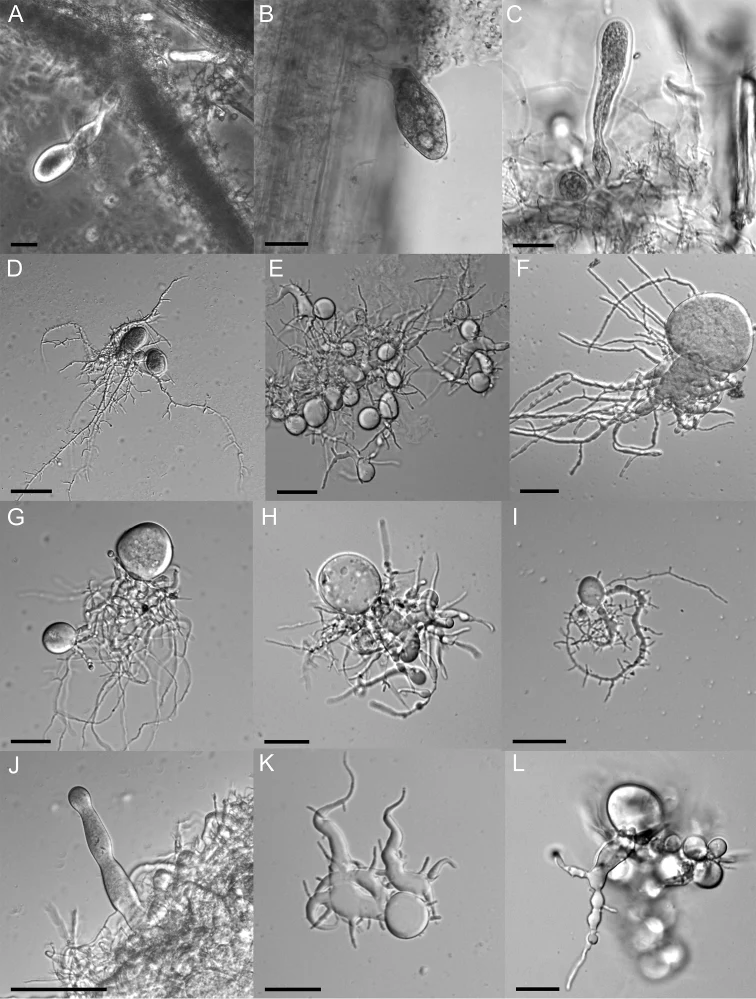
Microscopic features of Liebetanzomyces polymorphus showing pleomorphism in sporangial and rhizoidal structures, when grown on different carbon sources like rice straw (A), wheat straw (B), cellulose (C), xylan (D), starch (E), cellobiose (F), lactose (G), maltose (H), sucrose (I), glucose (J), xylose (K) and fructose (L). The exogenous sporangia appearing on a sporangiophore (A–B) and endogenous sporangia of different shapes (C–L) are shown. Scale bar: 20 µM.
Kredit dan penggunaan
Akshay Joshi, Vikram B. Lanjekar, Prashant K. Dhakephalkar, Tony M. Callaghan, Gareth W. Griffith, Sumit Singh Dagar
Ukuran dan format gambar disesuaikan tanpa pemotongan, retus, atau penambahan skala. Lisensi sumber dipertahankan.
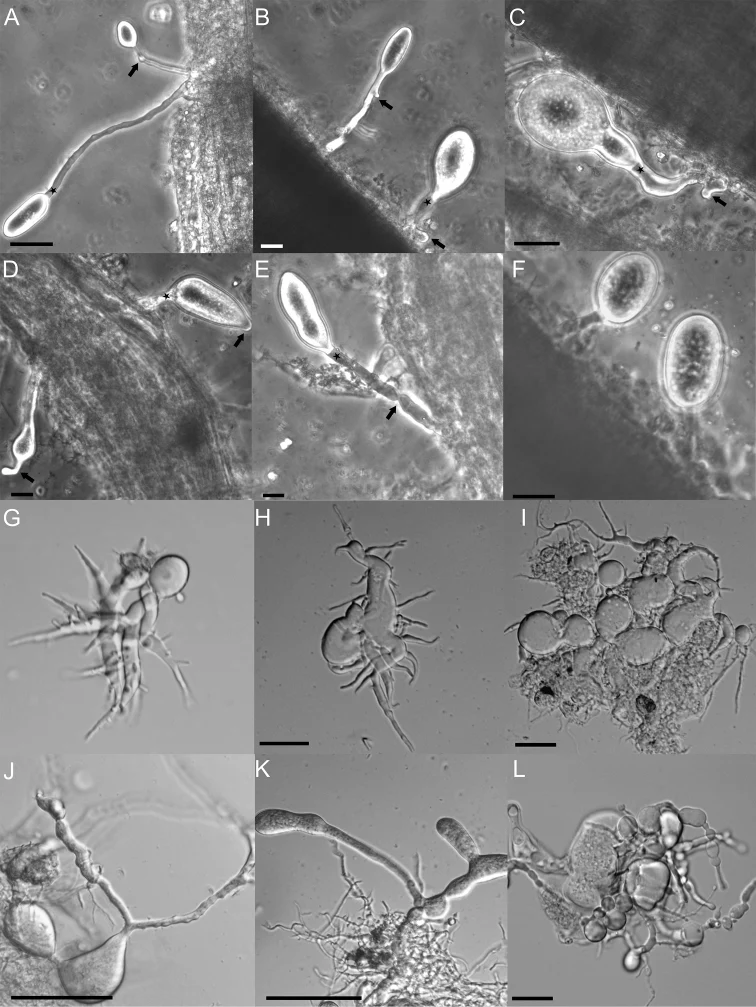
Microscopic images of Liebetanzomyces polymorphus. On rice straw (A–F) sporangia of varying sizes and shapes, like elongate (A), ellipsoid (B), ovoid (C), clavate (E) and globose (F). The zoospore cyst (A–C arrowed) is also visible, highlighting bipolar germination. Sporangiophore of varying length and shape, from short to long (A), sometimes eggcup shaped (C) and constricted (E arrowed) is shown. The sporangia with a papilla (D arrowed) and septum (B, C, D, E starred) are also indicated. Sporangia and thalli of irregular morphology on xylose (G–I) and cellobiose (J–L), including some pseudo-intercalary sporangia (J–L) can be observed. Scale bar: 20 µM.
Kredit dan penggunaan
Akshay Joshi, Vikram B. Lanjekar, Prashant K. Dhakephalkar, Tony M. Callaghan, Gareth W. Griffith, Sumit Singh Dagar
Ukuran dan format gambar disesuaikan tanpa pemotongan, retus, atau penambahan skala. Lisensi sumber dipertahankan.
Sumber profil
- [1] Liebetanzomyces polymorphus gen. et sp. nov., a new anaerobic fungus (Neocallimastigomycota) isolated from the rumen of a goat — Liebetanzomyces polymorphus
- [2] Catalogue of Life Base2026-09-11 — Liebetanzomyces polymorphus
- [3] Dokumentasi visual — Liebetanzomyces polymorphus
- [4] Dokumentasi visual — Liebetanzomyces polymorphus
- [5] Dokumentasi visual — Liebetanzomyces polymorphus
Rujukan halaman ini
Fungi. Liebetanzomyces polymorphus. Rilis data fungi-2026-10-12-expansion-2. https://fungi-atlas.mgadib.chatgpt.site/jamur/liebetanzomyces-polymorphus/.
Status: impor sumber; pemeriksaan editorial per profil belum selesai. Untuk klaim biologis, gunakan rujukan pada bagian terkait dan periksa konteks sumber aslinya.