01 / Morfologi

Ciri dan struktur

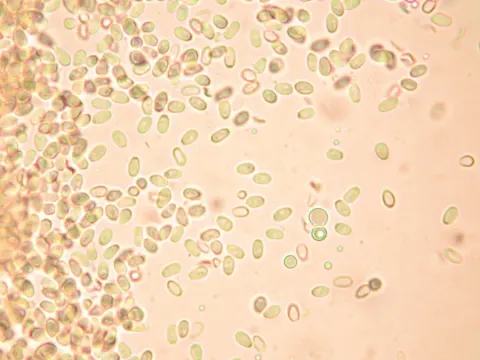
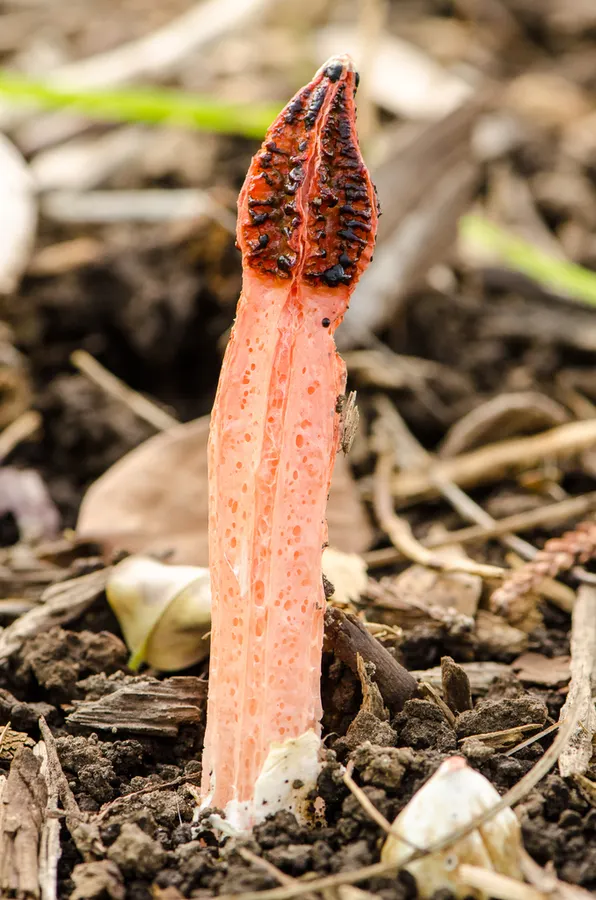
Immature fruit bodies of L. mokusin are white, gelatinous "eggs" measuring 1 – 3 cm in diameter, and are attached to the ground by thickened strands of mycelium called rhizomorphs. As the fungus matures, the egg ruptures as the fruit body rapidly expands, leaving volval remnants behind at the base. The stipe of the hollow, spongy mature fruiting body has dimensions of 10 – 15 cm by 1.5 – 2.5 cm, and ranges in color from white to pink to red, with 4–6 distinct deeply grooved sides divided lengthwise by ribs. The basis of distinction between L. mokusin and other species of Lysurus is the angular form of its stipe. The sides branch out into 4–6 arms that are fused together at the tip to form a pointed apex, resembling a spire. As the mushroom matures, the arms may spread apart. The outer surface of the arms is coated by a brownish, slimy, foul-smelling spore mass called the gleba; its fetid odor helps it attract flies and other insects to assist in spore dispersal. The odor has been compared to "fresh dog feces", "rotting flesh" or sewage. The spores are cylindrical in shape, smooth, thin-walled, and hyaline (translucent), with dimensions of 4–6 by 2–2.5 μm. Scanning electron microscopy reveals that one end of the spores has a hilar scar—an indentation in the spore wall that results during its separation from the sterigma of the basidium. The basidia (spore-bearing cells) are usually eight-spored, and the gleba composed of chains of roughly spherical, fusiform, ellipsoid to broadly club-shaped cells that are either 6.5–7.4 by 2.8–5.6 μm or 37.1–46.3 by 18–28 μm and also mixed with filamentous cells 2.3–4.5 μm wide.

Sebagian uraian ditampilkan dalam bahasa sumber; terjemahannya belum tersedia atau belum lolos pemeriksaan.

Rujukan: [1]

Pengukuran mengikuti objek, spesimen atau kultur, dan metode yang disebutkan sumber. Baca uraian asli untuk konteks lengkap.

02 / Kehidupan

Habitat dan peran ekologis

Lysurus mokusin adalah saprobik tumbuh secara sepi atau dalam kelompok kecil di sampah hutan dan mulch kayu yang digunakan dalam lanskap serta kompos. Documented sightings dari L. mokusin termasuk Australasia, Kepulauan Canary, Korea, Jepang, China (Provinsi Fujian), dan Kepulauan Bonin. Spesies ini tidak diketahui di Europe until dilaporkan di Italy in 1979; dianggap spesies asing di benua itu. Di Amerika Serikat, telah dikumpulkan dari negara bagian California, Texas, Timur Laut Oklahoma and Washington, D.C.

Rujukan: [1]

Habitat atau konteks temuan
hutan
Substrat
Informasi belum tersedia pada sumber rilis ini.
Peran atau konteks
Pengurai
Temukan hubungan serupa
03 / Siklus hidup

Reproduksi

Immature fruit bodies of L. mokusin are white, gelatinous "eggs" measuring 1 – 3 cm in diameter, and are attached to the ground by thickened strands of mycelium called rhizomorphs. As the fungus matures, the egg ruptures as the fruit body rapidly expands, leaving volval remnants behind at the base. The stipe of the hollow, spongy mature fruiting body has dimensions of 10 – 15 cm by 1.5 – 2.5 cm, and ranges in color from white to pink to red, with 4–6 distinct deeply grooved sides divided lengthwise by ribs. The basis of distinction between L. mokusin and other species of Lysurus is the angular form of its stipe. The sides branch out into 4–6 arms that are fused together at the tip to form a pointed apex, resembling a spire.

Sebagian uraian ditampilkan dalam bahasa sumber; terjemahannya belum tersedia atau belum lolos pemeriksaan.

Rujukan: [1]

Sinonim menurut acuan taksonomi rilis: Clathrus mokusin; Colus pentagonus; Lloydia quadrangularis; Lysurus beauvaisii; Lysurus brevipes; Lysurus kawamurensis; Lysurus mokusin f. sinensis; Lysurus pentagonus; Lysurus sinensis; Mutinus hardyi; Mutinus pentagonus; Mutinus pentagonus var. hardyi; Phallus mokusin; Sinolloydia quadrangularis; Sinolloydia sinensis
04 / Batas informasi

Catatan identitas dan cakupan

  • Nama diterima mengikuti Catalogue of Life Base2026-09-11; uraian mempertahankan konsep dan nama sumber aslinya.
  • Original geographic, specimen and life-cycle scope retained; source import awaits individual editorial review.
  • Impor dan terjemahan otomatis belum diperiksa editorial per profil. Struktur reproduktif yang disebutkan tidak membuktikan seluruh siklus hidup diketahui.
  • Pengukuran pada uraian mengikuti spesimen, kultur, dan metode sumber; angka tidak diperluas ke semua populasi.

Catatan distribusi dalam narasi mengikuti sumbernya. Dokumentasi spesimen atau foto mengikuti catatan sumber. Bukti wilayah Indonesia dan penilaian konservasi tidak disimpulkan dari gambar.

05 / Dokumentasi

Melihat dengan konteks

Dokumentasi Lysurus mokusin menurut asosiasi foto pada record takson iNaturalist. Kredit: Daniel Neal. Identitas mengikuti sumber; bukan penentuan spesimen independen.

Jenis
Fotografi
Kredit
(c) Daniel Neal, kai kurios teisės saugomos (CC BY)
Lisensi
CC BY 4.0
Sumber media
Buka entri sumber

Gambar menunjukkan objek menurut identifikasi sumber, bukan verifikasi independen spesimen oleh Fungi. Tidak ada skala baru yang ditambahkan.

06 / Rujukan

Sumber profil

  1. [1] Lysurus mokusin — Wikipedia (en)Bagian sumber: Frozen revision 1299048174
    Tanggal penghimpunan sumber: 2026-10-12
    Teks sumber: CC BY-SA4.0 · Wikipedia contributors
  2. [2] Catalogue of Life Base2026-09-11 — Lysurus mokusinBagian sumber: ColDP NameUsage.tsv ID 7335Z; accepted species; source 2073
    Tanggal penghimpunan sumber: 2026-10-12
  3. [3] Dokumentasi visual — Lysurus mokusinBagian sumber: Individual media record; identification follows the source, not independent determination
    Tanggal penghimpunan sumber: 2026-10-12
    Media sumber: CC BY 4.0 · (c) Daniel Neal, kai kurios teisės saugomos (CC BY)

Adaptasi teks: CC BY-SA 4.0. Wikipedia contributors — Lysurus mokusin — Wikipedia (en)

Uraian asli dan riwayat sumber

Riwayat atau halaman sumber

Ringkasan sumber

Lysurus mokusin, commonly known as the lantern stinkhorn, the small lizard's claw, or the ribbed lizard claw, is a saprobic species of fungus in the family Phallaceae. The fruit body consists of a reddish, cylindrical fluted stipe that is capped with several "arms". The arms can approach or even close in on each other to form a spire. The gleba—an olive-green slimy spore mass—is carried on the outer surface of the arms. The fruit body has an odor comparable to "fresh dog feces", "rotting flesh", or "sewage" when mature.

Revisi sumber

Morfologi sumber

Immature fruit bodies of L. mokusin are white, gelatinous "eggs" measuring 1 – 3 cm in diameter, and are attached to the ground by thickened strands of mycelium called rhizomorphs. As the fungus matures, the egg ruptures as the fruit body rapidly expands, leaving volval remnants behind at the base. The stipe of the hollow, spongy mature fruiting body has dimensions of 10 – 15 cm by 1.5 – 2.5 cm, and ranges in color from white to pink to red, with 4–6 distinct deeply grooved sides divided lengthwise by ribs. The basis of distinction between L. mokusin and other species of Lysurus is the angular form of its stipe. The sides branch out into 4–6 arms that are fused together at the tip to form a pointed apex, resembling a spire. As the mushroom matures, the arms may spread apart. The outer surface of the arms is coated by a brownish, slimy, foul-smelling spore mass called the gleba; its fetid odor helps it attract flies and other insects to assist in spore dispersal. The odor has been compared to "fresh dog feces", "rotting flesh" or sewage. The spores are cylindrical in shape, smooth, thin-walled, and hyaline (translucent), with dimensions of 4–6 by 2–2.5 μm. Scanning electron microscopy reveals that one end of the spores has a hilar scar—an indentation in the spore wall that results during its separation from the sterigma of the basidium. The basidia (spore-bearing cells) are usually eight-spored, and the gleba composed of chains of roughly spherical, fusiform, ellipsoid to broadly club-shaped cells that are either 6.5–7.4 by 2.8–5.6 μm or 37.1–46.3 by 18–28 μm and also mixed with filamentous cells 2.3–4.5 μm wide.

Revisi sumber

Ekologi sumber

Lysurus mokusin is saprobic growing solitarily or in small groups in forest litter and wood chip mulch used in landscaping as well as compost. Documented sightings of L. mokusin include Australasia, the Canary Islands, Korea, Japan, China (Fujian Province), and the Bonin Islands. The species was unknown in Europe until it was reported in Italy in 1979; it is considered an alien species on that continent. In the United States, it has been collected from the states of California, Texas, Northeast Oklahoma and Washington, D.C.

Revisi sumber

Struktur reproduksi sumber

Immature fruit bodies of L. mokusin are white, gelatinous "eggs" measuring 1 – 3 cm in diameter, and are attached to the ground by thickened strands of mycelium called rhizomorphs. As the fungus matures, the egg ruptures as the fruit body rapidly expands, leaving volval remnants behind at the base. The stipe of the hollow, spongy mature fruiting body has dimensions of 10 – 15 cm by 1.5 – 2.5 cm, and ranges in color from white to pink to red, with 4–6 distinct deeply grooved sides divided lengthwise by ribs. The basis of distinction between L. mokusin and other species of Lysurus is the angular form of its stipe. The sides branch out into 4–6 arms that are fused together at the tip to form a pointed apex, resembling a spire.

Revisi sumber

Rujukan halaman ini

Fungi. Lysurus mokusin. Rilis data fungi-2026-10-12-expansion-2. https://fungi-atlas.mgadib.chatgpt.site/jamur/lysurus-mokusin/.

Status: impor sumber; pemeriksaan editorial per profil belum selesai. Untuk klaim biologis, gunakan rujukan pada bagian terkait dan periksa konteks sumber aslinya.