Ciri dan struktur
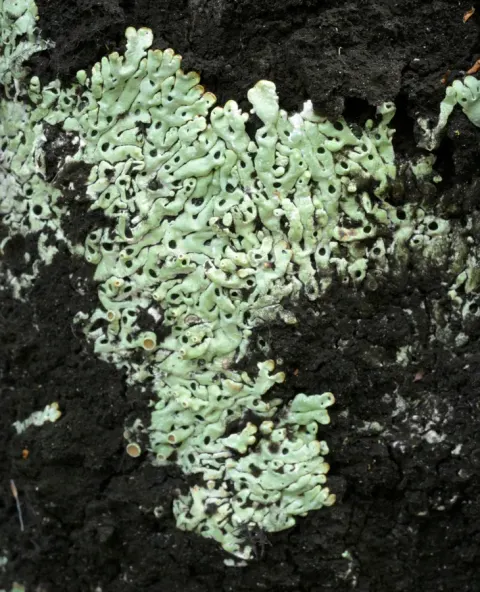
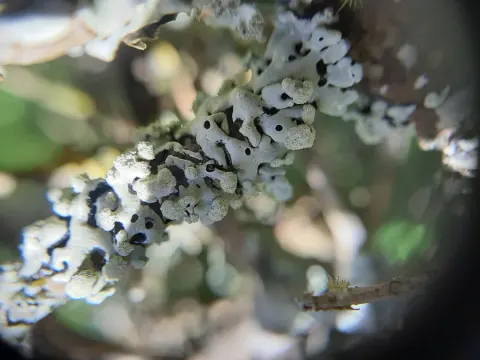
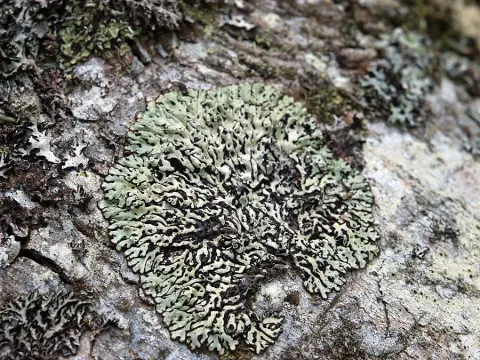
The lichen forms an irregular rosette or spreading patch up to about 3 cm across. It is foliose, meaning the thallus resembles tiny, leafy rather than a crust. Those lobes are hollow, extremely fragile and measure 0.5–1.5 mm wide, branching in a rather untidy, forked fashion. Their upper surface ranges from off-white through grey-brown to almost black, often becoming glossy with age, and lacks any powdery soredia or finger-like isidia. Scattered oval to round perforations (0.1–0.6 mm) pierce the surface; their rims show flecks of the white inner tissue (medulla). Because the species is saxicolous (rock-dwelling), the entire thallus lies close against or slightly lifted from its substrate. Rounded fruit-bodies (apothecia) are frequent. They sit flush with, or a little above, the lobe surface and mature into discs up to about 0.7 mm across, with a dull brown-black interior ringed by a similar-coloured margin. Microscopic examination shows clavate asci that hold just two colourless, ellipsoid spores – each longer than 60 micrometres (μm) and often packed with tiny oil droplets. Chemical spot tests yield cortex K+ (yellow) and medulla K+ (yellow), confirming atranorin in the outer layer and a stictic acid complex in the medulla; reactions with C and KC are negative. Immersed flask-shaped pycnidia produce slender, rod-shaped conidia (4.5–7.5 × 0.7–1 μm) that provide a second means of asexual dispersal.
Habitat dan peran ekologis
Menegazzia fortuita is known to occur only in four sandstone outcrops in Morton National Park, south-eastern New South Wales. It grows on Hawkesbury sandstone blocks and ledges within open Eucalyptus woodland, conditions that provide intermittent shade, regular moisture from run-off, and a generally nutrient-poor, siliceous substrate. Associated lichens include rock-dwelling species of Buellia, Lecanora, Pertusaria, Ramboldia and Xanthoparmelia, indicating a community adapted to the exposed but not fully coastal sandstone environments of the Southern Tablelands. All collections lie within a relatively small area of the park, suggesting the species may be a local endemic.
- Habitat atau konteks temuan
- hutan
- Substrat
- Informasi belum tersedia pada sumber rilis ini.
- Peran atau konteks
- Pembentuk liken
Reproduksi
The lichen forms an irregular rosette or spreading patch up to about 3 cm across. It is foliose, meaning the thallus resembles tiny, leafy rather than a crust. Those lobes are hollow, extremely fragile and measure 0.5–1.5 mm wide, branching in a rather untidy, forked fashion. Their upper surface ranges from off-white through grey-brown to almost black, often becoming glossy with age, and lacks any powdery soredia or finger-like isidia. Scattered oval to round perforations (0.1–0.6 mm) pierce the surface; their rims show flecks of the white inner tissue (medulla). Because the species is saxicolous (rock-dwelling), the entire thallus lies close against or slightly lifted from its substrate. Rounded fruit-bodies (apothecia) are frequent.
Catatan identitas dan cakupan
- Nama diterima mengikuti Catalogue of Life Base2026-09-11; uraian mempertahankan konsep dan nama sumber aslinya.
- Original geographic, specimen and life-cycle scope retained; source import awaits individual editorial review.
- Impor dan terjemahan otomatis belum diperiksa editorial per profil. Struktur reproduktif yang disebutkan tidak membuktikan seluruh siklus hidup diketahui.
- Pengukuran pada uraian mengikuti spesimen, kultur, dan metode sumber; angka tidak diperluas ke semua populasi.
Catatan distribusi dalam narasi mengikuti sumbernya. Dokumentasi spesimen atau foto mengikuti catatan sumber. Bukti wilayah Indonesia dan penilaian konservasi tidak disimpulkan dari gambar.
Melihat dengan konteks
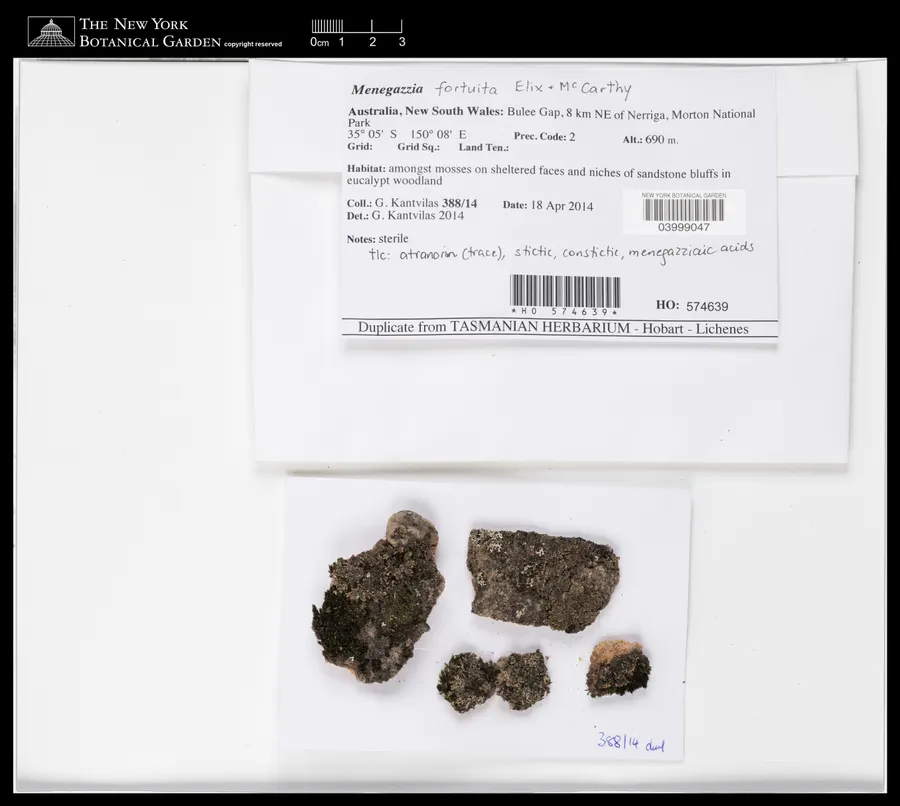
Voucher herbarium Menegazzia fortuita (03999047), The New York Botanical Garden. Identifikasi mengikuti record spesimen sumber. Foto bahan, kemasan, atau label herbarium sebagaimana tersedia pada record institusi; bukan foto lapangan atau penentuan spesimen independen.
- Jenis
- Voucher herbarium
- Kredit
- The New York Botanical Garden
- Lisensi
- CC BY 4.0
- Sumber media
- Buka entri sumber
Sumber profil
- [1] Menegazzia fortuita — Wikipedia (en)
- [2] Catalogue of Life Base2026-09-11 — Menegazzia fortuita
- [3] Dokumentasi visual — Menegazzia fortuita
Rujukan halaman ini
Fungi. Menegazzia fortuita. Rilis data fungi-2026-10-12-expansion-2. https://fungi-atlas.mgadib.chatgpt.site/jamur/menegazzia-fortuita/.
Status: impor sumber; pemeriksaan editorial per profil belum selesai. Untuk klaim biologis, gunakan rujukan pada bagian terkait dan periksa konteks sumber aslinya.