01 / Morfologi

Ciri dan struktur

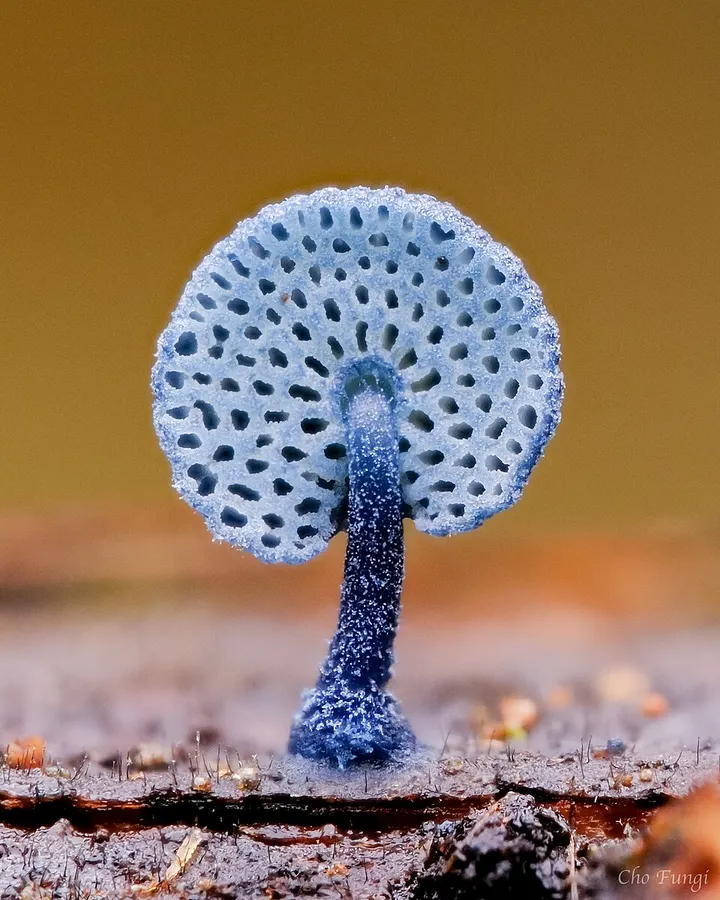
Morphologically the species is quite striking. The following is an excerpt from the descriptive paper on the species: "Basidiomata gregarious, not luminescent. Pileus 1.5-3.5 mm diam, at first semiglobose, then convex to flattened, non-striate, pale blue… to blue…when young, gradually with black tints with age, totally black when old or in dried specimens, slightly pruinose when young, glabrous with age, context white, margin entire, crenulate. Hymenophore consisting of 70-120 pores, pores circular, usually oval near stipe, concolorous with surface of pileus, 8-12 pores per mm. Stipe 2e4 x 0.5e1 mm, blue…to dark blue…gradually with black tints with age, pruinose when young, glabrous with age, cylindrical, central, basally bulbous". Additionally, the basidiospore morphology is globose to ellipisoid. Multiple cystidia cell types are reported (cheilo-, pleuro-, and caulo-), which is an important feature for identification of many Mycena individuals to species. Exceptional illustrations of microscopic features can be found within the descriptive paper. From available pictures, the species seems to invert the pilus and expose the hymenium, possibly a method for more efficient spore dispersal.

Sebagian uraian ditampilkan dalam bahasa sumber; terjemahannya belum tersedia atau belum lolos pemeriksaan.

Rujukan: [1]

Pengukuran mengikuti objek, spesimen atau kultur, dan metode yang disebutkan sumber. Baca uraian asli untuk konteks lengkap.

02 / Kehidupan

Habitat dan peran ekologis

Ecologically, the species seems to be a saprotrophic wood decaying fungus, which is in concordance with the majority of other species in the genus. The species was observed on a substrate of fallen Calamus sp. These were located within the lowland valleys of Taiwan near the city of New Taipei. The fungus was observed in all seasons except for the winter. This may suggest the utilization of survival structures by the genus that have not yet been noted or that this species fruits preferentially during warm weather. This species is currently only known from Northern Taiwan.

Sebagian uraian ditampilkan dalam bahasa sumber; terjemahannya belum tersedia atau belum lolos pemeriksaan.

Rujukan: [1]

Habitat atau konteks temuan
Informasi belum tersedia pada sumber rilis ini.
Substrat
Informasi belum tersedia pada sumber rilis ini.
Peran atau konteks
Pengurai
Temukan hubungan serupa
03 / Siklus hidup

Reproduksi

Morphologically the species is quite striking. The following is an excerpt from the descriptive paper on the species: "Basidiomata gregarious, not luminescent. Pileus 1.5-3.5 mm diam, at first semiglobose, then convex to flattened, non-striate, pale blue… to blue…when young, gradually with black tints with age, totally black when old or in dried specimens, slightly pruinose when young, glabrous with age, context white, margin entire, crenulate. Hymenophore consisting of 70-120 pores, pores circular, usually oval near stipe, concolorous with surface of pileus, 8-12 pores per mm. Stipe 2e4 x 0.5e1 mm, blue…to dark blue…gradually with black tints with age, pruinose when young, glabrous with age, cylindrical, central, basally bulbous".

Sebagian uraian ditampilkan dalam bahasa sumber; terjemahannya belum tersedia atau belum lolos pemeriksaan.

Rujukan: [1]

04 / Batas informasi

Catatan identitas dan cakupan

  • Nama diterima mengikuti Catalogue of Life Base2026-09-11; uraian mempertahankan konsep dan nama sumber aslinya.
  • Original geographic, specimen and life-cycle scope retained; source import awaits individual editorial review.
  • Impor dan terjemahan otomatis belum diperiksa editorial per profil. Struktur reproduktif yang disebutkan tidak membuktikan seluruh siklus hidup diketahui.
  • Pengukuran pada uraian mengikuti spesimen, kultur, dan metode sumber; angka tidak diperluas ke semua populasi.

Catatan distribusi dalam narasi mengikuti sumbernya. Dokumentasi spesimen atau foto mengikuti catatan sumber. Bukti wilayah Indonesia dan penilaian konservasi tidak disimpulkan dari gambar.

05 / Dokumentasi

Melihat dengan konteks

Dokumentasi Mycena indigotica dari Wikimedia Commons. For more information about this, see the observation page at Mushroom Observer. Identifikasi mengikuti record berkas sumber.

Jenis
Fotografi
Kredit
This image was created by user Cho Fungi (eric6717) at Mushroom Observer , a source for mycological images. You can contact this user here .
Sumber media
Buka entri sumber

Gambar menunjukkan objek menurut identifikasi sumber, bukan verifikasi independen spesimen oleh Fungi. Tidak ada skala baru yang ditambahkan.

06 / Rujukan

Sumber profil

  1. [1] Mycena indigotica — Wikipedia (en)Bagian sumber: Frozen revision 1314219995
    Tanggal penghimpunan sumber: 2026-10-12
    Teks sumber: CC BY-SA4.0 · Wikipedia contributors
  2. [2] Catalogue of Life Base2026-09-11 — Mycena indigoticaBagian sumber: ColDP NameUsage.tsv ID 73QC5; accepted species; source 2073
    Tanggal penghimpunan sumber: 2026-10-12
  3. [3] Dokumentasi visual — Mycena indigoticaBagian sumber: Individual media record; identification follows the source, not independent determination
    Tanggal penghimpunan sumber: 2026-10-12
    Media sumber: CC BY-SA 3.0 · This image was created by user Cho Fungi (eric6717) at Mushroom Observer , a source for mycological images. You can contact this user here .

Adaptasi teks: CC BY-SA 4.0. Wikipedia contributors — Mycena indigotica — Wikipedia (en)

Uraian asli dan riwayat sumber

Riwayat atau halaman sumber

Ringkasan sumber

Mycena indigotica is a species of fungus. It was described for the first time in 2018 by Chia Ling Wei and Roland Kirschner after its discovery on the North-western Pacific Island of Taiwan. The genus Mycena is most famous for containing the majority of described bioluminescent fungi. However, M. indigotica is one of the many non-bioluminescent species within the genus. Nonetheless, this mushroom is aesthetically striking, with a petite and novel morphology.

Revisi sumber

Morfologi sumber

Morphologically the species is quite striking. The following is an excerpt from the descriptive paper on the species: "Basidiomata gregarious, not luminescent. Pileus 1.5-3.5 mm diam, at first semiglobose, then convex to flattened, non-striate, pale blue… to blue…when young, gradually with black tints with age, totally black when old or in dried specimens, slightly pruinose when young, glabrous with age, context white, margin entire, crenulate. Hymenophore consisting of 70-120 pores, pores circular, usually oval near stipe, concolorous with surface of pileus, 8-12 pores per mm. Stipe 2e4 x 0.5e1 mm, blue…to dark blue…gradually with black tints with age, pruinose when young, glabrous with age, cylindrical, central, basally bulbous". Additionally, the basidiospore morphology is globose to ellipisoid. Multiple cystidia cell types are reported (cheilo-, pleuro-, and caulo-), which is an important feature for identification of many Mycena individuals to species. Exceptional illustrations of microscopic features can be found within the descriptive paper. From available pictures, the species seems to invert the pilus and expose the hymenium, possibly a method for more efficient spore dispersal.

Revisi sumber

Ekologi sumber

Ecologically, the species seems to be a saprotrophic wood decaying fungus, which is in concordance with the majority of other species in the genus. The species was observed on a substrate of fallen Calamus sp. These were located within the lowland valleys of Taiwan near the city of New Taipei. The fungus was observed in all seasons except for the winter. This may suggest the utilization of survival structures by the genus that have not yet been noted or that this species fruits preferentially during warm weather. This species is currently only known from Northern Taiwan.

Revisi sumber

Struktur reproduksi sumber

Morphologically the species is quite striking. The following is an excerpt from the descriptive paper on the species: "Basidiomata gregarious, not luminescent. Pileus 1.5-3.5 mm diam, at first semiglobose, then convex to flattened, non-striate, pale blue… to blue…when young, gradually with black tints with age, totally black when old or in dried specimens, slightly pruinose when young, glabrous with age, context white, margin entire, crenulate. Hymenophore consisting of 70-120 pores, pores circular, usually oval near stipe, concolorous with surface of pileus, 8-12 pores per mm. Stipe 2e4 x 0.5e1 mm, blue…to dark blue…gradually with black tints with age, pruinose when young, glabrous with age, cylindrical, central, basally bulbous".

Revisi sumber

Rujukan halaman ini

Fungi. Mycena indigotica. Rilis data fungi-2026-10-12-expansion-2. https://fungi-atlas.mgadib.chatgpt.site/jamur/mycena-indigotica/.

Status: impor sumber; pemeriksaan editorial per profil belum selesai. Untuk klaim biologis, gunakan rujukan pada bagian terkait dan periksa konteks sumber aslinya.