01 / Morfologi

Ciri dan struktur

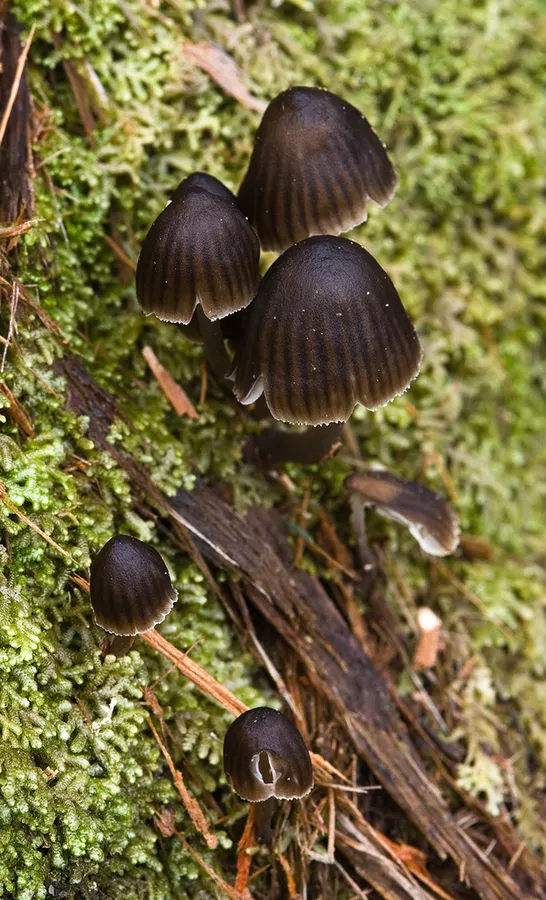
The caps of young mushrooms are initially egg-shaped to conical, expanding to become bell-shaped and up to 2 cm (0.8 in) in diameter. Initially, the margin of the cap is rolled inwards; it typically assumes a lighter color than the centre of the cap surface. Dark brown in color, the mushroom is distinguished by the presence of white speckles or scales on the cap and stem; these scales may disappear when they become sloughed off or washed away by rain, which can make the species hard to recognise. The thick gills have an adnate attachment to the stem (broadly attached to the stem slightly above the bottom of the gill, with most of the gill fused to the stem), and are white to light grey in colour, paler toward the edge. There are about 24–28 gills extending completely from the cap margin to the stem, and one or two tiers of lamellulae (shorter gills does do not extend fully from the margin to the stem). The thin stem is up to 4 cm (1.6 in) high and 0.3 cm (0.12 in) wide, and does not have a ring. Young specimens will typically have whitish scales at the base; later, these will slough off and a felt-like whitish mycelium may be apparent. The mushroom have no distinctive odour. The spore print is white or cream. The edibility of the mushroom has not been reported. The spores of M. nargan are roughly ellipsoid, smooth, hyaline, and measure 7.4–10.4 by 4.8–7.1 μm. They have a small, oblique apiculus, and lack oil droplets. In terms of staining reactions, they are acyanophilous (not absorbing methyl blue dye), and amyloid (turning blue-black in Melzer's reagent). The basidia (spore-bearing cells in the hymenium) are club-shaped, have clamp connections at their bases, and measure 29.6–36.4 by 8.2–10.7 μm.

Sebagian uraian ditampilkan dalam bahasa sumber; terjemahannya belum tersedia atau belum lolos pemeriksaan.

Rujukan: [1]

Pengukuran mengikuti objek, spesimen atau kultur, dan metode yang disebutkan sumber. Baca uraian asli untuk konteks lengkap.

02 / Kehidupan

Habitat dan peran ekologis

Jamur umum, Mycena nargan ditemukan tumbuh secara tunggal atau dalam kelompok di bagian bawah kayu yang membusuk di daerah basah dan berbayar, dan terutama sebagian Eucalyptus and Pinus pinaster. Fruit bodies biasanya muncul dari April to Juni. Spesies ini telah tercatat dari Tasmania, Victoria and tenggara Australia Selatan. Australian Fungimap initiative telah melaporkan koleksi terisolasi di Australia Barat, Australia Selatan, dan New South Wales, meskipun sebagian besar pengamatan telah terjadi di Victoria Tasmania and. Jamur adalah saprobik, yang berarti ia memperoleh nutrisi dari bahan organik mati atau mati. Sebuah studi lapangan yang dilakukan di Tasmania showed menunjukkan bahwa lebih mungkin untuk ditemukan di hutan eukalypt dewasa (diartikan telah tumbuh setidaknya 70 tahun sebelum kebakaran hutan terakhir) daripada hutan muda, yang regenerasi yang telah mengalami penebangan, pembakaran, dan penanaman dua sampai tiga tahun sebelumnya.

Rujukan: [1]

Habitat atau konteks temuan
hutan
Substrat
Informasi belum tersedia pada sumber rilis ini.
Peran atau konteks
Pengurai
Temukan hubungan serupa
03 / Siklus hidup

Reproduksi

The caps of young mushrooms are initially egg-shaped to conical, expanding to become bell-shaped and up to 2 cm (0.8 in) in diameter. Initially, the margin of the cap is rolled inwards; it typically assumes a lighter color than the centre of the cap surface. Dark brown in color, the mushroom is distinguished by the presence of white speckles or scales on the cap and stem; these scales may disappear when they become sloughed off or washed away by rain, which can make the species hard to recognise. The thick gills have an adnate attachment to the stem (broadly attached to the stem slightly above the bottom of the gill, with most of the gill fused to the stem), and are white to light grey in colour, paler toward the edge.

Sebagian uraian ditampilkan dalam bahasa sumber; terjemahannya belum tersedia atau belum lolos pemeriksaan.

Rujukan: [1]

04 / Batas informasi

Catatan identitas dan cakupan

  • Nama diterima mengikuti Catalogue of Life Base2026-09-11; uraian mempertahankan konsep dan nama sumber aslinya.
  • Original geographic, specimen and life-cycle scope retained; source import awaits individual editorial review.
  • Impor dan terjemahan otomatis belum diperiksa editorial per profil. Struktur reproduktif yang disebutkan tidak membuktikan seluruh siklus hidup diketahui.
  • Pengukuran pada uraian mengikuti spesimen, kultur, dan metode sumber; angka tidak diperluas ke semua populasi.

Catatan distribusi dalam narasi mengikuti sumbernya. Dokumentasi spesimen atau foto mengikuti catatan sumber. Bukti wilayah Indonesia dan penilaian konservasi tidak disimpulkan dari gambar.

05 / Dokumentasi

Melihat dengan konteks

Dokumentasi Mycena nargan menurut asosiasi foto pada record takson iNaturalist. Kredit: JJ Harrison. Identitas mengikuti sumber; bukan penentuan spesimen independen.

Jenis
Fotografi
Kredit
(c) JJ Harrison, some rights reserved (CC BY-SA)
Sumber media
Buka entri sumber

Gambar menunjukkan objek menurut identifikasi sumber, bukan verifikasi independen spesimen oleh Fungi. Tidak ada skala baru yang ditambahkan.

06 / Rujukan

Sumber profil

  1. [1] Mycena nargan — Wikipedia (en)Bagian sumber: Frozen revision 1371286313
    Tanggal penghimpunan sumber: 2026-10-12
    Teks sumber: CC BY-SA4.0 · Wikipedia contributors
  2. [2] Catalogue of Life Base2026-09-11 — Mycena narganBagian sumber: ColDP NameUsage.tsv ID 44THC; accepted species; source 2073
    Tanggal penghimpunan sumber: 2026-10-12
  3. [3] Dokumentasi visual — Mycena narganBagian sumber: Individual media record; identification follows the source, not independent determination
    Tanggal penghimpunan sumber: 2026-10-12
    Media sumber: CC BY-SA 4.0 · (c) JJ Harrison, some rights reserved (CC BY-SA)

Adaptasi teks: CC BY-SA 4.0. Wikipedia contributors — Mycena nargan — Wikipedia (en)

Uraian asli dan riwayat sumber

Riwayat atau halaman sumber

Ringkasan sumber

Mycena nargan, commonly known as the Nargan's bonnet, is a species of fungus in the family Mycenaceae, and the sole member of the section Nargan in the genus Mycena. Reported as a new species in 1995, it is known predominantly from Southern Australia. The saprobic fungus produces mushrooms that grow on well-decayed wood, often on the underside of wood lying in litter. The dark chestnut-coloured caps are covered with white, easily removed scales, and reach diameters of up to 2 cm wide. The pale, slender stems are up to 5 cm long and have white scales at the base.

Revisi sumber

Morfologi sumber

The caps of young mushrooms are initially egg-shaped to conical, expanding to become bell-shaped and up to 2 cm (0.8 in) in diameter. Initially, the margin of the cap is rolled inwards; it typically assumes a lighter color than the centre of the cap surface. Dark brown in color, the mushroom is distinguished by the presence of white speckles or scales on the cap and stem; these scales may disappear when they become sloughed off or washed away by rain, which can make the species hard to recognise. The thick gills have an adnate attachment to the stem (broadly attached to the stem slightly above the bottom of the gill, with most of the gill fused to the stem), and are white to light grey in colour, paler toward the edge. There are about 24–28 gills extending completely from the cap margin to the stem, and one or two tiers of lamellulae (shorter gills does do not extend fully from the margin to the stem). The thin stem is up to 4 cm (1.6 in) high and 0.3 cm (0.12 in) wide, and does not have a ring. Young specimens will typically have whitish scales at the base; later, these will slough off and a felt-like whitish mycelium may be apparent. The mushroom have no distinctive odour. The spore print is white or cream. The edibility of the mushroom has not been reported. The spores of M. nargan are roughly ellipsoid, smooth, hyaline, and measure 7.4–10.4 by 4.8–7.1 μm. They have a small, oblique apiculus, and lack oil droplets. In terms of staining reactions, they are acyanophilous (not absorbing methyl blue dye), and amyloid (turning blue-black in Melzer's reagent). The basidia (spore-bearing cells in the hymenium) are club-shaped, have clamp connections at their bases, and measure 29.6–36.4 by 8.2–10.7 μm.

Revisi sumber

Ekologi sumber

A common mushroom, Mycena nargan is found growing singly or in clusters on the underside of rotting wood in wet and shaded areas, and is especially partial to Eucalyptus and Pinus pinaster. Fruit bodies usually appear from April to June. The species has been recorded from Tasmania, Victoria and southeastern South Australia. The Australian Fungimap initiative has reported isolated collections in Western Australia, South Australia, and New South Wales, although the majority of sightings have been in Tasmania and Victoria. The fungus is saprobic, meaning it derives nutrients from dead or dying organic matter. A field study conducted in Tasmania showed that it is much more likely to be found in mature eucalypt forest (defined as having grown at least 70 years before the last wildfire) than young, regenerating forest that had experienced clearfelling, burning, and sowing two to three years previously.

Revisi sumber

Struktur reproduksi sumber

The caps of young mushrooms are initially egg-shaped to conical, expanding to become bell-shaped and up to 2 cm (0.8 in) in diameter. Initially, the margin of the cap is rolled inwards; it typically assumes a lighter color than the centre of the cap surface. Dark brown in color, the mushroom is distinguished by the presence of white speckles or scales on the cap and stem; these scales may disappear when they become sloughed off or washed away by rain, which can make the species hard to recognise. The thick gills have an adnate attachment to the stem (broadly attached to the stem slightly above the bottom of the gill, with most of the gill fused to the stem), and are white to light grey in colour, paler toward the edge.

Revisi sumber

Rujukan halaman ini

Fungi. Mycena nargan. Rilis data fungi-2026-10-12-expansion-2. https://fungi-atlas.mgadib.chatgpt.site/jamur/mycena-nargan/.

Status: impor sumber; pemeriksaan editorial per profil belum selesai. Untuk klaim biologis, gunakan rujukan pada bagian terkait dan periksa konteks sumber aslinya.