Ciri dan struktur
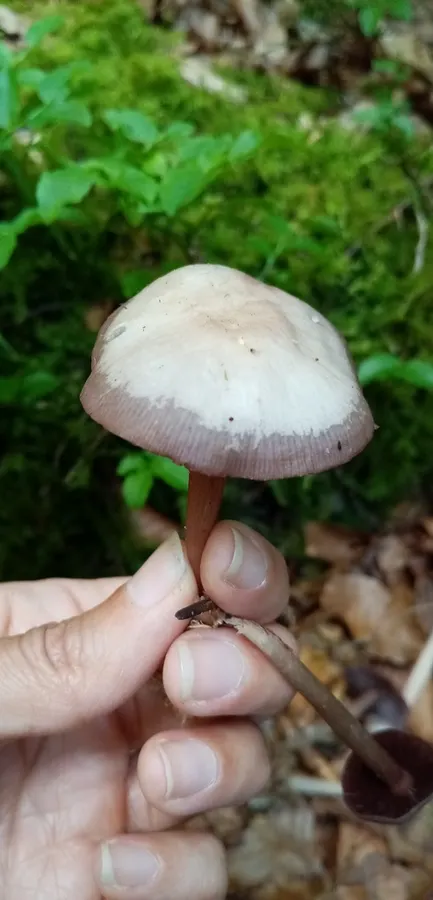
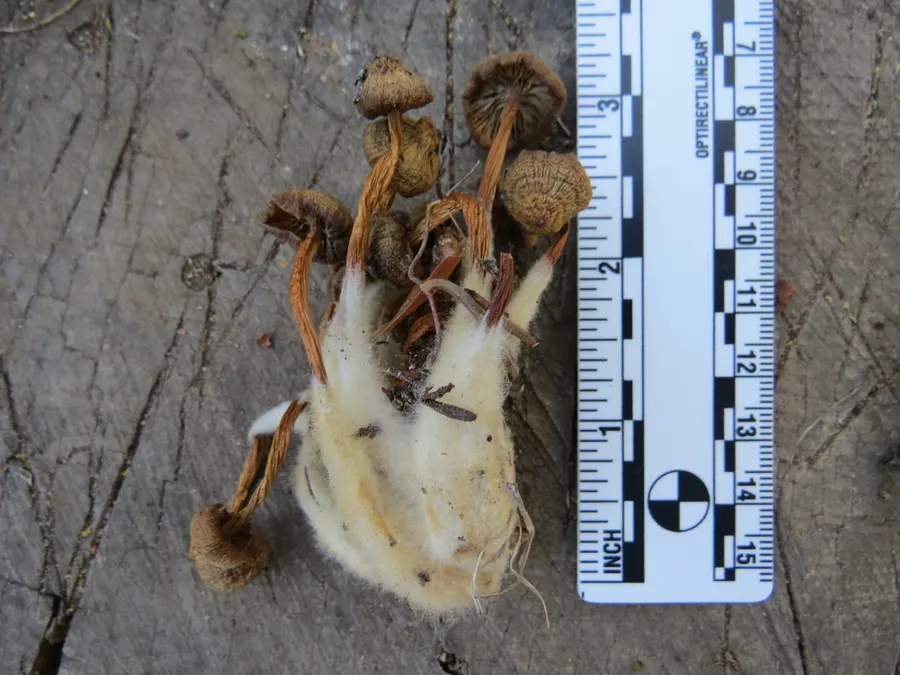
Mycena overholtsii produces some of the largest mushrooms of the genus Mycena. They have caps that are 1.5 to 5 cm in diameter, and convex in shape, developing an umbo (a central protrusion resembling a nipple) in maturity. The cap surface is smooth, moist, and marked with radial striations. The caps are somewhat hygrophanous, and depending on age and state of hydration, range in color from brown or grayish-brown, to dark or bluish-gray. The mushroom flesh is thin and watery, with a light gray color. The gills have an adnate, adnexed, or shallowly decurrent attachment to the stem, and are initially closely spaced before becoming well-spaced at maturity. They have a whitish to pale gray color, and will stain gray when they are bruised. There are three or four tiers of lamellulae (short gills that do not extend fully from the cap margin to the stem) interspersed between the gills. The stem is 4 to 15 cm long by 0.3 to 1 cm thick, and tapers upward so that the stem apex is slightly thinner than the base. It can be straight or curved, has cartilage-like flesh, and is hollow in maturity. When growing on soft, well-decayed wood, the stem often penetrates deeply into the substrate. The stem is pinkish-brown in color, and the lower half is tomentose – densely covered with white, woolly hairs. The mushroom has a yeast-like odor and a mild taste; its edibility is unknown, but it is not considered poisonous. Viewed in deposit, as with a spore print, the spores appear white. Microscopically, the spores are roughly elliptical, sometimes appearing bean-shaped, with dimensions of 5.5–7 by 3–3.5 μm.
Habitat dan peran ekologis
This species is sometimes found singly, but more often in clusters on well-rotted conifer logs and stumps (often Douglas-fir) near melting snowbanks, or sometimes in moist snow chambers formed by receding snow. Cool nighttime suhu mengurangi laju leleh salju, dan membantu memastikan bahwa spora yang dilepaskan oleh jamur akan tersebar ke tanah. Jamur ini umum di Amerika Utara barat, terutama di Pasifik Barat Laut, Rocky Mountains and dan Cascade mountains. Hal ini telah dilaporkan di empat negara bagian AS: Dakota Selatan, California, Washington and Wyoming, tetapi tidak diketahui di Oregon. Hal ini juga ditemukan di Kanada barat. Jamur ini dibatasi untuk daerah dengan ketinggian minimum 1000 m. Pada 2010, dilaporkan tumbuh di hutan konifer boreal Hokkaido, Jepang, di perkebunan Sakhalin fir (Abies sachalinensis), serta di hutan alami yang didominasi oleh kedua Sakhalin fir dan Jezo spruce (Picea jezoensis). In North America, the mushroom usually appears between March and July; Japanese collections were made in May. Periode berbuah dapat diperpanjang, terutama di daerah dengan salju besar, atau di ketinggian tinggi di mana peleburan salju tertunda.
- Habitat atau konteks temuan
- hutan
- Substrat
- Informasi belum tersedia pada sumber rilis ini.
- Peran atau konteks
- Belum dikategorikan pada rilis ini.
Reproduksi
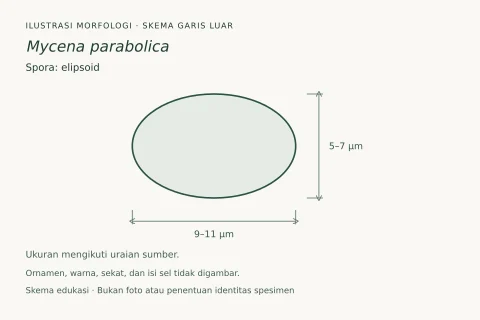
Viewed in deposit, as with a spore print, the spores appear white. Microscopically, the spores are roughly elliptical, sometimes appearing bean-shaped, with dimensions of 5.5–7 by 3–3.5 μm. They are thin-walled and smooth, and bear an indistinct hilar appendage. The spores are amyloid, meaning they will absorb iodine and turn black to blue-black when stained with Melzer's reagent. The basidia (spore-bearing cells) are four-spored. The cheilocystidia (cystidia on the gill edge), which are scattered and interspersed with basidia, are roughly cylindric to fusoid (spindle-shaped), smooth, hyaline (translucent), and measure 45–65 by 2–5.5 μm. Pleurocystidia (cystidia on the gill face) are uncommon, and similar in appearance to the cheilocystidia.
Catatan identitas dan cakupan
- Nama diterima mengikuti Catalogue of Life Base2026-09-11; uraian mempertahankan konsep dan nama sumber aslinya.
- Original geographic, specimen and life-cycle scope retained; source import awaits individual editorial review.
- Impor dan terjemahan otomatis belum diperiksa editorial per profil. Struktur reproduktif yang disebutkan tidak membuktikan seluruh siklus hidup diketahui.
- Pengukuran pada uraian mengikuti spesimen, kultur, dan metode sumber; angka tidak diperluas ke semua populasi.
Catatan distribusi dalam narasi mengikuti sumbernya. Dokumentasi spesimen atau foto mengikuti catatan sumber. Bukti wilayah Indonesia dan penilaian konservasi tidak disimpulkan dari gambar.
Melihat dengan konteks
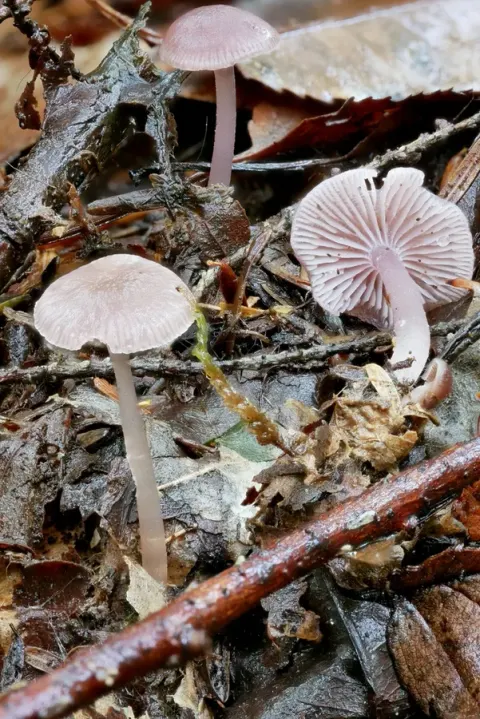
Dokumentasi Mycena overholtsii menurut asosiasi foto pada record takson iNaturalist. Kredit: Garth Harwood. Identitas mengikuti sumber; bukan penentuan spesimen independen.
- Jenis
- Fotografi
- Kredit
- (c) Garth Harwood, some rights reserved (CC BY), uploaded by Garth Harwood
- Lisensi
- CC BY 4.0
- Sumber media
- Buka entri sumber
Sumber profil
- [1] Mycena overholtsii — Wikipedia (en)
- [2] Catalogue of Life Base2026-09-11 — Mycena overholtsii
- [3] Dokumentasi visual — Mycena overholtsii
Rujukan halaman ini
Fungi. Mycena overholtsii. Rilis data fungi-2026-10-12-expansion-2. https://fungi-atlas.mgadib.chatgpt.site/jamur/mycena-overholtsii/.
Status: impor sumber; pemeriksaan editorial per profil belum selesai. Untuk klaim biologis, gunakan rujukan pada bagian terkait dan periksa konteks sumber aslinya.