Ciri dan struktur
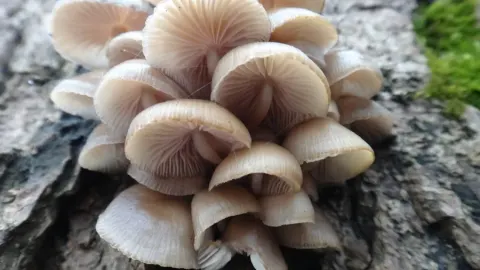
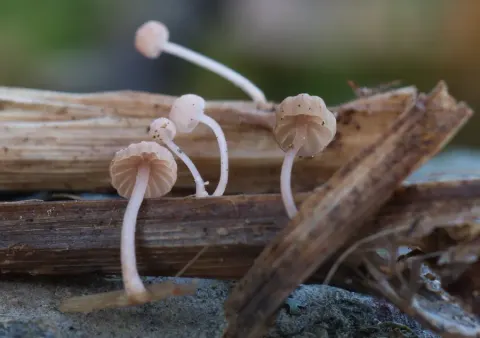
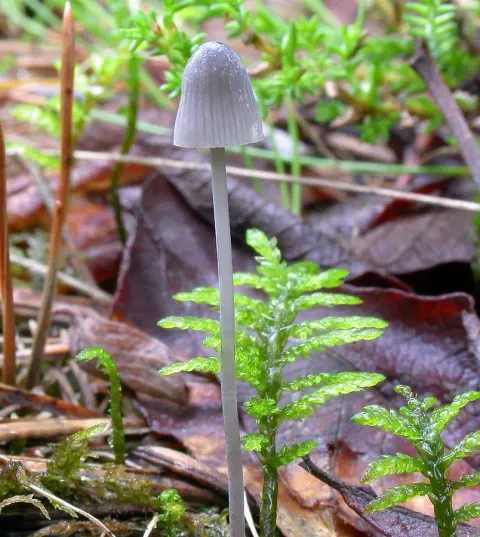
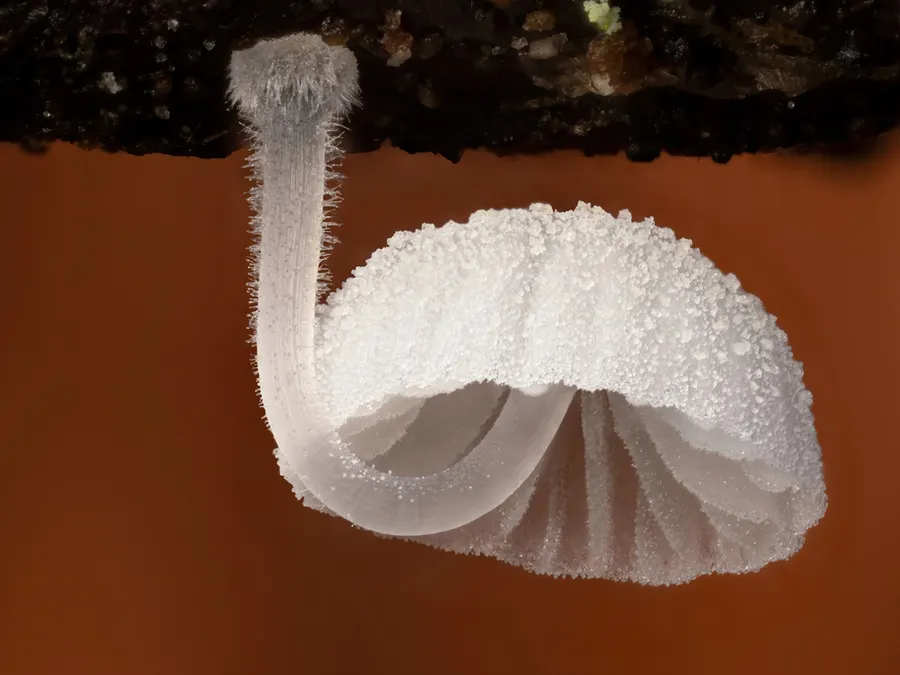
The cap is white and small, with a diameter typically ranging from 2.5 to 7.5 mm. Initially convex to cucullate (hood-shaped), it flattens during maturity, developing visible surface grooves that correspond to the gills underneath the cap; the surface may also be covered with glistening particles, remnants of the partial veil. At the very base of the stem is a small, white, and hairy disk-like base that attaches to the substrate. The edibility of the mushroom is unknown, but like many small Mycenas, they are insubstantial and not likely to be considered for the table. The variety carpophila is characterized by its tiny white cap up to 1 mm in diameter, and narrowly conical caulocystidia (cystidia found on the stem). Mycena adscendens produces a white spore print. The spores are broadly ellipsoid, amyloid, and have dimensions of 8–10 by 5–6.5 μm. Basidia (spore-bearing cells) are two-spored, club-shaped, and measure 14–17 by 7–9 μm. Pleurocystidia (cystidia on the gill faces) may be present or absent. If present, they are similar to the cheilocystidia (cystidia on the gill edges). The cheilocystidia are abundant, measuring 28–44 by 8–12 μm. They are variable in shape, often fusoid-ventricose (fuse-shaped with a swollen center) or with 2–3 needle-like projections arising from the apex; the projections are sometimes forked. The swollen parts of the cheilocystidia are covered with short rodlike protuberances or warts. The flesh of the gills is vinaceous-brown when stained in iodine. The flesh of the cap is made up of greatly enlarged cells, with the surface covered with club-shaped to almost globular cells measuring 25–40 by about 20 μm.
Habitat dan peran ekologis
Fruit bodies dari Mycena adscendens ditemukan berkeliaran untuk dikelompokkan bersama dalam dua atau tiga pada ranting, kulit, dan puing-puing kayu keras yang jatuh selama musim semi dan musim gugur; buahnya kurang sering pada kayu konifer. Fruitings are paling umum setelah periode cuaca basah. They are juga ditemukan tumbuh di kacang hazel yang telah jatuh ke tanah; dua Mycenas known lainnya untuk tumbuh di substrat ini termasuk M. discopus dan M. nucicola. In the United States, it is known from Washington to California. Hal ini juga ditemukan di Eropa, dan telah dikumpulkan di Provinsi Amasya, Turki. Varietas carpophila, yang awalnya digambarkan dari Denmark, dilaporkan dari Japan in 2003.
- Habitat atau konteks temuan
- Informasi belum tersedia pada sumber rilis ini.
- Substrat
- Informasi belum tersedia pada sumber rilis ini.
- Peran atau konteks
- Belum dikategorikan pada rilis ini.
Reproduksi
Mycena adscendens produces a white spore print. The spores are broadly ellipsoid, amyloid, and have dimensions of 8–10 by 5–6.5 μm. Basidia (spore-bearing cells) are two-spored, club-shaped, and measure 14–17 by 7–9 μm. Pleurocystidia (cystidia on the gill faces) may be present or absent. If present, they are similar to the cheilocystidia (cystidia on the gill edges). The cheilocystidia are abundant, measuring 28–44 by 8–12 μm. They are variable in shape, often fusoid-ventricose (fuse-shaped with a swollen center) or with 2–3 needle-like projections arising from the apex; the projections are sometimes forked. The swollen parts of the cheilocystidia are covered with short rodlike protuberances or warts.
Catatan identitas dan cakupan
- Nama diterima mengikuti Catalogue of Life Base2026-09-11; uraian mempertahankan konsep dan nama sumber aslinya.
- Original geographic, specimen and life-cycle scope retained; source import awaits individual editorial review.
- Impor dan terjemahan otomatis belum diperiksa editorial per profil. Struktur reproduktif yang disebutkan tidak membuktikan seluruh siklus hidup diketahui.
- Pengukuran pada uraian mengikuti spesimen, kultur, dan metode sumber; angka tidak diperluas ke semua populasi.
Catatan distribusi dalam narasi mengikuti sumbernya. Dokumentasi spesimen atau foto mengikuti catatan sumber. Bukti wilayah Indonesia dan penilaian konservasi tidak disimpulkan dari gambar.
Melihat dengan konteks
Dokumentasi Mycena tenerrima menurut asosiasi foto pada record takson iNaturalist. Kredit: Alan Rockefeller. Identitas mengikuti sumber; bukan penentuan spesimen independen.
- Jenis
- Fotografi
- Kredit
- (c) Alan Rockefeller, some rights reserved (CC BY), uploaded by Alan Rockefeller
- Lisensi
- CC BY 4.0
- Sumber media
- Buka entri sumber
Dokumentasi tambahan
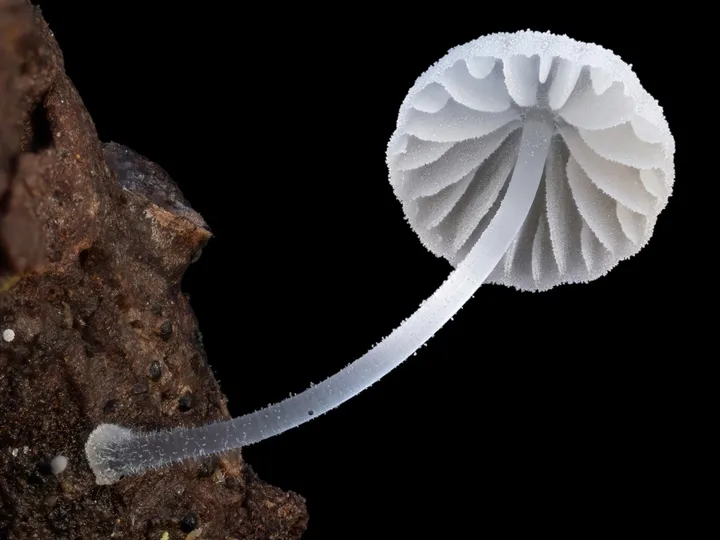
Foto yang diasosiasikan dengan Mycena tenerrima pada iNaturalist. Identifikasi mengikuti sumber; bukan penentuan spesimen independen.
Kredit dan penggunaan
(c) Alan Rockefeller, some rights reserved (CC BY), uploaded by Alan Rockefeller
Ukuran dan format gambar disesuaikan tanpa pemotongan, retus, atau penambahan skala. Lisensi sumber dipertahankan.
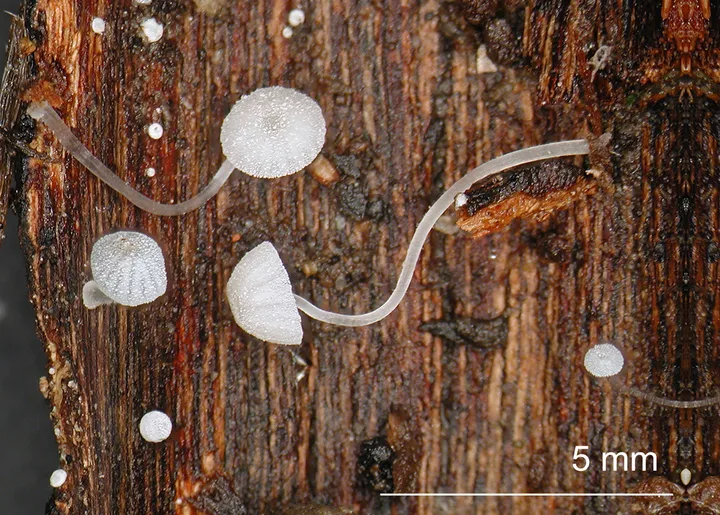
Foto yang diasosiasikan dengan Mycena tenerrima pada iNaturalist. Identifikasi mengikuti sumber; bukan penentuan spesimen independen.
Kredit dan penggunaan
(c) Jerry Cooper, some rights reserved (CC BY), uploaded by Jerry Cooper
Ukuran dan format gambar disesuaikan tanpa pemotongan, retus, atau penambahan skala. Lisensi sumber dipertahankan.
Sumber profil
- [1] Mycena adscendens — Wikipedia (en)
- [2] Catalogue of Life Base2026-09-11 — Mycena tenerrima
- [3] Dokumentasi visual — Mycena tenerrima
- [4] Dokumentasi visual — Mycena tenerrima
- [5] Dokumentasi visual — Mycena tenerrima
Rujukan halaman ini
Fungi. Mycena tenerrima. Rilis data fungi-2026-10-12-expansion-2. https://fungi-atlas.mgadib.chatgpt.site/jamur/mycena-tenerrima/.
Status: impor sumber; pemeriksaan editorial per profil belum selesai. Untuk klaim biologis, gunakan rujukan pada bagian terkait dan periksa konteks sumber aslinya.