Ciri dan struktur
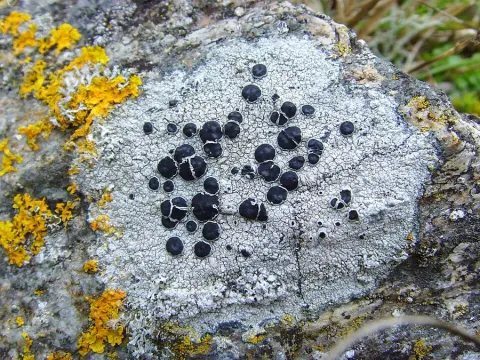
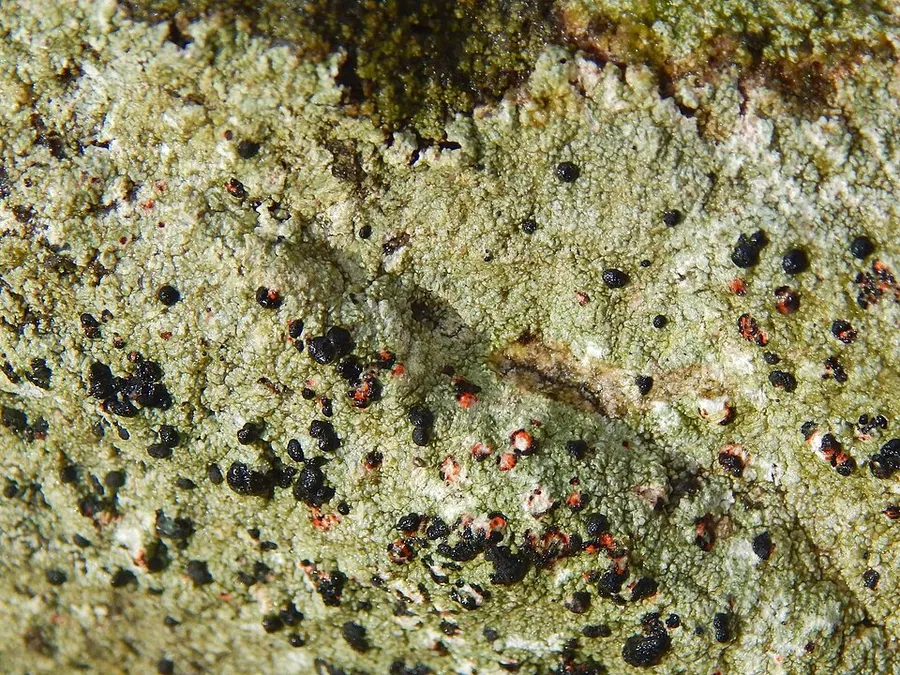
The thallus of Mycoblastus sanguinarius ranges in colour from pale to dark grey. The thallus is often very irregular, thick, and has a coarse, wart-like ( or -warted) texture, giving it a marbled appearance. It can be continuous or somewhat cracked, and sometimes a pale to dark grey (the initial growth stage) is present. Soralia (propagules for asexual reproduction) are rare but, when they do appear, they are rounded, scattered, often few in number, and can be the same colour as or paler than the thallus. These soralia are convex and have an efflorescent (powdery) appearance. The apothecia (sexual reproductive structures) are usually frequent and measure between 0.5 and 1.7 mm in diameter, occasionally up to 3.0 mm. They are black, becoming convex or hemispherical as they mature, and can be (sitting directly on the thallus) or slightly constricted at the base. These apothecia develop on a bright carmine-red thalline cushion that becomes visible when the thallus is damaged or worn. The asci (spore-producing cells) typically contain 1 to 3 spores. The ascospores themselves are cylindrical with rounded ends, measuring 70–100 μm in length and 35–45 μm in width, with a thick wall of about 6–7 μm. Mycoblastus sanguinarius also commonly has pycnidia, which are small asexual reproductive structures. These pycnidia are 40–50 μm in diameter, with dark green walls, and produce (rod-shaped) conidia measuring 6–9 μm in length and about 1 μm in width. The cortex of the thallus reacts to chemical spot tests with C–, K+ (yellow), and Pd+ (yellow), while the medulla reacts K+ (red) in parts and UV–, indicating the presence of chemical compounds such as atranorin, chloratranorin, rhodocladonic acid, and caperatic acid.
Habitat dan peran ekologis
Mycoblastus sanguinarius grows in a variety of habitats, primarily growing as an epiphyte on tree bark in cool, moist environments. It is found in temperate forests across North America, Europe, and Asia. This lichen is particularly abundant in boreal and montane forests, where it often grows on the bark of coniferous trees such as spruce and fir. The species is also known to colonise decaying wood and, less frequently, mossy rock surfaces.
- Habitat atau konteks temuan
- hutan
- Substrat
- Informasi belum tersedia pada sumber rilis ini.
- Peran atau konteks
- Pembentuk liken
Reproduksi
The thallus of Mycoblastus sanguinarius ranges in colour from pale to dark grey. The thallus is often very irregular, thick, and has a coarse, wart-like ( or -warted) texture, giving it a marbled appearance. It can be continuous or somewhat cracked, and sometimes a pale to dark grey (the initial growth stage) is present. Soralia (propagules for asexual reproduction) are rare but, when they do appear, they are rounded, scattered, often few in number, and can be the same colour as or paler than the thallus. These soralia are convex and have an efflorescent (powdery) appearance. The apothecia (sexual reproductive structures) are usually frequent and measure between 0.5 and 1.7 mm in diameter, occasionally up to 3.0 mm.
Catatan identitas dan cakupan
- Nama diterima mengikuti Catalogue of Life Base2026-09-11; uraian mempertahankan konsep dan nama sumber aslinya.
- Original geographic, specimen and life-cycle scope retained; source import awaits individual editorial review.
- Impor dan terjemahan otomatis belum diperiksa editorial per profil. Struktur reproduktif yang disebutkan tidak membuktikan seluruh siklus hidup diketahui.
- Pengukuran pada uraian mengikuti spesimen, kultur, dan metode sumber; angka tidak diperluas ke semua populasi.
Catatan distribusi dalam narasi mengikuti sumbernya. Dokumentasi spesimen atau foto mengikuti catatan sumber. Bukti wilayah Indonesia dan penilaian konservasi tidak disimpulkan dari gambar.
Melihat dengan konteks
Dokumentasi Mycoblastus sanguinarius dari Wikimedia Commons. A lichen - Mycoblastus sanguinarius Identifikasi mengikuti record berkas sumber.
- Jenis
- Fotografi
- Kredit
- Lairich Rig — A lichen - Mycoblastus sanguinarius by Lairich Rig
- Lisensi
- CC BY-SA 2.0
- Sumber media
- Buka entri sumber
Sumber profil
- [1] Mycoblastus sanguinarius — Wikipedia (en)
- [2] Catalogue of Life Base2026-09-11 — Mycoblastus sanguinarius
- [3] Dokumentasi visual — Mycoblastus sanguinarius
Rujukan halaman ini
Fungi. Mycoblastus sanguinarius. Rilis data fungi-2026-10-12-expansion-2. https://fungi-atlas.mgadib.chatgpt.site/jamur/mycoblastus-sanguinarius/.
Status: impor sumber; pemeriksaan editorial per profil belum selesai. Untuk klaim biologis, gunakan rujukan pada bagian terkait dan periksa konteks sumber aslinya.