Ciri dan struktur
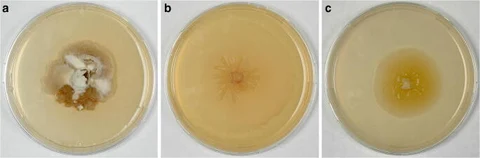
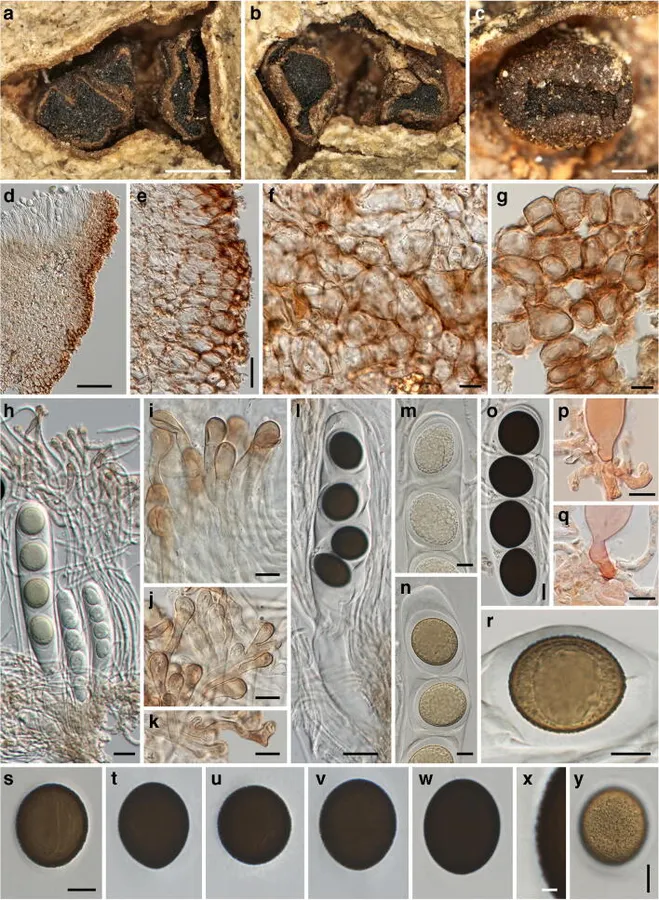
Sexual morph: Apothecia 0.4–2-mm diam, erumpent from bark, solitary or in groups of 2–5, sessile, without a basal stroma, forming circular to irregular plane to concave discs. Receptacle dark red-brown and scaly and the raised margin slightly paler. Hymenium roughened, dark brown to black. Ectal excipulum consisting of a 50–100-μm-thick layer, narrower at the margin, of dark orange brown textura globulosa-angularis, cells (9–)13–23(–28)-μm diam, with walls 1–2 μm thick. Medullary excipulum consisting of orange brown textura globulosa-angularis, cells (7–)13–24(–33)-μm diam. Subhymenium made of hyaline to pale brown textura intricata of densely interwoven thin-walled hyphae. Paraphyses ca. 250–310 μm long, 2.5–4.8 μm wide, cylindrical, hyaline, septate, branched, longer than the asci, with swollen, club-shaped red brown tips 5–11 μm wide, not encrusted. Asci 185–265(–305) × (26–)29–38(−42) μm (n = 29), cylindrical-clavate, unitunicate, with rounded to subtruncate apex, inamyloid, without visible apical apparatus, containing 4 uniseriately arranged ascospores, base tapering, with simple septum. Ascus dehiscence unknown. Ascospores (23.5–)26.5–31.5(−34) × (18.5–)23–27(–29) μm, l/w = (1.0–)1.1–1.2(–1.4), Me = 29 × 25 μm, Qe = 1.15 (n = 88), globose to ellipsoid, first hyaline, turning pale brown and finally dark brown to nearly black when mature, containing a large globose oil drop, walls verruculose and appearing rough in profile view, with a prominent refractive gelatinous sheath widely expanding in released spores. Asexual morph: Conidiomata acervular, subperidermal, scattered, scarcely raising the bark and becoming visible in the dry state by black irregular spots of distinctly glossy conidia and sometimes small bumps in the bark after the discharge of the conidia through bark fissures.
Habitat dan peran ekologis
Habitat: on dead corticated branches of Quercus spp. (Q. coccinea, Q. rubra), constantly associated with effete conidiomata or stromata of Coryneum spp. Distribution: Eastern North America (USA, Canada).
- Habitat atau konteks temuan
- Informasi belum tersedia pada sumber rilis ini.
- Substrat
- Informasi belum tersedia pada sumber rilis ini.
- Peran atau konteks
- Belum dikategorikan pada rilis ini.
Reproduksi
Sexual morph: Apothecia 0.4–2-mm diam, erumpent from bark, solitary or in groups of 2–5, sessile, without a basal stroma, forming circular to irregular plane to concave discs. Receptacle dark red-brown and scaly and the raised margin slightly paler. Hymenium roughened, dark brown to black. Ectal excipulum consisting of a 50–100-μm-thick layer, narrower at the margin, of dark orange brown textura globulosa-angularis, cells (9–)13–23(–28)-μm diam, with walls 1–2 μm thick. Medullary excipulum consisting of orange brown textura globulosa-angularis, cells (7–)13–24(–33)-μm diam. Subhymenium made of hyaline to pale brown textura intricata of densely interwoven thin-walled hyphae. Paraphyses ca. 250–310 μm long, 2.5–4.8 μm wide, cylindrical, hyaline, septate, branched, longer than the asci, with swollen, club-shaped red brown tips 5–11 μm wide, not encrusted.
Catatan identitas dan cakupan
- Nama diterima mengikuti Catalogue of Life Base2026-09-11; uraian mempertahankan konsep dan nama sumber aslinya.
- Preserve original treatment localities, hosts and substrate scope. Materials examined describe documented specimens, not the full global range.
- Impor dan terjemahan otomatis belum diperiksa editorial per profil. Struktur reproduktif yang disebutkan tidak membuktikan seluruh siklus hidup diketahui.
- Pengukuran pada uraian mengikuti spesimen, kultur, dan metode sumber; angka tidak diperluas ke semua populasi.
Catatan distribusi dalam narasi mengikuti sumbernya. Dokumentasi spesimen atau foto mengikuti catatan sumber. Bukti wilayah Indonesia dan penilaian konservasi tidak disimpulkan dari gambar.
Melihat dengan konteks
Mycosphaerangium tetrasporum, sexual morph ((a – c, g, i, l – o, q – u, w, x) GZU 000335639, lectotype; (d–f, h, j, k, p, v) WU 40040). (a–c) Apothecia in face view. (d) Apothecium margin in section. (e) Marginal excipulum in section. (f) Medulla in section. (g) Ectal excipulum cells in squash mount. (h) Paraphyses and immature asci. (i – k) Swollen, reddish brown paraphysis tips. (l) Mature ascus with four ascospores surrounded by thick gelatinous sheaths. (m – o) Ascus apices ((m, n) immature). (p, q) Ascus bases with simple septa. (r – w) Ascospores (in (r) showing widely expanded gelatinous sheath and distinctly verruculose wall; (x, y) verruculose contours and wall in face view). All mounts dead and in 3% KOH, except (p, q) in Congo red. Scale bars: (a, b) 500 μm; (c, d) 200 μm; (e) 30 μm; (f – k, m – w, y) 10 μm; (l) 20 μm; (x) 2 μm
- Jenis
- Pelat ilmiah
- Kredit
- © The Author(s) 2020
- Lisensi
- CC BY 4.0
- Sumber media
- Buka entri sumber
Dokumentasi tambahan
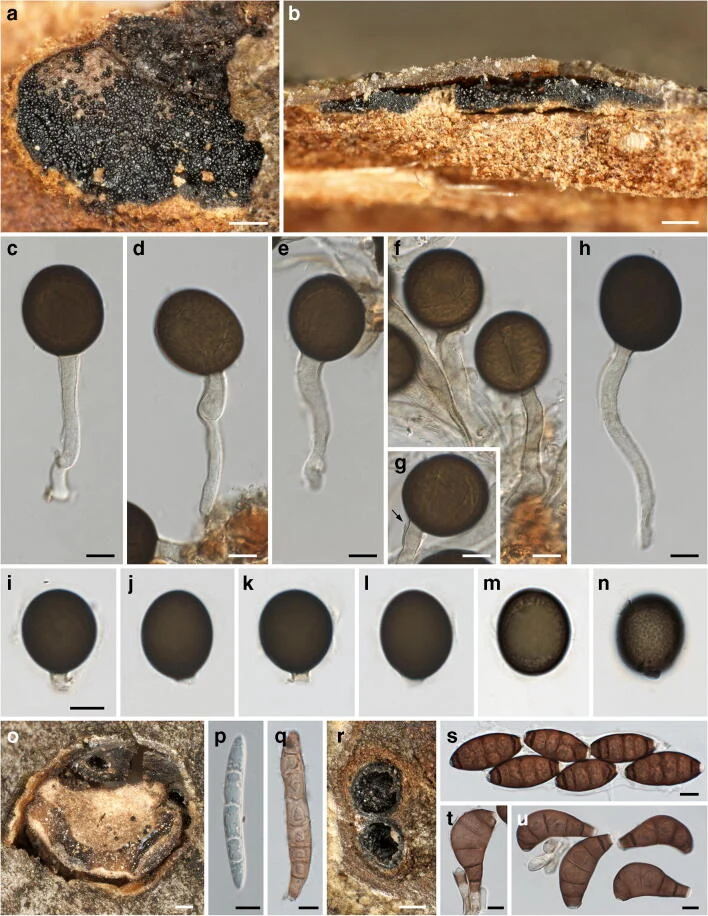
Mycosphaerangium tetrasporum, asexual morph ((a – h) GZU 000335720, isotype; (i – q) Lavoie; (r – u) GZU 000335639, lectotype). (a) Conidiomata in face view after removal of cortical layer. (b) Conidioma in vertical section. (c – h) Mature conidia on conidiogenous cells; arrow denoting single annellation. (i – n) Conidia ((m) showing large oil drop, (n) verrucae on inner wall). (o – u) Stromata (o, r), ascospores (p, s) and conidia (q, t, u) of Coryneum spp. associated with M. tetrasporum. All mounts in 3% KOH and dead. Scale bars: (a, b, o, r) 200 μm; (c – n, p, q, s – u) 10 μm
Kredit dan penggunaan
© The Author(s) 2020
Ukuran dan format gambar disesuaikan tanpa pemotongan, retus, atau penambahan skala. Lisensi sumber dipertahankan.
Sumber profil
- [1] Mycosphaerangium and Neomelanconium (Cenangiaceae) are closest relatives: phylogenetic relationships, morphology and a new species — Mycosphaerangium tetrasporum
- [2] Catalogue of Life Base2026-09-11 — Mycosphaerangium tetrasporum
- [3] Dokumentasi visual — Mycosphaerangium tetrasporum
- [4] Dokumentasi visual — Mycosphaerangium tetrasporum
Rujukan halaman ini
Fungi. Mycosphaerangium tetrasporum. Rilis data fungi-2026-10-12-expansion-2. https://fungi-atlas.mgadib.chatgpt.site/jamur/mycosphaerangium-tetrasporum/.
Status: impor sumber; pemeriksaan editorial per profil belum selesai. Untuk klaim biologis, gunakan rujukan pada bagian terkait dan periksa konteks sumber aslinya.