Ciri dan struktur
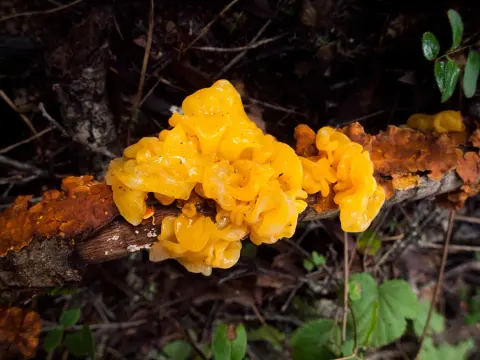
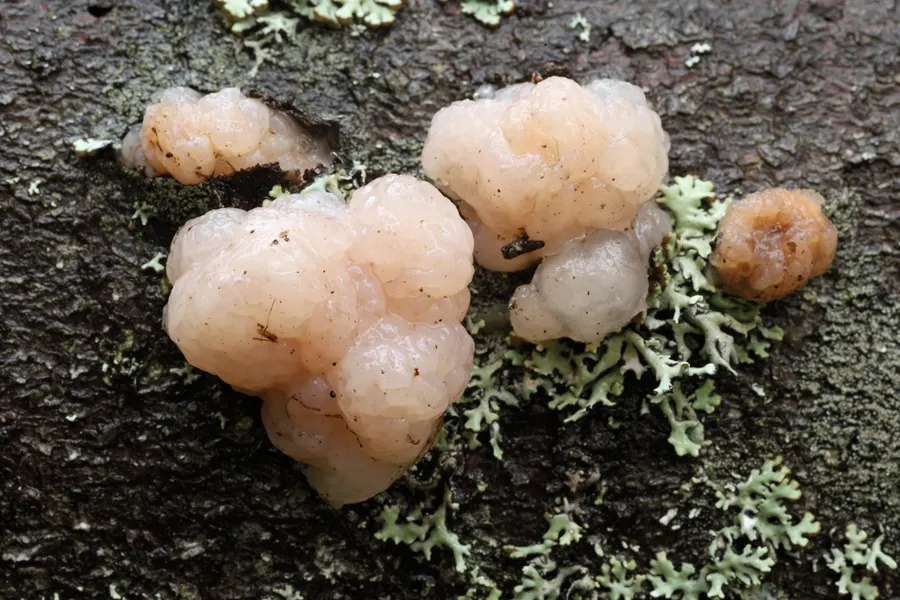
Fruit bodies are gelatinous, dull pale pink to yellowish pink, up to 3 cm (1 in) across, and brain-like (compact and densely folded) with a hard, whitish core when cut. Microscopically, the hyphae are clamped and occur within a dense gelatinous matrix. Haustorial cells arise on the hyphae, producing filaments that attach to and penetrate the unclamped hyphae of the host (abundant in the central core). The basidia are tremelloid (spherical to ellipsoid, with oblique to vertical septa), 13–20 by 12–17 μm, usually unstalked. The basidiospores are mostly subglobose, smooth, 6–11 by 5.5–9 μm, and germinate by hyphal tube or by yeast cells.
Habitat dan peran ekologis
Naematelia encephala is a parasite of Stereum sanguinolentum, growing on and often completely enveloping host basidiocarps. Following its host, fruit bodies are typically found on dead, attached or recently fallen branches of conifers. The species has a north temperate distribution and is known throughout North America, and Northern Eurasia. It has also been recorded from Australia.
- Habitat atau konteks temuan
- Informasi belum tersedia pada sumber rilis ini.
- Substrat
- Informasi belum tersedia pada sumber rilis ini.
- Peran atau konteks
- Belum dikategorikan pada rilis ini.
Reproduksi
Fruit bodies are gelatinous, dull pale pink to yellowish pink, up to 3 cm (1 in) across, and brain-like (compact and densely folded) with a hard, whitish core when cut. Microscopically, the hyphae are clamped and occur within a dense gelatinous matrix. Haustorial cells arise on the hyphae, producing filaments that attach to and penetrate the unclamped hyphae of the host (abundant in the central core). The basidia are tremelloid (spherical to ellipsoid, with oblique to vertical septa), 13–20 by 12–17 μm, usually unstalked. The basidiospores are mostly subglobose, smooth, 6–11 by 5.5–9 μm, and germinate by hyphal tube or by yeast cells.
Catatan identitas dan cakupan
- Nama diterima mengikuti Catalogue of Life Base2026-09-11; uraian mempertahankan konsep dan nama sumber aslinya.
- Original geographic, specimen and life-cycle scope retained; source import awaits individual editorial review.
- Impor dan terjemahan otomatis belum diperiksa editorial per profil. Struktur reproduktif yang disebutkan tidak membuktikan seluruh siklus hidup diketahui.
- Pengukuran pada uraian mengikuti spesimen, kultur, dan metode sumber; angka tidak diperluas ke semua populasi.
Catatan distribusi dalam narasi mengikuti sumbernya. Dokumentasi spesimen atau foto mengikuti catatan sumber. Bukti wilayah Indonesia dan penilaian konservasi tidak disimpulkan dari gambar.
Melihat dengan konteks
Dokumentasi Naematelia encephala menurut asosiasi foto pada record takson iNaturalist. Kredit: Ireen Trummer. Identitas mengikuti sumber; bukan penentuan spesimen independen.
- Jenis
- Fotografi
- Kredit
- (c) Ireen Trummer, some rights reserved (CC BY-SA)
- Lisensi
- CC BY-SA 4.0
- Sumber media
- Buka entri sumber
Dokumentasi tambahan
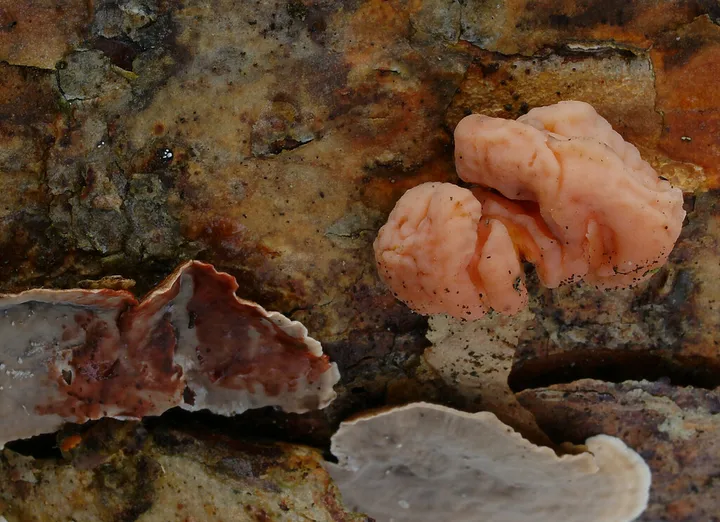
Foto yang diasosiasikan dengan Naematelia encephala pada iNaturalist. Identifikasi mengikuti sumber; bukan penentuan spesimen independen.
Kredit dan penggunaan
(c) Andreas Kunze, some rights reserved (CC BY-SA)
Ukuran dan format gambar disesuaikan tanpa pemotongan, retus, atau penambahan skala. Lisensi sumber dipertahankan.
Sumber profil
- [1] Naematelia encephala — Wikipedia (en)
- [2] Catalogue of Life Base2026-09-11 — Naematelia encephala
- [3] Dokumentasi visual — Naematelia encephala
- [4] Dokumentasi visual — Naematelia encephala
Rujukan halaman ini
Fungi. Naematelia encephala. Rilis data fungi-2026-10-12-expansion-2. https://fungi-atlas.mgadib.chatgpt.site/jamur/naematelia-encephala/.
Status: impor sumber; pemeriksaan editorial per profil belum selesai. Untuk klaim biologis, gunakan rujukan pada bagian terkait dan periksa konteks sumber aslinya.