01 / Morfologi

Ciri dan struktur

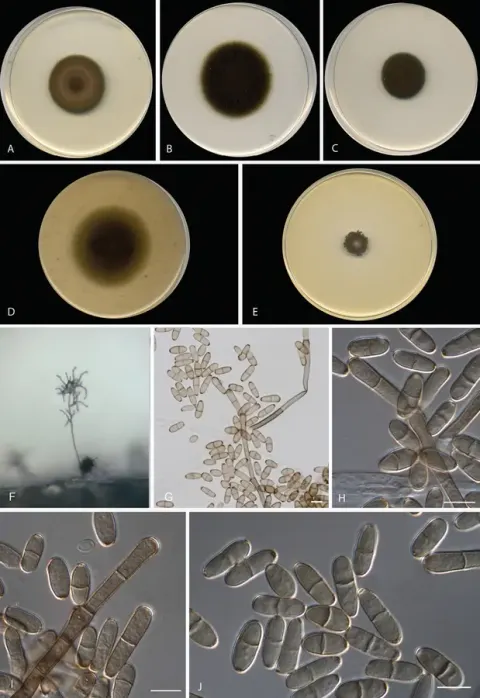
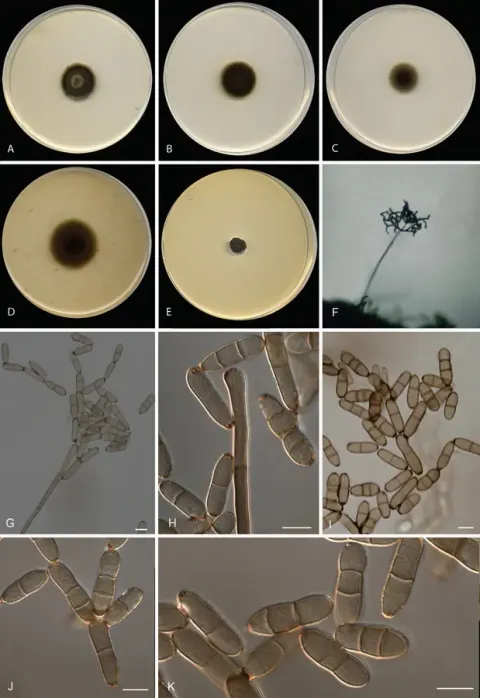
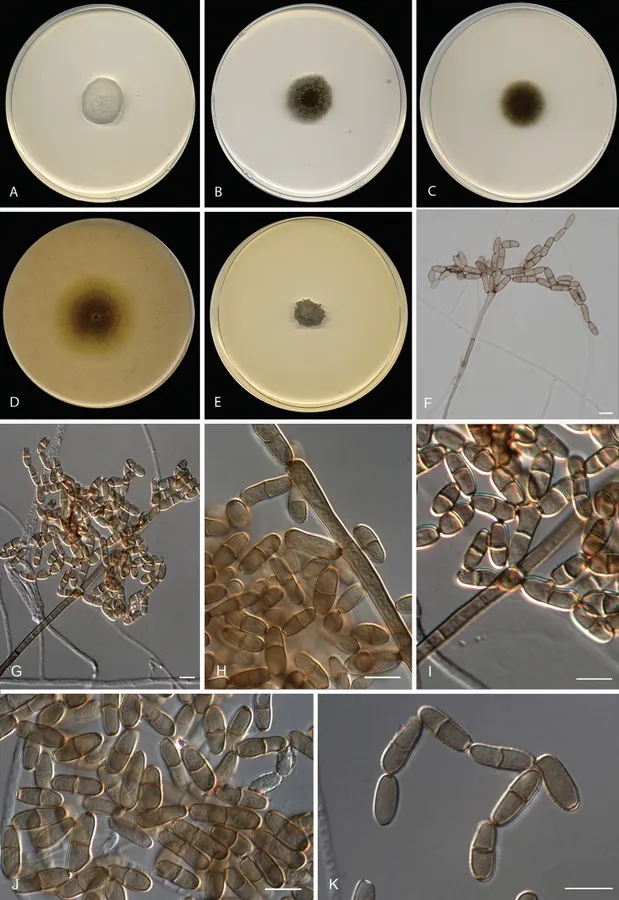
Mycelium superficial and immersed, composed of septate, branched, smooth to verruculose, hyaline to pale brown hyphae of 1–3 μm wide. Conidiophores semi-macronematous to macronematous, mononematous, erect or slightly flexuous, branched or unbranched, up to 11-septate, cylindrical, up to 385 μm long, 3–4 μm wide, brown, usually darker toward the base, smooth to verrucose. Conidiogenous terminal and intercalary, mostly cylindrical, 8–38 × 3–4(–5) μm, with 1–4 pores. Ramoconidia 0–1-septate, with up to 3 terminal and lateral pores, pale brown, smooth to verruculose, mostly cylindrical, (11–)15–17(–21) × 3–4 μm. Conidia catenate, with up to 10 conidia in the terminal unbranched part, (0–)1-septate, usually not constricted at the septum, pale brown, verruculose to verrucose, ellipsoidal, doliiform or subcylindrical with more or less rounded ends, 4–15 × 3–5 μm. (14 d at 25 °C). Colonies on PDA reaching 22 mm diam., convex, slightly convoluted at the centre, pastel grey to white (1C1/1A1), aerial mycelium scarce, with slightly fimbriate margin; reverse olive brown to yellowish-brown (4D3/3A2). On PCA attaining 23 mm diam., flat, olive brown to greyish-beige (4F8/4C2), aerial mycelium scarce, slightly fimbriate margin; reverse greyish-beige to brownish-grey (4C2/4D2). On OA reaching 40 mm diam., flat, granular, yellowish-brown to reddish-yellow (5E8/4B7), aerial mycelium scarce, with a regular margin; reverse olive brown to yellowish-brown (4D8/4B7). On SNA attaining 24 mm diam., flat, slightly granular, olive brown to grey (4F8/4B1), aerial mycelium scarce, with fimbriate margin; reverse yellowish-brown (5F7/5E4).

Sebagian uraian ditampilkan dalam bahasa sumber; terjemahannya belum tersedia atau belum lolos pemeriksaan.

Rujukan: [1]

Pengukuran mengikuti objek, spesimen atau kultur, dan metode yang disebutkan sumber. Baca uraian asli untuk konteks lengkap.

02 / Kehidupan

Habitat dan peran ekologis

(14 d at 25 °C). Colonies on PDA reaching 22 mm diam., convex, slightly convoluted at the centre, pastel grey to white (1C1/1A1), aerial mycelium scarce, with slightly fimbriate margin; reverse olive brown to yellowish-brown (4D3/3A2). On PCA attaining 23 mm diam., flat, olive brown to greyish-beige (4F8/4C2), aerial mycelium scarce, slightly fimbriate margin; reverse greyish-beige to brownish-grey (4C2/4D2). On OA reaching 40 mm diam., flat, granular, yellowish-brown to reddish-yellow (5E8/4B7), aerial mycelium scarce, with a regular margin; reverse olive brown to yellowish-brown (4D8/4B7). On SNA attaining 24 mm diam., flat, slightly granular, olive brown to grey (4F8/4B1), aerial mycelium scarce, with fimbriate margin; reverse yellowish-brown (5F7/5E4). On MEA reaching 11–15 mm diam., umbonate, slightly cerebriform towards the periphery, velvety, olive grey (3E2), with irregular margin; reverse olive grey (3E2). Although LSU sequences of N. mali (CBS 139.95 and FMR 17003) were very similar to those of N. michoacanensis (FMR 16098) and N. tarraconensis (FMR 16234), ITS regions showed a similarity of 96.2% (identities = 441/458, gaps 2/458 (0 %)) with respect to N. michoacanensis and of 92.3% (identities = 423/458, gaps 1/458 (0%)) with respect to N. tarraconensis.

Sebagian uraian ditampilkan dalam bahasa sumber; terjemahannya belum tersedia atau belum lolos pemeriksaan.

Rujukan: [1]

Habitat atau konteks temuan
kultur yang didokumentasikan
Substrat
Informasi belum tersedia pada sumber rilis ini.
Peran atau konteks
Belum dikategorikan pada rilis ini.
Temukan hubungan serupa
03 / Siklus hidup

Reproduksi

Mycelium superficial and immersed, composed of septate, branched, smooth to verruculose, hyaline to pale brown hyphae of 1–3 μm wide. Conidiophores semi-macronematous to macronematous, mononematous, erect or slightly flexuous, branched or unbranched, up to 11-septate, cylindrical, up to 385 μm long, 3–4 μm wide, brown, usually darker toward the base, smooth to verrucose. Conidiogenous terminal and intercalary, mostly cylindrical, 8–38 × 3–4(–5) μm, with 1–4 pores. Ramoconidia 0–1-septate, with up to 3 terminal and lateral pores, pale brown, smooth to verruculose, mostly cylindrical, (11–)15–17(–21) × 3–4 μm. Conidia catenate, with up to 10 conidia in the terminal unbranched part, (0–)1-septate, usually not constricted at the septum, pale brown, verruculose to verrucose, ellipsoidal, doliiform or subcylindrical with more or less rounded ends, 4–15 × 3–5 μm.

Sebagian uraian ditampilkan dalam bahasa sumber; terjemahannya belum tersedia atau belum lolos pemeriksaan.

Rujukan: [1]

04 / Batas informasi

Catatan identitas dan cakupan

  • Nama diterima mengikuti Catalogue of Life Base2026-09-11; uraian mempertahankan konsep dan nama sumber aslinya.
  • Preserve original treatment localities, hosts and substrate scope. Materials examined describe documented specimens, not the full global range.
  • Impor dan terjemahan otomatis belum diperiksa editorial per profil. Struktur reproduktif yang disebutkan tidak membuktikan seluruh siklus hidup diketahui.
  • Pengukuran pada uraian mengikuti spesimen, kultur, dan metode sumber; angka tidak diperluas ke semua populasi.

Catatan distribusi dalam narasi mengikuti sumbernya. Dokumentasi spesimen atau foto mengikuti catatan sumber. Bukti wilayah Indonesia dan penilaian konservasi tidak disimpulkan dari gambar.

05 / Dokumentasi

Melihat dengan konteks

Neodendryphiella mali sp. nov. (ex-type CBS 139.95). A–E Colonies on A PDA B PCA C SNA D OA E MEA at 25 °C after 14 d F–K Conidiophores and conidia. Scale bars: 10 µm (F–K).

Jenis
Pelat ilmiah
Kredit
Isabel Iturrieta-González, Josepa Gené, Josep Guarro, Rafael F. Castañeda-Ruiz, Dania García
Lisensi
CC BY 4.0
Sumber media
Buka entri sumber

Gambar menunjukkan objek menurut identifikasi sumber, bukan verifikasi independen spesimen oleh Fungi. Tidak ada skala baru yang ditambahkan.

06 / Rujukan

Sumber profil

  1. [1] Neodendryphiella, a novel genus of the Dictyosporiaceae (Pleosporales) — Neodendryphiella maliBagian sumber: PMC6108305_section_12
    Tanggal penghimpunan sumber: 2026-10-12
    Teks sumber: CC BY 4.0 · Iturrieta-Gonzalez, Isabel & Gene, Josepa & Guarro, Josep
  2. [2] Catalogue of Life Base2026-09-11 — Neodendryphiella maliBagian sumber: ColDP NameUsage.tsv ID 7487N; accepted species; source 2073
    Tanggal penghimpunan sumber: 2026-10-12
  3. [3] Dokumentasi visual — Neodendryphiella maliBagian sumber: Individual media record; identification follows the source, not independent determination
    Tanggal penghimpunan sumber: 2026-10-12
    Media sumber: CC BY 4.0 · Isabel Iturrieta-González, Josepa Gené, Josep Guarro, Rafael F. Castañeda-Ruiz, Dania García

Adaptasi teks: CC BY 4.0. Iturrieta-Gonzalez, Isabel & Gene, Josepa & Guarro, Josep — Neodendryphiella, a novel genus of the Dictyosporiaceae (Pleosporales) — Neodendryphiella mali

Uraian asli dan riwayat sumber

Riwayat atau halaman sumber

Ringkasan sumber

Mycelium superficial and immersed, composed of septate, branched, smooth to verruculose, hyaline to pale brown hyphae of 1–3 μm wide. Conidiophores semi-macronematous to macronematous, mononematous, erect or slightly flexuous, branched or unbranched, up to 11-septate, cylindrical, up to 385 μm long, 3–4 μm wide, brown, usually darker toward the base, smooth to verrucose. Conidiogenous terminal and intercalary, mostly cylindrical, 8–38 × 3–4(–5) μm, with 1–4 pores. Ramoconidia 0–1-septate, with up to 3 terminal and lateral pores, pale brown, smooth to verruculose, mostly cylindrical, (11–)15–17(–21) × 3–4 μm.

Revisi sumber

Morfologi sumber

Mycelium superficial and immersed, composed of septate, branched, smooth to verruculose, hyaline to pale brown hyphae of 1–3 μm wide. Conidiophores semi-macronematous to macronematous, mononematous, erect or slightly flexuous, branched or unbranched, up to 11-septate, cylindrical, up to 385 μm long, 3–4 μm wide, brown, usually darker toward the base, smooth to verrucose. Conidiogenous terminal and intercalary, mostly cylindrical, 8–38 × 3–4(–5) μm, with 1–4 pores. Ramoconidia 0–1-septate, with up to 3 terminal and lateral pores, pale brown, smooth to verruculose, mostly cylindrical, (11–)15–17(–21) × 3–4 μm. Conidia catenate, with up to 10 conidia in the terminal unbranched part, (0–)1-septate, usually not constricted at the septum, pale brown, verruculose to verrucose, ellipsoidal, doliiform or subcylindrical with more or less rounded ends, 4–15 × 3–5 μm. (14 d at 25 °C). Colonies on PDA reaching 22 mm diam., convex, slightly convoluted at the centre, pastel grey to white (1C1/1A1), aerial mycelium scarce, with slightly fimbriate margin; reverse olive brown to yellowish-brown (4D3/3A2). On PCA attaining 23 mm diam., flat, olive brown to greyish-beige (4F8/4C2), aerial mycelium scarce, slightly fimbriate margin; reverse greyish-beige to brownish-grey (4C2/4D2). On OA reaching 40 mm diam., flat, granular, yellowish-brown to reddish-yellow (5E8/4B7), aerial mycelium scarce, with a regular margin; reverse olive brown to yellowish-brown (4D8/4B7). On SNA attaining 24 mm diam., flat, slightly granular, olive brown to grey (4F8/4B1), aerial mycelium scarce, with fimbriate margin; reverse yellowish-brown (5F7/5E4).

Revisi sumber

Ekologi sumber

(14 d at 25 °C). Colonies on PDA reaching 22 mm diam., convex, slightly convoluted at the centre, pastel grey to white (1C1/1A1), aerial mycelium scarce, with slightly fimbriate margin; reverse olive brown to yellowish-brown (4D3/3A2). On PCA attaining 23 mm diam., flat, olive brown to greyish-beige (4F8/4C2), aerial mycelium scarce, slightly fimbriate margin; reverse greyish-beige to brownish-grey (4C2/4D2). On OA reaching 40 mm diam., flat, granular, yellowish-brown to reddish-yellow (5E8/4B7), aerial mycelium scarce, with a regular margin; reverse olive brown to yellowish-brown (4D8/4B7). On SNA attaining 24 mm diam., flat, slightly granular, olive brown to grey (4F8/4B1), aerial mycelium scarce, with fimbriate margin; reverse yellowish-brown (5F7/5E4). On MEA reaching 11–15 mm diam., umbonate, slightly cerebriform towards the periphery, velvety, olive grey (3E2), with irregular margin; reverse olive grey (3E2). Although LSU sequences of N. mali (CBS 139.95 and FMR 17003) were very similar to those of N. michoacanensis (FMR 16098) and N. tarraconensis (FMR 16234), ITS regions showed a similarity of 96.2% (identities = 441/458, gaps 2/458 (0 %)) with respect to N. michoacanensis and of 92.3% (identities = 423/458, gaps 1/458 (0%)) with respect to N. tarraconensis.

Revisi sumber

Struktur reproduksi sumber

Mycelium superficial and immersed, composed of septate, branched, smooth to verruculose, hyaline to pale brown hyphae of 1–3 μm wide. Conidiophores semi-macronematous to macronematous, mononematous, erect or slightly flexuous, branched or unbranched, up to 11-septate, cylindrical, up to 385 μm long, 3–4 μm wide, brown, usually darker toward the base, smooth to verrucose. Conidiogenous terminal and intercalary, mostly cylindrical, 8–38 × 3–4(–5) μm, with 1–4 pores. Ramoconidia 0–1-septate, with up to 3 terminal and lateral pores, pale brown, smooth to verruculose, mostly cylindrical, (11–)15–17(–21) × 3–4 μm. Conidia catenate, with up to 10 conidia in the terminal unbranched part, (0–)1-septate, usually not constricted at the septum, pale brown, verruculose to verrucose, ellipsoidal, doliiform or subcylindrical with more or less rounded ends, 4–15 × 3–5 μm.

Revisi sumber

Rujukan halaman ini

Fungi. Neodendryphiella mali. Rilis data fungi-2026-10-12-expansion-2. https://fungi-atlas.mgadib.chatgpt.site/jamur/neodendryphiella-mali/.

Status: impor sumber; pemeriksaan editorial per profil belum selesai. Untuk klaim biologis, gunakan rujukan pada bagian terkait dan periksa konteks sumber aslinya.