01 / Morfologi

Ciri dan struktur

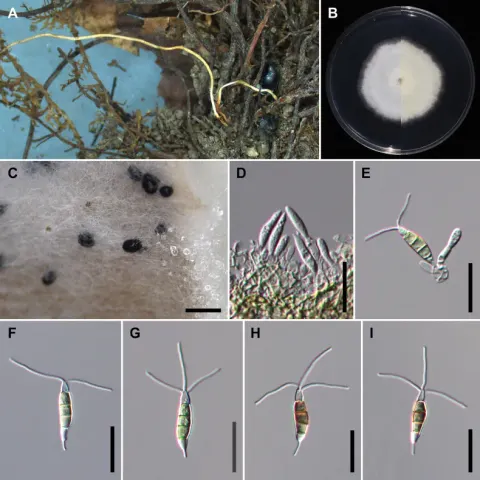
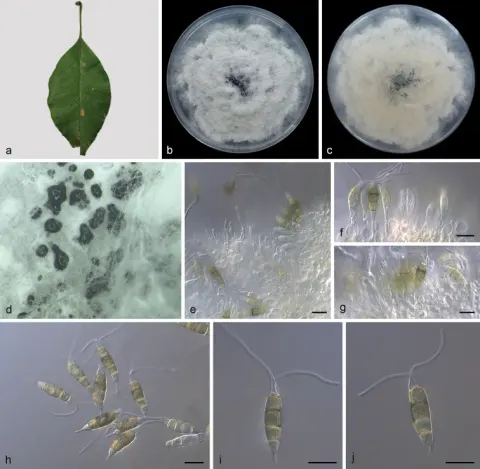
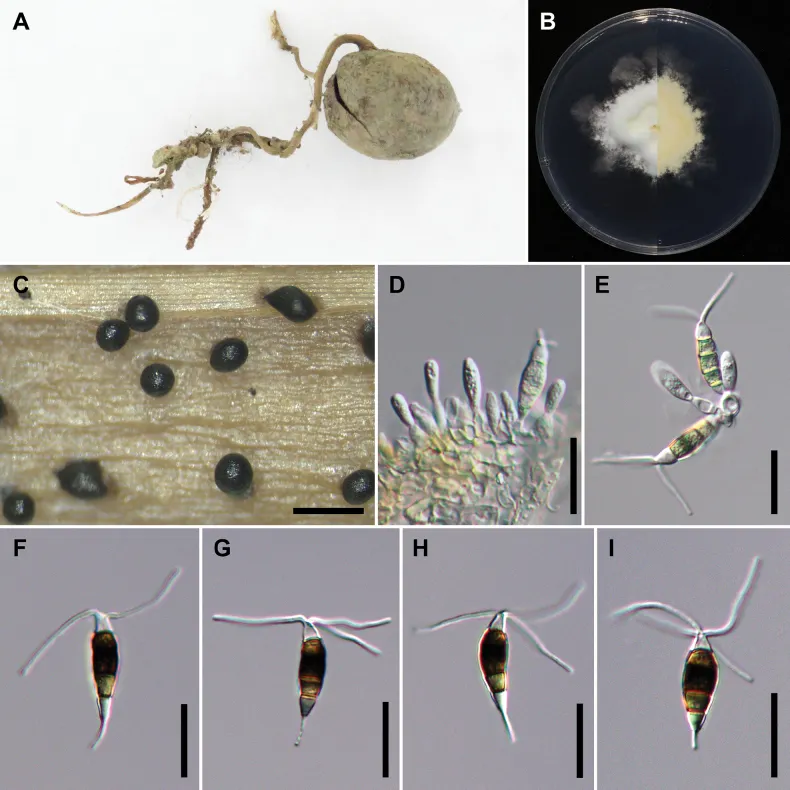
On carnation leaves (Dianthus caryophyllus) supplanted on WA (NTUPPMCC 18-166). Sexual morph was not observed in culture. Asexual morph: Conidiomata acervular, globose, semi-immersed, solitary or gregarious, 50–250 μm diam.; oozing globose, black conidial masses. Conidiophores obclavate to subcylindrical, hyaline, smooth, annelidic, indistinct and frequently merged to conidiogenous cells. Conidiogenous cells ampulliform to fusiform, hyaline or sometimes pale brown, smooth, (2.1–)2.9–4.5(–5.2) × (3.8–)5.5–8.7(–10.8) μm, x– ± SD = 3.7 ± 0.8 × 7.1 ± 1.6 μm. Conidia fusoid, straight or slightly curved, 4-septate, smooth, (5.5–)6.3–7.3(–7.8) × (22.1–)23.5–27.4(–29.4) μm, x– ± SD = 6.8 ± 0.5 × 25.4 ± 2 μm, bearing appendages; basal cell obconic with a truncate base, hyaline, thin-walled, (3.6–)4.6–5.8(–6.6) μm long, x– ± SD = 5.2 ± 0.6 μm; three median cells doliiform to subcylindrical, versicoloured, septa darker than the rest of the cell, thick-walled, the first median cell from base pale brown, (4.1–)4.4–5.7(–6.1) μm long (x– ± SD = 5.1 ± 0.6 μm), the second median cell medium to dark brown, (4.1–)4.7–5.9(–6.4) μm long (x– ± SD = 5.3 ± 0.6 μm), the third median cell medium to dark brown, (2.9–)4.6–6.1(–6.6) μm long (x– ± SD = 5.3 ± 0.7 μm), together (13.2–)14.4–17(–18.1) μm long (x– ± SD = 15.7 ± 1.3 μm); apical cell conical to subcylindrical with a truncate or acute apex, hyaline, thick-walled, (3.5–)4.1–5(–5.4) μm long (x– ± SD = 4.5 ± 0.4 μm). Appendages tubular, hyaline, straight or slightly bent, apical appendage 2–4 (mostly 3), unbranched, (16.3–)21.0–27.0(–30.1) μm long (x– ± SD = 24.0 ± 3.0 μm), basal appendage single, centric, unbranched, (4–)6.5–9.6(–10.3) μm long (x– ± SD = 8.1 ± 1.5 μm).

Sebagian uraian ditampilkan dalam bahasa sumber; terjemahannya belum tersedia atau belum lolos pemeriksaan.

Rujukan: [1]

Pengukuran mengikuti objek, spesimen atau kultur, dan metode yang disebutkan sumber. Baca uraian asli untuk konteks lengkap.

02 / Kehidupan

Habitat dan peran ekologis

Colonies on PDA reaching 46.25 mm diam. on average after culturing at 25 °C in the dark for seven days, filamentous to circular, with slightly undulate edge, aerial mycelium dense, white to yellowish; reverse yellowish.

Sebagian uraian ditampilkan dalam bahasa sumber; terjemahannya belum tersedia atau belum lolos pemeriksaan.

Rujukan: [1]

Habitat atau konteks temuan
kultur yang didokumentasikan
Substrat
Informasi belum tersedia pada sumber rilis ini.
Peran atau konteks
Belum dikategorikan pada rilis ini.
Temukan hubungan serupa
03 / Siklus hidup

Reproduksi

On carnation leaves (Dianthus caryophyllus) supplanted on WA (NTUPPMCC 18-166). Sexual morph was not observed in culture. Asexual morph: Conidiomata acervular, globose, semi-immersed, solitary or gregarious, 50–250 μm diam.; oozing globose, black conidial masses. Conidiophores obclavate to subcylindrical, hyaline, smooth, annelidic, indistinct and frequently merged to conidiogenous cells. Conidiogenous cells ampulliform to fusiform, hyaline or sometimes pale brown, smooth, (2.1–)2.9–4.5(–5.2) × (3.8–)5.5–8.7(–10.8) μm, x– ± SD = 3.7 ± 0.8 × 7.1 ± 1.6 μm. Conidia fusoid, straight or slightly curved, 4-septate, smooth, (5.5–)6.3–7.3(–7.8) × (22.1–)23.5–27.4(–29.4) μm, x– ± SD = 6.8 ± 0.5 × 25.4 ± 2 μm, bearing appendages; basal cell obconic with a truncate base, hyaline, thin-walled, (3.6–)4.6–5.8(–6.6) μm long, x– ± SD = 5.2 ± 0.6 μm; three median cells doliiform to subcylindrical, versicoloured, septa darker than the rest of the cell, thick-walled, the first median cell from base pale brown, (4.1–)4.4–5.7(–6.1) μm long (x– ± SD = 5.1 ± 0.6 μm), the second median cell medium to dark brown, (4.1–)4.7–5.9(–6.4) μm long (x– ± SD = 5.3 ± 0.6 μm), the third median cell medium to dark brown, (2.9–)4.6–6.1(–6.6) μm long (x– ± SD = 5.3 ± 0.7 μm), together (13.2–)14.4–17(–18.1) μm long (x– ± SD = 15.7 ± 1.3 μm); apical cell conical to subcylindrical with a truncate or acute apex, hyaline, thick-walled, (3.5–)4.1–5(–5.4) μm long (x– ± SD = 4.5 ± 0.4 μm).

Sebagian uraian ditampilkan dalam bahasa sumber; terjemahannya belum tersedia atau belum lolos pemeriksaan.

Rujukan: [1]

04 / Batas informasi

Catatan identitas dan cakupan

  • Nama diterima mengikuti Catalogue of Life Base2026-09-11; uraian mempertahankan konsep dan nama sumber aslinya.
  • Preserve original treatment localities, hosts and substrate scope. Materials examined describe documented specimens, not the full global range.
  • Impor dan terjemahan otomatis belum diperiksa editorial per profil. Struktur reproduktif yang disebutkan tidak membuktikan seluruh siklus hidup diketahui.
  • Pengukuran pada uraian mengikuti spesimen, kultur, dan metode sumber; angka tidak diperluas ke semua populasi.

Catatan distribusi dalam narasi mengikuti sumbernya. Dokumentasi spesimen atau foto mengikuti catatan sumber. Bukti wilayah Indonesia dan penilaian konservasi tidak disimpulkan dari gambar.

05 / Dokumentasi

Melihat dengan konteks

Neopestalotiopsis camelliae-oleiferae (NTUPPMCC 18-166 = CD08) A the original habitat of Neopestalotiopsis camelliae-oleiferae; the stroma of Tolypocladium sp. hyperparasitic on an ascocarps of Elaphomyces sp. (Ascomycota) B top view (left) and bottom view (right) of the colony on potato dextrose agar (PDA) after incubation for seven days C conidiomata on carnation leaf D, E conidiogenous cells and immature conidia F–I conidia. Scale bars: 250 μm (C); 20 μm (D–I).

Jenis
Pelat ilmiah
Kredit
Sheng-Yu Hsu, Yuan-Cheng Xu, Yu-Chen Lin, Wei-Yu Chuang, Shiou-Ruei Lin, Marc Stadler, Narumon Tangthirasunun, Ratchadawan Cheewangkoon, Hind A. AL-Shwaiman, Abdallah M. Elgorban, Hiran A. Ariyawansa
Lisensi
CC BY 4.0
Sumber media
Buka entri sumber

Gambar menunjukkan objek menurut identifikasi sumber, bukan verifikasi independen spesimen oleh Fungi. Tidak ada skala baru yang ditambahkan.

06 / Rujukan

Sumber profil

  1. [1] Hidden diversity of Pestalotiopsis and Neopestalotiopsis (Amphisphaeriales, Sporocadaceae) species allied with the stromata of entomopathogenic fungi in Taiwan — Neopestalotiopsis camelliae-oleiferaeBagian sumber: PMC10851163_section_39
    Tanggal penghimpunan sumber: 2026-10-12
    Teks sumber: CC BY 4.0 · Hsu SY, Xu YC, Lin YC, Chuang WY, Lin SR, Stadler M, Tangthirasunun N, Cheewangkoon R, Al-Shwaiman HA, Elgorban AM, Ariyawansa HA.
  2. [2] Catalogue of Life Base2026-09-11 — Neopestalotiopsis camelliae-oleiferaeBagian sumber: ColDP NameUsage.tsv ID B2T6R; accepted species; source 2073
    Tanggal penghimpunan sumber: 2026-10-12
  3. [3] Dokumentasi visual — Neopestalotiopsis camelliae-oleiferaeBagian sumber: Individual media record; identification follows the source, not independent determination
    Tanggal penghimpunan sumber: 2026-10-12
    Media sumber: CC BY 4.0 · Sheng-Yu Hsu, Yuan-Cheng Xu, Yu-Chen Lin, Wei-Yu Chuang, Shiou-Ruei Lin, Marc Stadler, Narumon Tangthirasunun, Ratchadawan Cheewangkoon, Hind A. AL-Shwaiman, Abdallah M. Elgorban, Hiran A. Ariyawansa

Adaptasi teks: CC BY 4.0. Hsu SY, Xu YC, Lin YC, Chuang WY, Lin SR, Stadler M, Tangthirasunun N, Cheewangkoon R, Al-Shwaiman HA, Elgorban AM, Ariyawansa HA. — Hidden diversity of Pestalotiopsis and Neopestalotiopsis (Amphisphaeriales, Sporocadaceae) species allied with the stromata of entomopathogenic fungi in Taiwan — Neopestalotiopsis camelliae-oleiferae

Uraian asli dan riwayat sumber

Riwayat atau halaman sumber

Ringkasan sumber

On carnation leaves (Dianthus caryophyllus) supplanted on WA (NTUPPMCC 18-166). Sexual morph was not observed in culture. Asexual morph: Conidiomata acervular, globose, semi-immersed, solitary or gregarious, 50–250 μm diam.; oozing globose, black conidial masses. Conidiophores obclavate to subcylindrical, hyaline, smooth, annelidic, indistinct and frequently merged to conidiogenous cells. Conidiogenous cells ampulliform to fusiform, hyaline or sometimes pale brown, smooth, (2.1–)2.9–4.5(–5.2) × (3.8–)5.5–8.7(–10.8) μm, x– ± SD = 3.7 ± 0.8 × 7.1 ± 1.6 μm.

Revisi sumber

Morfologi sumber

On carnation leaves (Dianthus caryophyllus) supplanted on WA (NTUPPMCC 18-166). Sexual morph was not observed in culture. Asexual morph: Conidiomata acervular, globose, semi-immersed, solitary or gregarious, 50–250 μm diam.; oozing globose, black conidial masses. Conidiophores obclavate to subcylindrical, hyaline, smooth, annelidic, indistinct and frequently merged to conidiogenous cells. Conidiogenous cells ampulliform to fusiform, hyaline or sometimes pale brown, smooth, (2.1–)2.9–4.5(–5.2) × (3.8–)5.5–8.7(–10.8) μm, x– ± SD = 3.7 ± 0.8 × 7.1 ± 1.6 μm. Conidia fusoid, straight or slightly curved, 4-septate, smooth, (5.5–)6.3–7.3(–7.8) × (22.1–)23.5–27.4(–29.4) μm, x– ± SD = 6.8 ± 0.5 × 25.4 ± 2 μm, bearing appendages; basal cell obconic with a truncate base, hyaline, thin-walled, (3.6–)4.6–5.8(–6.6) μm long, x– ± SD = 5.2 ± 0.6 μm; three median cells doliiform to subcylindrical, versicoloured, septa darker than the rest of the cell, thick-walled, the first median cell from base pale brown, (4.1–)4.4–5.7(–6.1) μm long (x– ± SD = 5.1 ± 0.6 μm), the second median cell medium to dark brown, (4.1–)4.7–5.9(–6.4) μm long (x– ± SD = 5.3 ± 0.6 μm), the third median cell medium to dark brown, (2.9–)4.6–6.1(–6.6) μm long (x– ± SD = 5.3 ± 0.7 μm), together (13.2–)14.4–17(–18.1) μm long (x– ± SD = 15.7 ± 1.3 μm); apical cell conical to subcylindrical with a truncate or acute apex, hyaline, thick-walled, (3.5–)4.1–5(–5.4) μm long (x– ± SD = 4.5 ± 0.4 μm). Appendages tubular, hyaline, straight or slightly bent, apical appendage 2–4 (mostly 3), unbranched, (16.3–)21.0–27.0(–30.1) μm long (x– ± SD = 24.0 ± 3.0 μm), basal appendage single, centric, unbranched, (4–)6.5–9.6(–10.3) μm long (x– ± SD = 8.1 ± 1.5 μm).

Revisi sumber

Ekologi sumber

Colonies on PDA reaching 46.25 mm diam. on average after culturing at 25 °C in the dark for seven days, filamentous to circular, with slightly undulate edge, aerial mycelium dense, white to yellowish; reverse yellowish.

Revisi sumber

Struktur reproduksi sumber

On carnation leaves (Dianthus caryophyllus) supplanted on WA (NTUPPMCC 18-166). Sexual morph was not observed in culture. Asexual morph: Conidiomata acervular, globose, semi-immersed, solitary or gregarious, 50–250 μm diam.; oozing globose, black conidial masses. Conidiophores obclavate to subcylindrical, hyaline, smooth, annelidic, indistinct and frequently merged to conidiogenous cells. Conidiogenous cells ampulliform to fusiform, hyaline or sometimes pale brown, smooth, (2.1–)2.9–4.5(–5.2) × (3.8–)5.5–8.7(–10.8) μm, x– ± SD = 3.7 ± 0.8 × 7.1 ± 1.6 μm. Conidia fusoid, straight or slightly curved, 4-septate, smooth, (5.5–)6.3–7.3(–7.8) × (22.1–)23.5–27.4(–29.4) μm, x– ± SD = 6.8 ± 0.5 × 25.4 ± 2 μm, bearing appendages; basal cell obconic with a truncate base, hyaline, thin-walled, (3.6–)4.6–5.8(–6.6) μm long, x– ± SD = 5.2 ± 0.6 μm; three median cells doliiform to subcylindrical, versicoloured, septa darker than the rest of the cell, thick-walled, the first median cell from base pale brown, (4.1–)4.4–5.7(–6.1) μm long (x– ± SD = 5.1 ± 0.6 μm), the second median cell medium to dark brown, (4.1–)4.7–5.9(–6.4) μm long (x– ± SD = 5.3 ± 0.6 μm), the third median cell medium to dark brown, (2.9–)4.6–6.1(–6.6) μm long (x– ± SD = 5.3 ± 0.7 μm), together (13.2–)14.4–17(–18.1) μm long (x– ± SD = 15.7 ± 1.3 μm); apical cell conical to subcylindrical with a truncate or acute apex, hyaline, thick-walled, (3.5–)4.1–5(–5.4) μm long (x– ± SD = 4.5 ± 0.4 μm).

Revisi sumber

Rujukan halaman ini

Fungi. Neopestalotiopsis camelliae-oleiferae. Rilis data fungi-2026-10-12-expansion-2. https://fungi-atlas.mgadib.chatgpt.site/jamur/neopestalotiopsis-camelliae-oleiferae/.

Status: impor sumber; pemeriksaan editorial per profil belum selesai. Untuk klaim biologis, gunakan rujukan pada bagian terkait dan periksa konteks sumber aslinya.