01 / Morfologi

Ciri dan struktur

Morphologically similar to the northern hemispheric Protoparmelia montagnei (Fr.) Poelt & Nimis, but mainly differing from it by the presence of alectoronic acid as major secondary metabolite in the medulla. The two species, P. montagnei and N. capensis, are also genetically not closely-related and belong to different genera. Thallus saxicolous, crustose, up to 8 cm wide, thin and areolate (in younger parts, up to 1 mm thick) to mainly thick and areolate, warted or subsquamulose (up to 2.2 mm thick), irregular or orbicular; surface light grey, pale to strong brown, with whitish mottled-fissured areas (by a locally strong mucilaginous epicortex), dull; delimited, or not, by a blackish hypothalline line. Areoles irregular, polygonal to rounded, up to 2 mm in diam., mainly slightly convex to irregular or flat, surface smooth to irregular, cracked or warted, marginal areoles sometimes lobe-like. Apothecia frequent, 1 to several per areolae, zeorine to lecanorine, immersed and nearly urceolate when young to adnate or sessile and constricted at the base when adult, rounded to irregular, up to 2 mm in diam.; disc brown to brown-black, dull, concave to flat or sometimes convex; thalline exciple persistent or excluded with age, concolorous with thallus to whitish (by a strong mucilaginous epicortex); proper exciple cupulate, up to 70–155 µm thick, coherent, hyphae mainly periclinal with strong mucilaginous walls, margins reduced in young apothecia. Hymenium hyaline to yellowish, coherent, 60–75 µm tall, in the margins somewhat fan-like (together with proper exciple) and exceeding the thalline exciple in adult apothecia; epihymenium light brown to brown, up to 15 µm tall, with few irregular granules; hypothecium and subhymenium hyaline to slightly yellowish, 25–70 µm thick.

Sebagian uraian ditampilkan dalam bahasa sumber; terjemahannya belum tersedia atau belum lolos pemeriksaan.

Rujukan: [1]

Pengukuran mengikuti objek, spesimen atau kultur, dan metode yang disebutkan sumber. Baca uraian asli untuk konteks lengkap.

02 / Kehidupan

Habitat dan peran ekologis

Only known from the type locality in the arid north-west of the Cape Region (South Africa), rich in succulent plants (succulent Karoo biomes, cf. Mucina and Rutherford 2006), growing on exposed sandstones next to the Atlantic coast.

Sebagian uraian ditampilkan dalam bahasa sumber; terjemahannya belum tersedia atau belum lolos pemeriksaan.

Rujukan: [1]

Habitat atau konteks temuan
Informasi belum tersedia pada sumber rilis ini.
Substrat
Informasi belum tersedia pada sumber rilis ini.
Peran atau konteks
Pembentuk liken
Temukan hubungan serupa
03 / Siklus hidup

Reproduksi

Thallus saxicolous, crustose, up to 8 cm wide, thin and areolate (in younger parts, up to 1 mm thick) to mainly thick and areolate, warted or subsquamulose (up to 2.2 mm thick), irregular or orbicular; surface light grey, pale to strong brown, with whitish mottled-fissured areas (by a locally strong mucilaginous epicortex), dull; delimited, or not, by a blackish hypothalline line. Areoles irregular, polygonal to rounded, up to 2 mm in diam., mainly slightly convex to irregular or flat, surface smooth to irregular, cracked or warted, marginal areoles sometimes lobe-like. Apothecia frequent, 1 to several per areolae, zeorine to lecanorine, immersed and nearly urceolate when young to adnate or sessile and constricted at the base when adult, rounded to irregular, up to 2 mm in diam.; disc brown to brown-black, dull, concave to flat or sometimes convex; thalline exciple persistent or excluded with age, concolorous with thallus to whitish (by a strong mucilaginous epicortex); proper exciple cupulate, up to 70–155 µm thick, coherent, hyphae mainly periclinal with strong mucilaginous walls, margins reduced in young apothecia.

Sebagian uraian ditampilkan dalam bahasa sumber; terjemahannya belum tersedia atau belum lolos pemeriksaan.

Rujukan: [1]

04 / Batas informasi

Catatan identitas dan cakupan

  • Nama diterima mengikuti Catalogue of Life Base2026-09-11; uraian mempertahankan konsep dan nama sumber aslinya.
  • Preserve original treatment localities, hosts and substrate scope. Materials examined describe documented specimens, not the full global range.
  • Impor dan terjemahan otomatis belum diperiksa editorial per profil. Struktur reproduktif yang disebutkan tidak membuktikan seluruh siklus hidup diketahui.
  • Pengukuran pada uraian mengikuti spesimen, kultur, dan metode sumber; angka tidak diperluas ke semua populasi.

Catatan distribusi dalam narasi mengikuti sumbernya. Dokumentasi spesimen atau foto mengikuti catatan sumber. Bukti wilayah Indonesia dan penilaian konservasi tidak disimpulkan dari gambar.

05 / Dokumentasi

Melihat dengan konteks

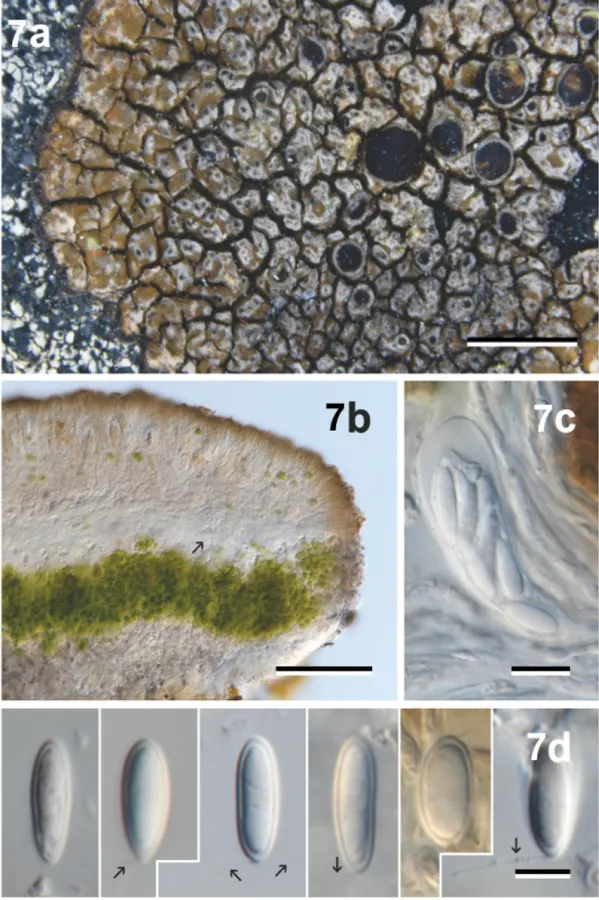
Neoprotoparmelia capensis, holotype Crespo, Divakar, Hawksworth, Amo & Lumbsch 63f (MAF-Lich. 19584). a Habit b Section through centre of apothecium, showing cupular proper exciple (arrow) c Ascus d Spores, showing setae (arrow). Scale bars: 2 mm (a), 100 µm (b), 10 µm (c), 5 µm (d).

Jenis
Pelat ilmiah
Kredit
Garima Singh, André ptroot, Víctor J. ico, Jürgen tte, Pradeep K. Divakar, Ana Crespo, Marcela Eugenia da Silva Cáceres, H. Thorsten Lumbsch, Imke Schmitt
Lisensi
CC BY 4.0
Sumber media
Buka entri sumber

Gambar menunjukkan objek menurut identifikasi sumber, bukan verifikasi independen spesimen oleh Fungi. Tidak ada skala baru yang ditambahkan.

06 / Rujukan

Sumber profil

  1. [1] Neoprotoparmelia gen. nov. and Maronina (Lecanorales, Protoparmelioideae): species description and generic delimitation using DNA barcodes and phenotypical characters — Neoprotoparmelia capensisBagian sumber: PMC6303283_section_48
    Tanggal penghimpunan sumber: 2026-10-12
    Teks sumber: CC BY 4.0 · Singh G, Ptroot A, Ico VJ, Tte J, Pradeep K Divakar, Crespo A, Cáceres MEDS, H Thorsten Lumbsch, Schmitt I.
  2. [2] Catalogue of Life Base2026-09-11 — Neoprotoparmelia capensisBagian sumber: ColDP NameUsage.tsv ID 7484R; accepted species; source 2073
    Tanggal penghimpunan sumber: 2026-10-12
  3. [3] Dokumentasi visual — Neoprotoparmelia capensisBagian sumber: Individual media record; identification follows the source, not independent determination
    Tanggal penghimpunan sumber: 2026-10-12
    Media sumber: CC BY 4.0 · Garima Singh, André ptroot, Víctor J. ico, Jürgen tte, Pradeep K. Divakar, Ana Crespo, Marcela Eugenia da Silva Cáceres, H. Thorsten Lumbsch, Imke Schmitt

Adaptasi teks: CC BY 4.0. Singh G, Ptroot A, Ico VJ, Tte J, Pradeep K Divakar, Crespo A, Cáceres MEDS, H Thorsten Lumbsch, Schmitt I. — Neoprotoparmelia gen. nov. and Maronina (Lecanorales, Protoparmelioideae): species description and generic delimitation using DNA barcodes and phenotypical characters — Neoprotoparmelia capensis

Uraian asli dan riwayat sumber

Riwayat atau halaman sumber

Ringkasan sumber

Morphologically similar to the northern hemispheric Protoparmelia montagnei (Fr.) Poelt & Nimis, but mainly differing from it by the presence of alectoronic acid as major secondary metabolite in the medulla. The two species, P. montagnei and N. capensis, are also genetically not closely-related and belong to different genera. Thallus saxicolous, crustose, up to 8 cm wide, thin and areolate (in younger parts, up to 1 mm thick) to mainly thick and areolate, warted or subsquamulose (up to 2.2 mm thick), irregular or orbicular; surface light grey, pale to strong brown, with whitish mottled-fissured areas (by a locally strong mucilaginous epicortex), dull; delimited, or not, by a blackish hypothalline line.

Revisi sumber

Morfologi sumber

Morphologically similar to the northern hemispheric Protoparmelia montagnei (Fr.) Poelt & Nimis, but mainly differing from it by the presence of alectoronic acid as major secondary metabolite in the medulla. The two species, P. montagnei and N. capensis, are also genetically not closely-related and belong to different genera. Thallus saxicolous, crustose, up to 8 cm wide, thin and areolate (in younger parts, up to 1 mm thick) to mainly thick and areolate, warted or subsquamulose (up to 2.2 mm thick), irregular or orbicular; surface light grey, pale to strong brown, with whitish mottled-fissured areas (by a locally strong mucilaginous epicortex), dull; delimited, or not, by a blackish hypothalline line. Areoles irregular, polygonal to rounded, up to 2 mm in diam., mainly slightly convex to irregular or flat, surface smooth to irregular, cracked or warted, marginal areoles sometimes lobe-like. Apothecia frequent, 1 to several per areolae, zeorine to lecanorine, immersed and nearly urceolate when young to adnate or sessile and constricted at the base when adult, rounded to irregular, up to 2 mm in diam.; disc brown to brown-black, dull, concave to flat or sometimes convex; thalline exciple persistent or excluded with age, concolorous with thallus to whitish (by a strong mucilaginous epicortex); proper exciple cupulate, up to 70–155 µm thick, coherent, hyphae mainly periclinal with strong mucilaginous walls, margins reduced in young apothecia. Hymenium hyaline to yellowish, coherent, 60–75 µm tall, in the margins somewhat fan-like (together with proper exciple) and exceeding the thalline exciple in adult apothecia; epihymenium light brown to brown, up to 15 µm tall, with few irregular granules; hypothecium and subhymenium hyaline to slightly yellowish, 25–70 µm thick.

Revisi sumber

Ekologi sumber

Only known from the type locality in the arid north-west of the Cape Region (South Africa), rich in succulent plants (succulent Karoo biomes, cf. Mucina and Rutherford 2006), growing on exposed sandstones next to the Atlantic coast.

Revisi sumber

Struktur reproduksi sumber

Thallus saxicolous, crustose, up to 8 cm wide, thin and areolate (in younger parts, up to 1 mm thick) to mainly thick and areolate, warted or subsquamulose (up to 2.2 mm thick), irregular or orbicular; surface light grey, pale to strong brown, with whitish mottled-fissured areas (by a locally strong mucilaginous epicortex), dull; delimited, or not, by a blackish hypothalline line. Areoles irregular, polygonal to rounded, up to 2 mm in diam., mainly slightly convex to irregular or flat, surface smooth to irregular, cracked or warted, marginal areoles sometimes lobe-like. Apothecia frequent, 1 to several per areolae, zeorine to lecanorine, immersed and nearly urceolate when young to adnate or sessile and constricted at the base when adult, rounded to irregular, up to 2 mm in diam.; disc brown to brown-black, dull, concave to flat or sometimes convex; thalline exciple persistent or excluded with age, concolorous with thallus to whitish (by a strong mucilaginous epicortex); proper exciple cupulate, up to 70–155 µm thick, coherent, hyphae mainly periclinal with strong mucilaginous walls, margins reduced in young apothecia.

Revisi sumber

Rujukan halaman ini

Fungi. Neoprotoparmelia capensis. Rilis data fungi-2026-10-12-expansion-2. https://fungi-atlas.mgadib.chatgpt.site/jamur/neoprotoparmelia-capensis/.

Status: impor sumber; pemeriksaan editorial per profil belum selesai. Untuk klaim biologis, gunakan rujukan pada bagian terkait dan periksa konteks sumber aslinya.