Ciri dan struktur
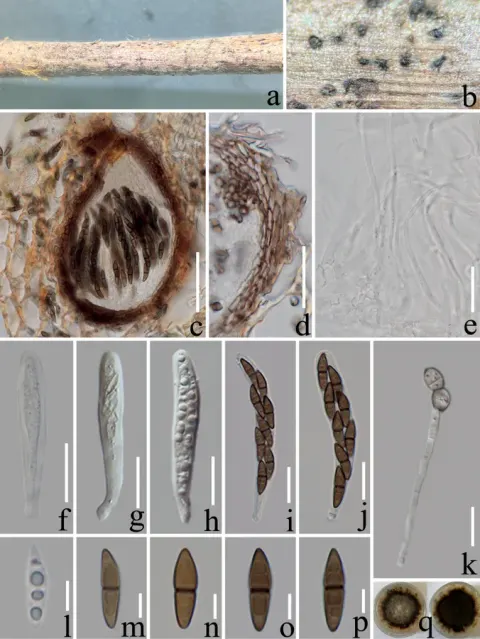
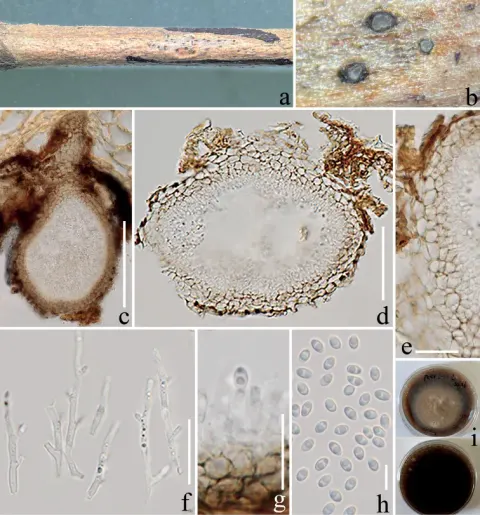
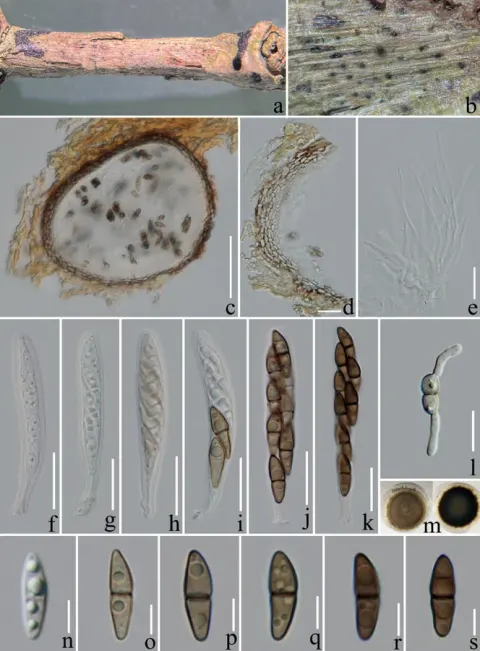
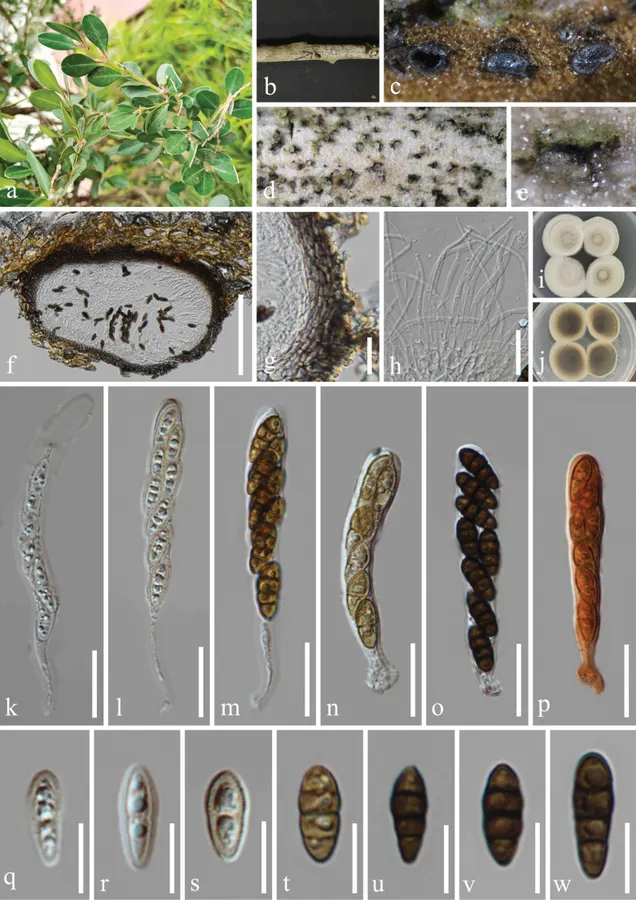
Saprobic on dead branches of Buxus sinica (Buxaceae). Sexual morph: Ascomata 204–326 μm wide, 140–220 μm high (x̅ = 248 × 187 μm, n = 20), solitary or gregarious, scattered, immersed to semi-immersed, with only ostiolar necks visible on the host surface, trigonoid, uniloculate, perithecioid, globose to subglobose, brown to dark brown, with an ostiole. Ostiole central or eccentric, brittle. Peridium 15–23 μm (x̅ = 18 μm, n = 20) composed of angular cells, consisting 4–5 layers, brown to dark brown thick-walled cells of outer layer, hyaline to subhyaline thin-walled cells of inner layer. Hamathecium 1–3 μm (x̅ = 2 μm, n = 20) wide, composed of numerous, filamentous, hyaline, aseptate or separate, rarely branched, smooth-walled pseudoparaphyses. Asci 57–103 × 8–11 μm (x̅ = 72.5 × 10 μm, n = 30), 8-spored, bitunicate, fissitunicate, clavate to long cylindric-clavate, short cylindrical pedicellate with a swollen base, apically rounded, with a minute ocular chamber. Ascospores 13–19 × 4.5–6 μm (x̅ = 14.5 × 5 μm, n = 50), 1–2-seriate, partially overlapping, fusoid to ellipsoid, tapering towards the blunt ends, or blunt at both ends, guttulate, smooth-walled, olivaceous to yellowish-brown when young, 1-septate; deeply constricted at septa, becoming 3-septate, brown to dark brown when mature, without appendages. Asexual morph: Undetermined. Ascospores germinated on PDA within 24 h, and germ tubes produced from basal cell. Colonies growing on PDA reached 32−33 mm in diameter after three weeks at 25 °C in dark, white in the whole colony from above, and slightly raised in the center, circular, flat, edge entire, margin well-defined; in reverse, grayish black in the center, off-white at the margin, the color gradually lightens from center to edge, no pigmentation on PDA.
Habitat dan peran ekologis
Saprobic on dead branches of Buxus sinica (Buxaceae). Sexual morph: Ascomata 204–326 μm wide, 140–220 μm high (x̅ = 248 × 187 μm, n = 20), solitary or gregarious, scattered, immersed to semi-immersed, with only ostiolar necks visible on the host surface, trigonoid, uniloculate, perithecioid, globose to subglobose, brown to dark brown, with an ostiole. Ostiole central or eccentric, brittle. Peridium 15–23 μm (x̅ = 18 μm, n = 20) composed of angular cells, consisting 4–5 layers, brown to dark brown thick-walled cells of outer layer, hyaline to subhyaline thin-walled cells of inner layer. Hamathecium 1–3 μm (x̅ = 2 μm, n = 20) wide, composed of numerous, filamentous, hyaline, aseptate or separate, rarely branched, smooth-walled pseudoparaphyses. Asci 57–103 × 8–11 μm (x̅ = 72.5 × 10 μm, n = 30), 8-spored, bitunicate, fissitunicate, clavate to long cylindric-clavate, short cylindrical pedicellate with a swollen base, apically rounded, with a minute ocular chamber. Ascospores 13–19 × 4.5–6 μm (x̅ = 14.5 × 5 μm, n = 50), 1–2-seriate, partially overlapping, fusoid to ellipsoid, tapering towards the blunt ends, or blunt at both ends, guttulate, smooth-walled, olivaceous to yellowish-brown when young, 1-septate; deeply constricted at septa, becoming 3-septate, brown to dark brown when mature, without appendages.
- Habitat atau konteks temuan
- Informasi belum tersedia pada sumber rilis ini.
- Substrat
- kayu
- Peran atau konteks
- Pengurai
Reproduksi
Saprobic on dead branches of Buxus sinica (Buxaceae). Sexual morph: Ascomata 204–326 μm wide, 140–220 μm high (x̅ = 248 × 187 μm, n = 20), solitary or gregarious, scattered, immersed to semi-immersed, with only ostiolar necks visible on the host surface, trigonoid, uniloculate, perithecioid, globose to subglobose, brown to dark brown, with an ostiole. Ostiole central or eccentric, brittle. Peridium 15–23 μm (x̅ = 18 μm, n = 20) composed of angular cells, consisting 4–5 layers, brown to dark brown thick-walled cells of outer layer, hyaline to subhyaline thin-walled cells of inner layer. Hamathecium 1–3 μm (x̅ = 2 μm, n = 20) wide, composed of numerous, filamentous, hyaline, aseptate or separate, rarely branched, smooth-walled pseudoparaphyses.
Catatan identitas dan cakupan
- Nama diterima mengikuti Catalogue of Life Base2026-09-11; uraian mempertahankan konsep dan nama sumber aslinya.
- Preserve original treatment localities, hosts and substrate scope. Materials examined describe documented specimens, not the full global range.
- Impor dan terjemahan otomatis belum diperiksa editorial per profil. Struktur reproduktif yang disebutkan tidak membuktikan seluruh siklus hidup diketahui.
- Pengukuran pada uraian mengikuti spesimen, kultur, dan metode sumber; angka tidak diperluas ke semua populasi.
Catatan distribusi dalam narasi mengikuti sumbernya. Dokumentasi spesimen atau foto mengikuti catatan sumber. Bukti wilayah Indonesia dan penilaian konservasi tidak disimpulkan dari gambar.
Melihat dengan konteks
Nigrograna magnoliae (HUEST 23.0203, new host record) a host Buxus sinica b branch of Buxus sinica c–e appearance of ascomata on host surface f vertical section through ascoma g peridium h hamathecium i, j colonies on PDA, above (i) and below (j) k–o asci p asci in Congo red q–w ascospores. Scale bars: 100 µm (f); 20 µm (g, h, k–p); 10 µm (q–w).
- Jenis
- Pelat ilmiah
- Kredit
- Hong-Zhi Du, Yu-Hang Lu, Ratchadawan Cheewangkoon, Jian-Kui Liu
- Lisensi
- CC BY 4.0
- Sumber media
- Buka entri sumber
Sumber profil
- [1] Morpho-phylogenetic evidence reveals novel species and new records of Nigrograna (Nigrogranaceae) associated with medicinal plants in Southwestern China — Nigrograna magnoliae
- [2] Catalogue of Life Base2026-09-11 — Nigrograna magnoliae
- [3] Dokumentasi visual — Nigrograna magnoliae
Rujukan halaman ini
Fungi. Nigrograna magnoliae. Rilis data fungi-2026-10-12-expansion-2. https://fungi-atlas.mgadib.chatgpt.site/jamur/nigrograna-magnoliae/.
Status: impor sumber; pemeriksaan editorial per profil belum selesai. Untuk klaim biologis, gunakan rujukan pada bagian terkait dan periksa konteks sumber aslinya.