Ciri dan struktur
Leaf spots amphigenous, subcircular to irregularly angular, 2–8 mm diam., reddish brown, later dark brown by abundant caespituli, finally sometimes greyish brown to blackish brown, margin indefinite. Caespituli amphigenous, greyish brown to dark brown. Mycelium mainly internal. Stromata small to well-developed, up to 48 μm diam., immersed in the mesophyll or in substomatal chambers, subcircular to irregular, brown to dark brown. Conidiophores in moderately dense to dense fascicles, arising from stromata, breaking through the adaxial epidermis of the leaves or penetrating through stomatal openings, or solitarily arising through stomatal openings, cylindrical, straight to sinuous or geniculate, conically truncate at the apex, unbranched, (12.5–)20–55.5(–58) × 5–7 μm, 1–3(–4)-septate, pale brown to brown, paler towards the apex. Conidiogenous loci 2.5 μm wide, thickened and darkened. Conidia solitary, cylindrical to long-obclavate with round apex, straight to curved, (14–)23–68(–80) × (5–)5.5–8(–9) μm, 2–6-septate, pale brown to olivaceous brown, base obconically truncate, 2–3 μm wide, hila thickened and darkened.
Habitat dan peran ekologis
On Arachis glabrata Benth., A. hypogaea (Fabaceae), known in tropical regions where the host is cultivated, including Afghanistan, Angola, Argentina, Australia, Azerbaijan, Bangladesh, Barbados, Benin, Bermuda, Bhutan, Bolivia, Brazil, Brunei, Burkina Faso, Cambodia, Canada, China, Cambodia, Cameroon, Chad, Colombia, Congo, Cuba, Dominican Republic, Egypt, EI Salvador, Ethiopia, Fiji, French Polynesia, Gabon, Gambia, Georgia, Ghana, Greece, Guam, Guatemala, Guinea, Guyana, Haiti, Honduras, Hong Kong, India, Indonesia, Iran, Iraq, Israel, Ivory Coast, Jamaica, Jordan, Kenya, Korea, Laos, Lesser Antilles, Liberia, Libya, Madagascar, Malawi, Malaysia, Mali, Mauritius, Mexico, Morocco, Mozambique, Myanmar, Nepal, New Caledonia, Nicaragua, Niger, Nigeria, Pakistan, Panama, Papua New Guinea, Paraguay, Peru, Philippines, Puerto Rico, Russia, Saint Vincent and the Grenadines, Senegal, Sierra Leone, Singapore, Solomon Islands, Somalia, South Africa, Spain, Sri Lanka, Sudan, Suriname, Taiwan, Tanzania, Thailand, Togo, Tonga, Trinidad and Tobago, Turkmenistan, Turkey, Uganda, Uruguay, USA, Uzbekistan, Venezuela, Vietnam, Zambia, Zimbabwe (Yen and Lim 1980; Hsieh and Goh 1990; Shin and Kim 2001; Crous and Braun 2003; Farr and Rossman 2021).
- Habitat atau konteks temuan
- Informasi belum tersedia pada sumber rilis ini.
- Substrat
- Informasi belum tersedia pada sumber rilis ini.
- Peran atau konteks
- Belum dikategorikan pada rilis ini.
Reproduksi
Leaf spots amphigenous, subcircular to irregularly angular, 2–8 mm diam., reddish brown, later dark brown by abundant caespituli, finally sometimes greyish brown to blackish brown, margin indefinite. Caespituli amphigenous, greyish brown to dark brown. Mycelium mainly internal. Stromata small to well-developed, up to 48 μm diam., immersed in the mesophyll or in substomatal chambers, subcircular to irregular, brown to dark brown. Conidiophores in moderately dense to dense fascicles, arising from stromata, breaking through the adaxial epidermis of the leaves or penetrating through stomatal openings, or solitarily arising through stomatal openings, cylindrical, straight to sinuous or geniculate, conically truncate at the apex, unbranched, (12.5–)20–55.5(–58) × 5–7 μm, 1–3(–4)-septate, pale brown to brown, paler towards the apex.
Catatan identitas dan cakupan
- Nama diterima mengikuti Catalogue of Life Base2026-09-11; uraian mempertahankan konsep dan nama sumber aslinya.
- Preserve original treatment localities, hosts and substrate scope. Materials examined describe documented specimens, not the full global range.
- Impor dan terjemahan otomatis belum diperiksa editorial per profil. Struktur reproduktif yang disebutkan tidak membuktikan seluruh siklus hidup diketahui.
- Pengukuran pada uraian mengikuti spesimen, kultur, dan metode sumber; angka tidak diperluas ke semua populasi.
Catatan distribusi dalam narasi mengikuti sumbernya. Dokumentasi spesimen atau foto mengikuti catatan sumber. Bukti wilayah Indonesia dan penilaian konservasi tidak disimpulkan dari gambar.
Melihat dengan konteks
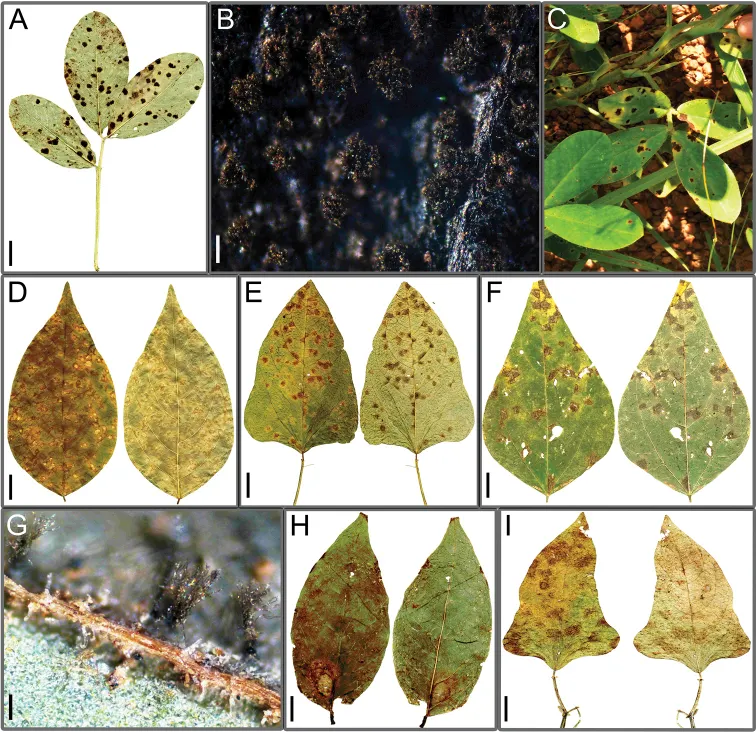
Leaf spot symptoms associated with cercosporoid fungi A, B Nothopassalora personata on Arachis hypogaea (YMM49A) B close-up of lesions with caespituli C Passalora arachidicola on Arachis hypogaea (YMM49B) D Pseudocercospora bradburyae on Centrosema pubescens (YMM275) E Pseudocercospora cruenta on Phaseolus sp. (YMM288) F, G Pseudocercospora griseola on Phaseolus lunatus (YMM297A) G close-up of lesions with sporulation H Pseudocercospora sennicola on Senna occidentalis (YMM12) I Pseudocercospora tabei on Vigna unguiculata (YMM220). Scale bars: 15 mm (A, D, E, F, I); 100 μm (B, G); 12 mm (D, H).
- Jenis
- Pelat ilmiah
- Kredit
- Yalemwork Meswaet, Ralph Mangelsdorff, Nourou S. Yorou, Meike Piepenbring
- Lisensi
- CC BY 4.0
- Sumber media
- Buka entri sumber
Dokumentasi tambahan
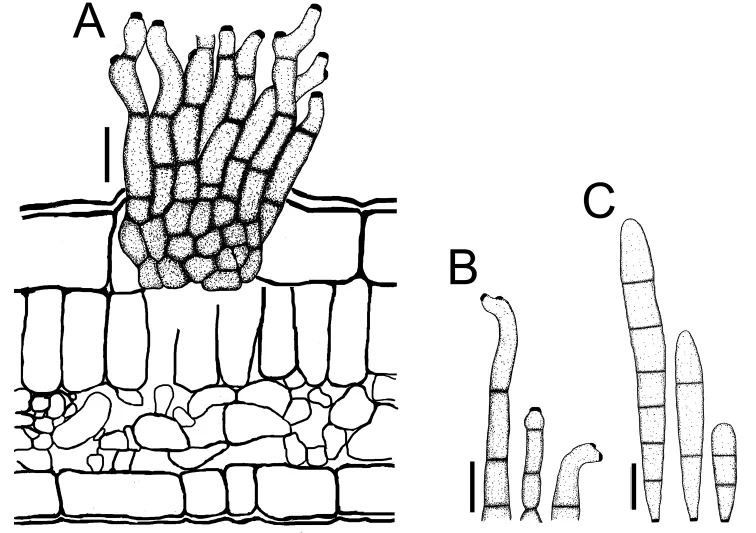
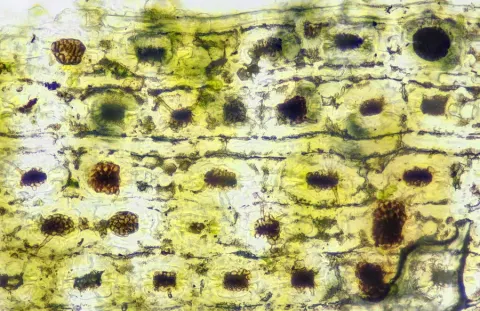
Nothopassalora personata on Arachis hypogaea (YMM49A) A fascicle of conidiophores growing out from a developed stroma embedded in the epidermis B solitary conidiophores C conidia. Scale bars: 15 μm (A); 12 μm (B, C).
Kredit dan penggunaan
Yalemwork Meswaet, Ralph Mangelsdorff, Nourou S. Yorou, Meike Piepenbring
Ukuran dan format gambar disesuaikan tanpa pemotongan, retus, atau penambahan skala. Lisensi sumber dipertahankan.
Sumber profil
- [1] Unravelling unexplored diversity of cercosporoid fungi (Mycosphaerellaceae, Mycosphaerellales, Ascomycota) in tropical Africa — Nothopassalora personata
- [2] Catalogue of Life Base2026-09-11 — Nothopassalora personata
- [3] Dokumentasi visual — Nothopassalora personata
- [4] Dokumentasi visual — Nothopassalora personata
Rujukan halaman ini
Fungi. Nothopassalora personata. Rilis data fungi-2026-10-12-expansion-2. https://fungi-atlas.mgadib.chatgpt.site/jamur/nothopassalora-personata/.
Status: impor sumber; pemeriksaan editorial per profil belum selesai. Untuk klaim biologis, gunakan rujukan pada bagian terkait dan periksa konteks sumber aslinya.