01 / Morfologi

Ciri dan struktur

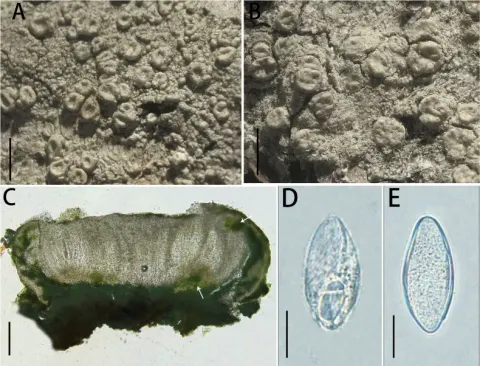
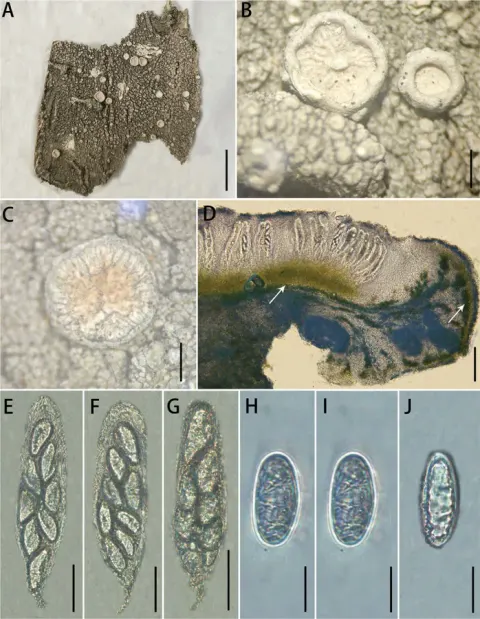
Ochrolechia cooperi forms a crust-like thallus that sits tightly on its substrate and breaks into a fine network of cracks (). A patch rarely exceeds 5–7 cm across but can be up to 1.2 mm thick. The surface is a creamy white, though it is speckled with scattered coral-shaped isidia—tiny, finger-like outgrowths 0.1–0.5 mm wide that begin as pinkish-tan warts and branch upward. Some specimens bear isidia across most of the thallus, while others have broad isidia-free areas. No dark border () is visible at the margin. The lichen's photosynthetic partner is a green alga with nearly spherical cells 10–15 μm in diameter, each surrounded by a clear wall about 1 μm thick. Rounded fruiting bodies (apothecia) 0.8–2.4 mm wide have been found on only one studied specimen. They sit flush with the surface and eventually hollow out, suggesting that spore production may often abort. The outer rim derived from the thallus is thick and whitish, while the inner fungal rim measures about 50 μm across. In section, the outer wall () is about 190 μm thick at the sides and 310 μm at the base, with the algae appearing in small isolated patches. The spore-forming layer (hymenium) can reach 200 μm tall; it is colorless but turns hazy aqua blue in iodine and is sprinkled with crystals that dissolve to pale yellow in potassium hydroxide (KOH) solution. Supporting filaments (paraphyses) are slender—only 1.8 μm thick in mid-section—and loosen in KOH. The basal tissue () is a faint cream and up to 90 μm thick. Club-shaped asci measure about 155 × 58 μm and swell dramatically in KOH, but mature spores have not yet been observed, and no asexual structures are known.

Sebagian uraian ditampilkan dalam bahasa sumber; terjemahannya belum tersedia atau belum lolos pemeriksaan.

Rujukan: [1]

Pengukuran mengikuti objek, spesimen atau kultur, dan metode yang disebutkan sumber. Baca uraian asli untuk konteks lengkap.

02 / Kehidupan

Habitat dan peran ekologis

Ochrolechia cooperi has so far been found only in the coastal lowlands of southeastern and south-central Alaska. Verified collections come from Glacier Bay National Park (Falls Creek, Dundas Bay, Excursion Ridge, and the Gustavus area), Frederick Sound on the north shore of Mitkof Island, Chugach National Forest, and Kenai Fjords National Park, where several sites cluster around Three Hole Bay on the Aialik Peninsula. All records lie between sea level and roughly 250 m elevation. The lichen colonizes intact bark or decorticated wood of living or fallen conifers—chiefly Sitka spruce (Picea sitchensis) and mountain hemlock (Tsuga mertensiana)—in humid muskeg "tree islands", pond margins, and other wet forest settings. It favors shaded, persistently damp microsites where the substrate retains moisture year-round, such as moss-covered logs and lower trunk bases.

Sebagian uraian ditampilkan dalam bahasa sumber; terjemahannya belum tersedia atau belum lolos pemeriksaan.

Rujukan: [1]

Habitat atau konteks temuan
hutan
Substrat
Informasi belum tersedia pada sumber rilis ini.
Peran atau konteks
Pembentuk liken
Temukan hubungan serupa
03 / Siklus hidup

Reproduksi

Ochrolechia cooperi forms a crust-like thallus that sits tightly on its substrate and breaks into a fine network of cracks (). A patch rarely exceeds 5–7 cm across but can be up to 1.2 mm thick. The surface is a creamy white, though it is speckled with scattered coral-shaped isidia—tiny, finger-like outgrowths 0.1–0.5 mm wide that begin as pinkish-tan warts and branch upward. Some specimens bear isidia across most of the thallus, while others have broad isidia-free areas. No dark border () is visible at the margin. The lichen's photosynthetic partner is a green alga with nearly spherical cells 10–15 μm in diameter, each surrounded by a clear wall about 1 μm thick. Rounded fruiting bodies (apothecia) 0.8–2.4 mm wide have been found on only one studied specimen.

Sebagian uraian ditampilkan dalam bahasa sumber; terjemahannya belum tersedia atau belum lolos pemeriksaan.

Rujukan: [1]

04 / Batas informasi

Catatan identitas dan cakupan

  • Nama diterima mengikuti Catalogue of Life Base2026-09-11; uraian mempertahankan konsep dan nama sumber aslinya.
  • Original geographic, specimen and life-cycle scope retained; source import awaits individual editorial review.
  • Impor dan terjemahan otomatis belum diperiksa editorial per profil. Struktur reproduktif yang disebutkan tidak membuktikan seluruh siklus hidup diketahui.
  • Pengukuran pada uraian mengikuti spesimen, kultur, dan metode sumber; angka tidak diperluas ke semua populasi.

Catatan distribusi dalam narasi mengikuti sumbernya. Dokumentasi spesimen atau foto mengikuti catatan sumber. Bukti wilayah Indonesia dan penilaian konservasi tidak disimpulkan dari gambar.

05 / Dokumentasi

Melihat dengan konteks

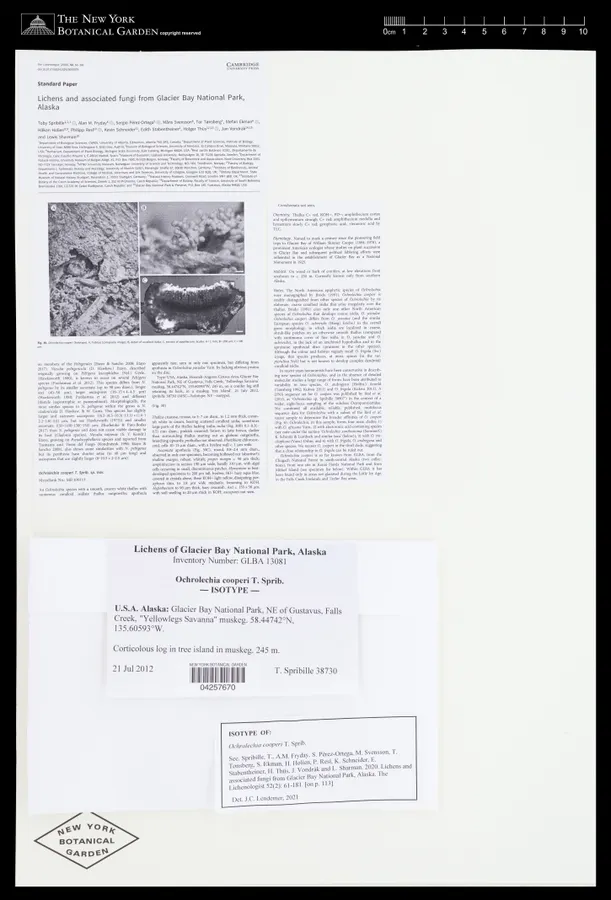
Voucher herbarium Ochrolechia cooperi (04257670), The New York Botanical Garden. Identifikasi mengikuti record spesimen sumber. Foto bahan, kemasan, atau label herbarium sebagaimana tersedia pada record institusi; bukan foto lapangan atau penentuan spesimen independen.

Jenis
Voucher herbarium
Kredit
The New York Botanical Garden
Lisensi
CC BY 4.0
Sumber media
Buka entri sumber

Gambar menunjukkan objek menurut identifikasi sumber, bukan verifikasi independen spesimen oleh Fungi. Tidak ada skala baru yang ditambahkan.

06 / Rujukan

Sumber profil

  1. [1] Ochrolechia cooperi — Wikipedia (en)Bagian sumber: Frozen revision 1300596224
    Tanggal penghimpunan sumber: 2026-10-12
    Teks sumber: CC BY-SA4.0 · Wikipedia contributors
  2. [2] Catalogue of Life Base2026-09-11 — Ochrolechia cooperiBagian sumber: ColDP NameUsage.tsv ID B2Y7X; accepted species; source 2073
    Tanggal penghimpunan sumber: 2026-10-12
  3. [3] Dokumentasi visual — Ochrolechia cooperiBagian sumber: Individual media record; identification follows the source, not independent determination
    Tanggal penghimpunan sumber: 2026-10-12
    Media sumber: CC BY 4.0 · The New York Botanical Garden

Adaptasi teks: CC BY-SA 4.0. Wikipedia contributors — Ochrolechia cooperi — Wikipedia (en)

Uraian asli dan riwayat sumber

Riwayat atau halaman sumber

Ringkasan sumber

Ochrolechia cooperi is a species of crustose lichen in the family Ochrolechiaceae. The lichen forms a creamy white crust with small coral-shaped outgrowths that help it reproduce without producing spores. It was discovered in 2020 in Alaska's Glacier Bay National Park and Preserve and is named after ecologist William Skinner Cooper, who helped establish the park. The species grows on the bark and wood of conifer trees in persistently damp, shaded areas of coastal Alaska's wet forests and muskegs.

Revisi sumber

Morfologi sumber

Ochrolechia cooperi forms a crust-like thallus that sits tightly on its substrate and breaks into a fine network of cracks (). A patch rarely exceeds 5–7 cm across but can be up to 1.2 mm thick. The surface is a creamy white, though it is speckled with scattered coral-shaped isidia—tiny, finger-like outgrowths 0.1–0.5 mm wide that begin as pinkish-tan warts and branch upward. Some specimens bear isidia across most of the thallus, while others have broad isidia-free areas. No dark border () is visible at the margin. The lichen's photosynthetic partner is a green alga with nearly spherical cells 10–15 μm in diameter, each surrounded by a clear wall about 1 μm thick. Rounded fruiting bodies (apothecia) 0.8–2.4 mm wide have been found on only one studied specimen. They sit flush with the surface and eventually hollow out, suggesting that spore production may often abort. The outer rim derived from the thallus is thick and whitish, while the inner fungal rim measures about 50 μm across. In section, the outer wall () is about 190 μm thick at the sides and 310 μm at the base, with the algae appearing in small isolated patches. The spore-forming layer (hymenium) can reach 200 μm tall; it is colorless but turns hazy aqua blue in iodine and is sprinkled with crystals that dissolve to pale yellow in potassium hydroxide (KOH) solution. Supporting filaments (paraphyses) are slender—only 1.8 μm thick in mid-section—and loosen in KOH. The basal tissue () is a faint cream and up to 90 μm thick. Club-shaped asci measure about 155 × 58 μm and swell dramatically in KOH, but mature spores have not yet been observed, and no asexual structures are known.

Revisi sumber

Ekologi sumber

Ochrolechia cooperi has so far been found only in the coastal lowlands of southeastern and south-central Alaska. Verified collections come from Glacier Bay National Park (Falls Creek, Dundas Bay, Excursion Ridge, and the Gustavus area), Frederick Sound on the north shore of Mitkof Island, Chugach National Forest, and Kenai Fjords National Park, where several sites cluster around Three Hole Bay on the Aialik Peninsula. All records lie between sea level and roughly 250 m elevation. The lichen colonizes intact bark or decorticated wood of living or fallen conifers—chiefly Sitka spruce (Picea sitchensis) and mountain hemlock (Tsuga mertensiana)—in humid muskeg "tree islands", pond margins, and other wet forest settings. It favors shaded, persistently damp microsites where the substrate retains moisture year-round, such as moss-covered logs and lower trunk bases.

Revisi sumber

Struktur reproduksi sumber

Ochrolechia cooperi forms a crust-like thallus that sits tightly on its substrate and breaks into a fine network of cracks (). A patch rarely exceeds 5–7 cm across but can be up to 1.2 mm thick. The surface is a creamy white, though it is speckled with scattered coral-shaped isidia—tiny, finger-like outgrowths 0.1–0.5 mm wide that begin as pinkish-tan warts and branch upward. Some specimens bear isidia across most of the thallus, while others have broad isidia-free areas. No dark border () is visible at the margin. The lichen's photosynthetic partner is a green alga with nearly spherical cells 10–15 μm in diameter, each surrounded by a clear wall about 1 μm thick. Rounded fruiting bodies (apothecia) 0.8–2.4 mm wide have been found on only one studied specimen.

Revisi sumber

Rujukan halaman ini

Fungi. Ochrolechia cooperi. Rilis data fungi-2026-10-12-expansion-2. https://fungi-atlas.mgadib.chatgpt.site/jamur/ochrolechia-cooperi/.

Status: impor sumber; pemeriksaan editorial per profil belum selesai. Untuk klaim biologis, gunakan rujukan pada bagian terkait dan periksa konteks sumber aslinya.