Ciri dan struktur
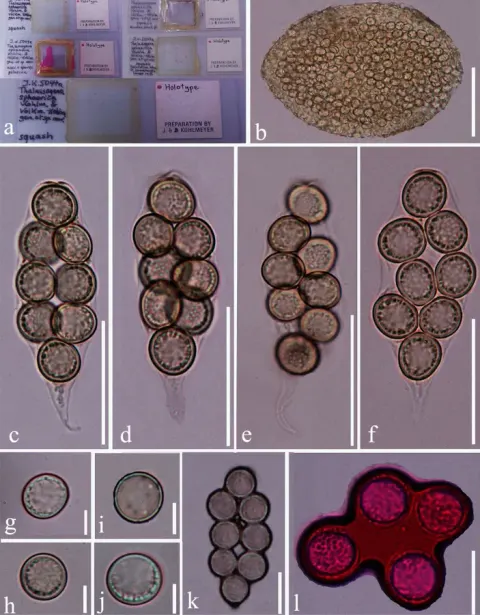
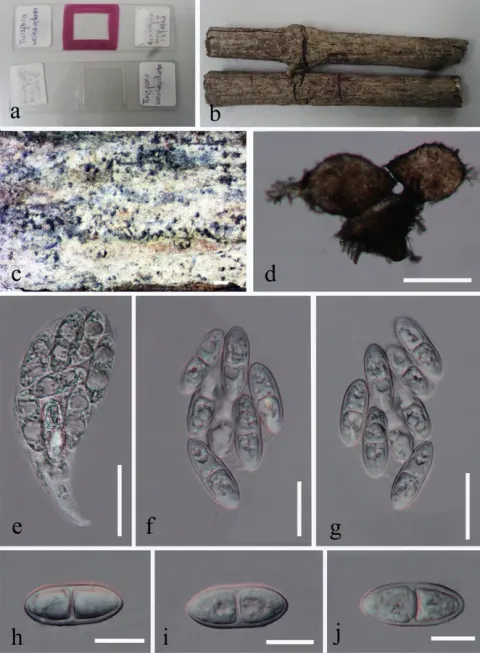
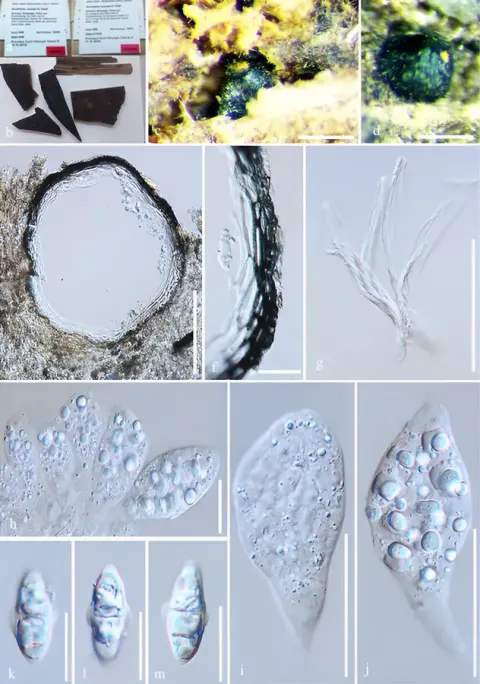
Saprobic on wood. Sexual morph. Ascomata 150–245 high, 150–250 µm in diam., subglobose or ampulliform, immersed, ostiolate, papillate, coriaceous, brownish-black or brownish-red, solitary or gregarious. Peridium 7.5–11.5 µm thick, composed of four to six layers of thick-walled, mostly ellipsoidal cells, forming a textura angularis, merging toward the center into the pseudoparenchyma. Necks 55–100 µm long, 28–75 µm in diam., cylindrical or conical; ostiolar canal at first filled with a small-celled pseudoparenchyma. Pseudoparenchyma of thin-walled, polygonal or rounded cells filling venter of young ascomata; eventually breaking up into catenophyses; cells 9–23 µm, 6–15 µm in diameter. Asci 45–70 × 15–30 µm, 8-spored, clavate, short pedunculate, unitunicate, thin-walled, early deliquescing, developing at the base of the ascoma venter. Ascospores 20–68.5 × 6–11.5 µm, cylindrical or rarely ellipsoidal, 1-septate, upon germination often becoming two- to four-septate, slightly or not constricted at the septa, hyaline, with a cap-like, subglobose, terminal, deciduous appendage at one end, 5–5.8 µm in diameter. Asexual morph. Conidiophores 5–200 × 2.5 μm, cylindrical, septate, simple or branched, hyaline, often forming pustules on the surface of the substrate. Conidiogenous cell ellipsoidal or ovoid, hyaline, produced acrogenously. Conidia 6–13(–20) μm in diam., one-celled, subglobose or ovoid, smooth, thick-walled, light brown with a reddish tint or dark brown, developing basipetally, catenulate, cells finally separating (Periconia prolifica).
Habitat dan peran ekologis
Okeanomyces cucullatus is a widely collected species with records from: Australia, Bahamas, Belize, Brazil, Brunei, Great Abaco, Guatemala, Hawaii, India, Japan, Malaysia, Mauritius, Mexico, South Africa, Thailand, United States. The asexual stage Periconia prolifica is widely documented from tropical locations: Bahamas, Bermuda, Brazil, Belize, East Mexico, US (Florida, Hawaii), Ghana, Martinique, Sierra Leone, Republic of Trinidad and Tobago, Andaman Islands, India (Andhra Pradesh, Lakshadweep Islands, Maharashtra, Tamil Nadu), East South Africa, Indonesia (Java, Sumatra), Maldives, Mauritius, Nicobar Islands, Seychelles, Kuwait, Saudi Arabia, Brunei, China (Hong Kong, Shenzhen), Malaysia, Australia (New South Wales, Queensland, Victoria), Philippines, Singapore, Society Islands, Thailand, West Guatemala, West Mexico, and Taiwan.
- Habitat atau konteks temuan
- Informasi belum tersedia pada sumber rilis ini.
- Substrat
- Informasi belum tersedia pada sumber rilis ini.
- Peran atau konteks
- Belum dikategorikan pada rilis ini.
Reproduksi
Saprobic on wood. Sexual morph. Ascomata 150–245 high, 150–250 µm in diam., subglobose or ampulliform, immersed, ostiolate, papillate, coriaceous, brownish-black or brownish-red, solitary or gregarious. Peridium 7.5–11.5 µm thick, composed of four to six layers of thick-walled, mostly ellipsoidal cells, forming a textura angularis, merging toward the center into the pseudoparenchyma. Necks 55–100 µm long, 28–75 µm in diam., cylindrical or conical; ostiolar canal at first filled with a small-celled pseudoparenchyma. Pseudoparenchyma of thin-walled, polygonal or rounded cells filling venter of young ascomata; eventually breaking up into catenophyses; cells 9–23 µm, 6–15 µm in diameter. Asci 45–70 × 15–30 µm, 8-spored, clavate, short pedunculate, unitunicate, thin-walled, early deliquescing, developing at the base of the ascoma venter.
Catatan identitas dan cakupan
- Nama diterima mengikuti Catalogue of Life Base2026-09-11; uraian mempertahankan konsep dan nama sumber aslinya.
- Preserve original treatment localities, hosts and substrate scope. Materials examined describe documented specimens, not the full global range.
- Impor dan terjemahan otomatis belum diperiksa editorial per profil. Struktur reproduktif yang disebutkan tidak membuktikan seluruh siklus hidup diketahui.
- Pengukuran pada uraian mengikuti spesimen, kultur, dan metode sumber; angka tidak diperluas ke semua populasi.
Catatan distribusi dalam narasi mengikuti sumbernya. Dokumentasi spesimen atau foto mengikuti catatan sumber. Bukti wilayah Indonesia dan penilaian konservasi tidak disimpulkan dari gambar.
Melihat dengan konteks
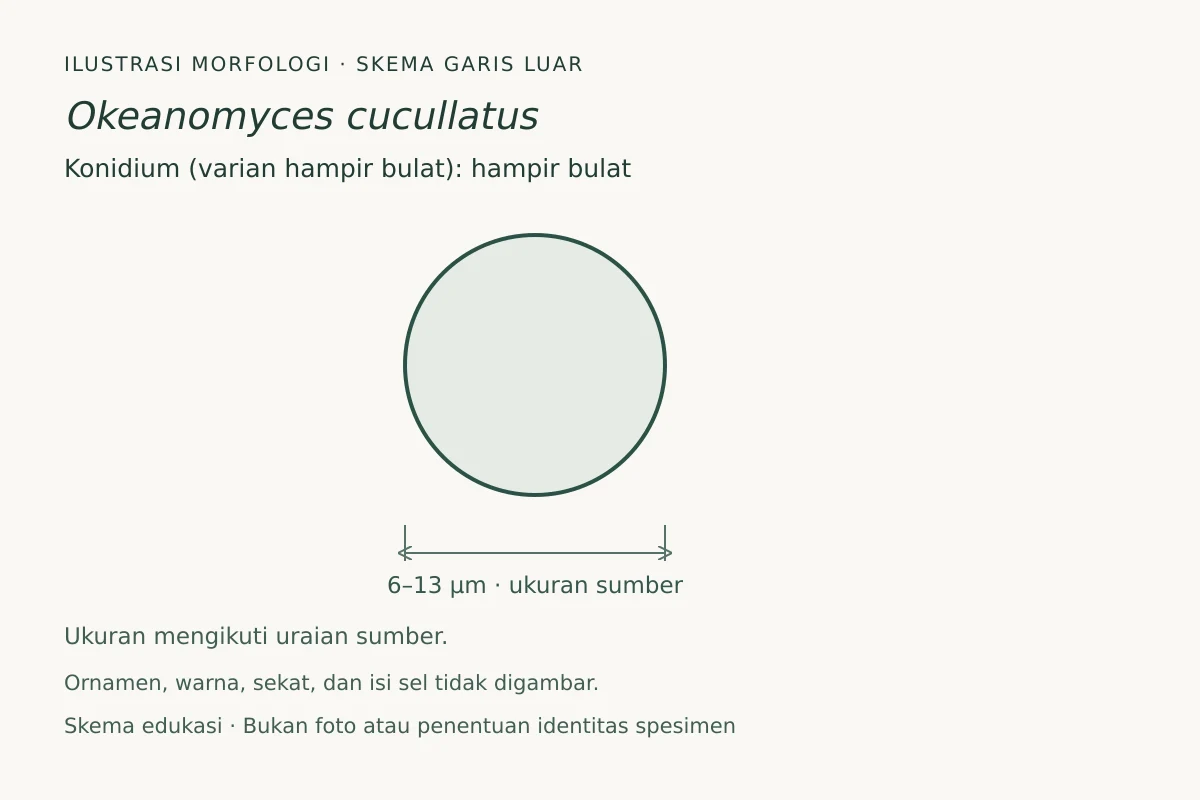
Ilustrasi skematis garis luar konidium (varian hampir bulat) Okeanomyces cucullatus, berdasarkan uraian sumber; ukuran yang dilaporkan 6–13 µm. Proporsi disederhanakan, bukan salinan satu spesimen. Ornamen permukaan, warna, sekat, dan isi sel tidak direkonstruksi. Varian konidium hampir bulat dari morfa aseksual pada sumber, diameter utama 6–13 µm. Diameter ekstrem 20 µm dan rantai tidak ditampilkan; appendage askospora merupakan bagian lain. Ornamen, warna, sekat, dan isi sel tidak digambar. Skema edukasi, bukan alat identifikasi.
- Jenis
- Ilustrasi skematis
- Kredit
- Fungi, ilustrasi orisinal (2026); fakta morfologi berdasarkan Dayarathne MC, Jones EBG, Bahkali AH, Devadatha B, Hyde KD, Abdel-Wahab MA, Calabon MS, Correia P, Abdel-Aziz FA, Bakhit MS, Sakayaroj J, Prematunga C, Caeiro MF, Azevedo E, Asghari R, Apurillo CCS, Bhagya AT, Aumentado HD, Mukhopadhyay S, Phukhamsakda C, Chen Y, Maharachchikumbura SS, Guo SY, Pang KL.
- Lisensi
- CC BY-SA 4.0
- Sumber media
- Buka entri sumber
Sumber profil
- [1] Taxonomy and molecular evaluation of the Halosphaeriaceae (Microascales, Hypocreomycetidae) — Okeanomyces cucullatus
- [2] Catalogue of Life Base2026-09-11 — Okeanomyces cucullatus
Rujukan halaman ini
Fungi. Okeanomyces cucullatus. Rilis data fungi-2026-10-12-expansion-2. https://fungi-atlas.mgadib.chatgpt.site/jamur/okeanomyces-cucullatus/.
Status: impor sumber; pemeriksaan editorial per profil belum selesai. Untuk klaim biologis, gunakan rujukan pada bagian terkait dan periksa konteks sumber aslinya.