01 / Morfologi

Ciri dan struktur

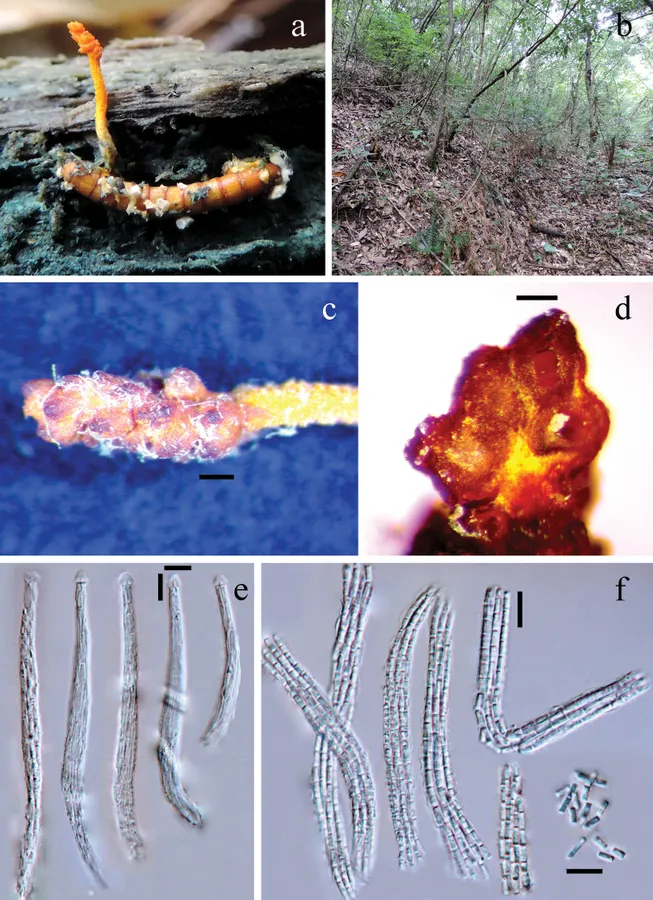
Parasitising a Tenebrionoidea larva (Coleoptera) living in humid and decayed wood. The larva is cylindrical, 7.5 mm long and 1.0–1.1 mm thick, yellowish-brown. White mycelia stuff the body cavity, also partially cover the intersegmental membranes of the body surface. Stroma arising from the first quarter of the larval body, single, fleshy, 5 mm in length. Stipe yellow, cylindrical, 3.5 mm long and 0.35–0.4 mm thick, surface rough and pubescent. Fertile head spicate, unbranched, orange, 1.5 mm long and 0.5–0.7 mm thick, obviously differentiated from stipe; its surface rugged and consisting of many humps (outer portions of perithecia), tops of the humps obtuse and with opening ostioles, darker in colour. Perithecia partially immersed and obliquely or at right angles to the surface of stipe, broadly pyriform, 200–250 × 170–200 μm; walls 25–35 μm thick. Asci cylindrical, 5–9 μm thick, middle part wider than two terminal parts; caps hemispheric, 4.6–5.3 (x – = 4.9, n = 30) μm wide and 4.0–4.6 (x – = 4.3, n = 30) μm high. Ascospores filiform; part-spores cylindrical, truncated at both ends, 3.5–6.5 (x – = 4.7, n = 30) μm long and 1.7–2.0 μm thick. Asexual morph. Unknown. Ophiocordyceps spicatus is morphologically somewhat similar to O. formosana (Kobayasi and Shimizu 1981; Li et al. 2016), but it has a much smaller stroma (stipes 6–10 (or 19–37) mm long and 1.5–1.7 (or 2–4) mm wide in O. formosana), a spicate and rugged fertile head (surface entire and flattened, never spicate or rugged in O. formosana) and partially immersed perithecia (immersed in O. formosana). Nucleotide sequences of O. spicatus are most similar to those of O. formosana, but there is 5.2% bp difference in ITS, 2.0% bp difference in TEF1-α and 0.1% bp difference in SSU (LSU rDNA sequence unavailable for O. formosana).

Sebagian uraian ditampilkan dalam bahasa sumber; terjemahannya belum tersedia atau belum lolos pemeriksaan.

Rujukan: [1]

Pengukuran mengikuti objek, spesimen atau kultur, dan metode yang disebutkan sumber. Baca uraian asli untuk konteks lengkap.

02 / Kehidupan

Habitat dan peran ekologis

Growing on a Tenebrionoidea larva (Coleoptera) living in humid and decayed wood in a broad-leaved forest.

Sebagian uraian ditampilkan dalam bahasa sumber; terjemahannya belum tersedia atau belum lolos pemeriksaan.

Rujukan: [1]

Habitat atau konteks temuan
hutan
Substrat
Informasi belum tersedia pada sumber rilis ini.
Peran atau konteks
Belum dikategorikan pada rilis ini.
Temukan hubungan serupa
03 / Siklus hidup

Reproduksi

Parasitising a Tenebrionoidea larva (Coleoptera) living in humid and decayed wood. The larva is cylindrical, 7.5 mm long and 1.0–1.1 mm thick, yellowish-brown. White mycelia stuff the body cavity, also partially cover the intersegmental membranes of the body surface. Stroma arising from the first quarter of the larval body, single, fleshy, 5 mm in length. Stipe yellow, cylindrical, 3.5 mm long and 0.35–0.4 mm thick, surface rough and pubescent. Fertile head spicate, unbranched, orange, 1.5 mm long and 0.5–0.7 mm thick, obviously differentiated from stipe; its surface rugged and consisting of many humps (outer portions of perithecia), tops of the humps obtuse and with opening ostioles, darker in colour.

Sebagian uraian ditampilkan dalam bahasa sumber; terjemahannya belum tersedia atau belum lolos pemeriksaan.

Rujukan: [1]

04 / Batas informasi

Catatan identitas dan cakupan

  • Nama diterima mengikuti Catalogue of Life Base2026-09-11; uraian mempertahankan konsep dan nama sumber aslinya.
  • Preserve original treatment localities, hosts and substrate scope. Materials examined describe documented specimens, not the full global range.
  • Impor dan terjemahan otomatis belum diperiksa editorial per profil. Struktur reproduktif yang disebutkan tidak membuktikan seluruh siklus hidup diketahui.
  • Pengukuran pada uraian mengikuti spesimen, kultur, dan metode sumber; angka tidak diperluas ke semua populasi.

Catatan distribusi dalam narasi mengikuti sumbernya. Dokumentasi spesimen atau foto mengikuti catatan sumber. Bukti wilayah Indonesia dan penilaian konservasi tidak disimpulkan dari gambar.

05 / Dokumentasi

Melihat dengan konteks

Ophiocordyceps spicatus (MFLU 18-0164) a infected larva in decayed wood b habitat environment c fertile head of stroma d transverse section of fertile head, on which sparse arranged perithecia are shown e Asci f Ascospores and part-spores. Scale bars: 200 µm (c); 100 µm (d) 10 µm (e, f).

Jenis
Pelat ilmiah
Kredit
Ling-Sheng Zha, Vadim Yu Kryukov, Jian-Hua Ding, Rajesh Jeewon, Putarak Chomnunti
Lisensi
CC BY 4.0
Sumber media
Buka entri sumber

Gambar menunjukkan objek menurut identifikasi sumber, bukan verifikasi independen spesimen oleh Fungi. Tidak ada skala baru yang ditambahkan.

06 / Rujukan

Sumber profil

  1. [1] Novel taxa and species diversity of Cordyceps sensu lato (Hypocreales, Ascomycota) developing on wireworms (Elateroidea and Tenebrionoidea, Coleoptera) — Ophiocordyceps spicatusBagian sumber: PMC8021543_section_15
    Tanggal penghimpunan sumber: 2026-10-12
    Teks sumber: CC BY 4.0 · Zha LS, Kryukov VY, Ding JH, Jeewon R, Chomnunti P.
  2. [2] Catalogue of Life Base2026-09-11 — Ophiocordyceps spicatusBagian sumber: ColDP NameUsage.tsv ID B2MF9; accepted species; source 2073
    Tanggal penghimpunan sumber: 2026-10-12
  3. [3] Dokumentasi visual — Ophiocordyceps spicatusBagian sumber: Individual media record; identification follows the source, not independent determination
    Tanggal penghimpunan sumber: 2026-10-12
    Media sumber: CC BY 4.0 · Ling-Sheng Zha, Vadim Yu Kryukov, Jian-Hua Ding, Rajesh Jeewon, Putarak Chomnunti

Adaptasi teks: CC BY 4.0. Zha LS, Kryukov VY, Ding JH, Jeewon R, Chomnunti P. — Novel taxa and species diversity of Cordyceps sensu lato (Hypocreales, Ascomycota) developing on wireworms (Elateroidea and Tenebrionoidea, Coleoptera) — Ophiocordyceps spicatus

Uraian asli dan riwayat sumber

Riwayat atau halaman sumber

Ringkasan sumber

Parasitising a Tenebrionoidea larva (Coleoptera) living in humid and decayed wood. The larva is cylindrical, 7.5 mm long and 1.0–1.1 mm thick, yellowish-brown. White mycelia stuff the body cavity, also partially cover the intersegmental membranes of the body surface. Stroma arising from the first quarter of the larval body, single, fleshy, 5 mm in length. Stipe yellow, cylindrical, 3.5 mm long and 0.35–0.4 mm thick, surface rough and pubescent. Fertile head spicate, unbranched, orange, 1.5 mm long and 0.5–0.7 mm thick, obviously differentiated from stipe; its surface rugged and consisting of many humps (outer portions of perithecia), tops of the humps obtuse and with opening ostioles, darker in colour.

Revisi sumber

Morfologi sumber

Parasitising a Tenebrionoidea larva (Coleoptera) living in humid and decayed wood. The larva is cylindrical, 7.5 mm long and 1.0–1.1 mm thick, yellowish-brown. White mycelia stuff the body cavity, also partially cover the intersegmental membranes of the body surface. Stroma arising from the first quarter of the larval body, single, fleshy, 5 mm in length. Stipe yellow, cylindrical, 3.5 mm long and 0.35–0.4 mm thick, surface rough and pubescent. Fertile head spicate, unbranched, orange, 1.5 mm long and 0.5–0.7 mm thick, obviously differentiated from stipe; its surface rugged and consisting of many humps (outer portions of perithecia), tops of the humps obtuse and with opening ostioles, darker in colour. Perithecia partially immersed and obliquely or at right angles to the surface of stipe, broadly pyriform, 200–250 × 170–200 μm; walls 25–35 μm thick. Asci cylindrical, 5–9 μm thick, middle part wider than two terminal parts; caps hemispheric, 4.6–5.3 (x – = 4.9, n = 30) μm wide and 4.0–4.6 (x – = 4.3, n = 30) μm high. Ascospores filiform; part-spores cylindrical, truncated at both ends, 3.5–6.5 (x – = 4.7, n = 30) μm long and 1.7–2.0 μm thick. Asexual morph. Unknown. Ophiocordyceps spicatus is morphologically somewhat similar to O. formosana (Kobayasi and Shimizu 1981; Li et al. 2016), but it has a much smaller stroma (stipes 6–10 (or 19–37) mm long and 1.5–1.7 (or 2–4) mm wide in O. formosana), a spicate and rugged fertile head (surface entire and flattened, never spicate or rugged in O. formosana) and partially immersed perithecia (immersed in O. formosana). Nucleotide sequences of O. spicatus are most similar to those of O. formosana, but there is 5.2% bp difference in ITS, 2.0% bp difference in TEF1-α and 0.1% bp difference in SSU (LSU rDNA sequence unavailable for O. formosana).

Revisi sumber

Ekologi sumber

Growing on a Tenebrionoidea larva (Coleoptera) living in humid and decayed wood in a broad-leaved forest.

Revisi sumber

Struktur reproduksi sumber

Parasitising a Tenebrionoidea larva (Coleoptera) living in humid and decayed wood. The larva is cylindrical, 7.5 mm long and 1.0–1.1 mm thick, yellowish-brown. White mycelia stuff the body cavity, also partially cover the intersegmental membranes of the body surface. Stroma arising from the first quarter of the larval body, single, fleshy, 5 mm in length. Stipe yellow, cylindrical, 3.5 mm long and 0.35–0.4 mm thick, surface rough and pubescent. Fertile head spicate, unbranched, orange, 1.5 mm long and 0.5–0.7 mm thick, obviously differentiated from stipe; its surface rugged and consisting of many humps (outer portions of perithecia), tops of the humps obtuse and with opening ostioles, darker in colour.

Revisi sumber

Rujukan halaman ini

Fungi. Ophiocordyceps spicatus. Rilis data fungi-2026-10-12-expansion-2. https://fungi-atlas.mgadib.chatgpt.site/jamur/ophiocordyceps-spicatus/.

Status: impor sumber; pemeriksaan editorial per profil belum selesai. Untuk klaim biologis, gunakan rujukan pada bagian terkait dan periksa konteks sumber aslinya.