01 / Morfologi

Ciri dan struktur

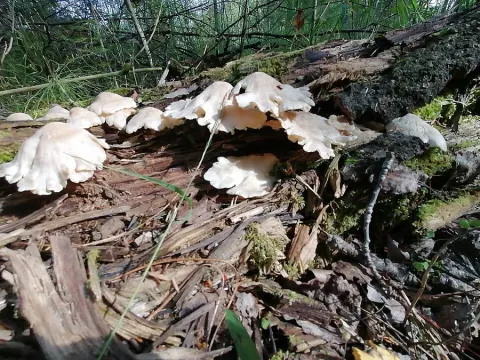
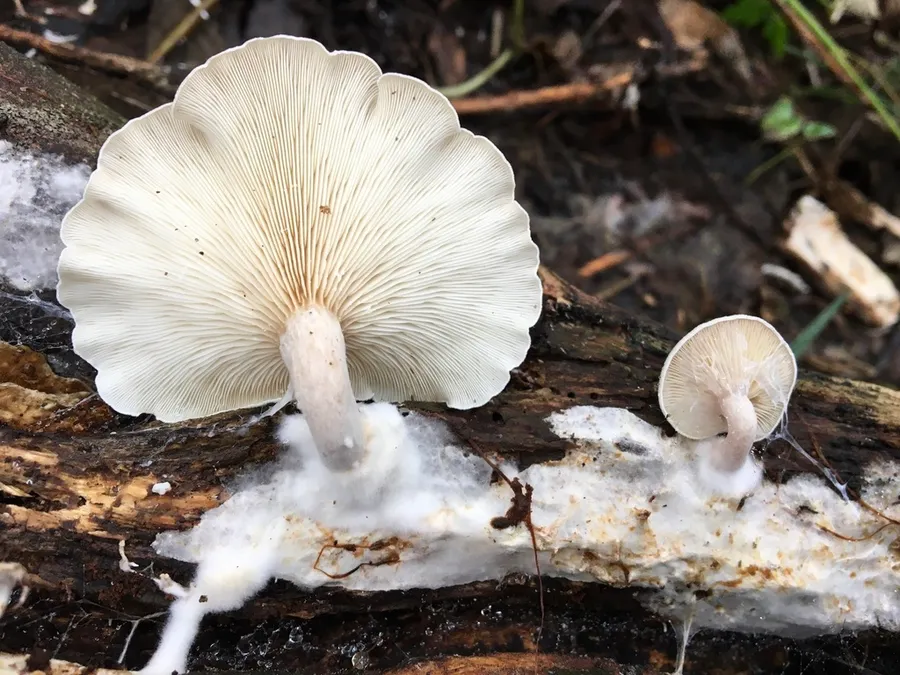
Pileus 1.2 to 6.2 cm diameter, at first slightly convex with down turned edge, then sometimes expanded and upturned, often depressed over the attachment of the stem, wavy, irregular and more or less lobed at the margin, when found growing usually whitish to dingy whitish or pale buffy white (Cartridge Buff, XXX.) or creamy white and opaque, smooth, a little translucent when very moist, when gathered becoming Ochraceous Buff (XV.) round the edge and even browner in the centre, herbarium specimens drying a dingy biscuit colour. Gills adnate to sometimes slightly decurrent, close, narrow, whitish, then creamy-white. Stem short, 1.2 to 2.5 cm, central to excentric or occasionally almost lateral from the position in which it may have grown, similarly often bent, slender or rather stout, equal or slightly attenuated downwards, pruinose, tough, hollow above, the colour of the pileus. Flesh thin, equally attenuated outwards. Spores nearly subspherical, 3.5 to 4 x 2.5 to 2.8 μm, 4 μm. Sometimes caespitose (growing in dense tufts or clusters). Attached by fluffy-white mycelium to the undersides of thick sheets of fallen or stripped bark and fallen wood on the ground beneath eucalypts, or around the base of stumps, the pilei often emerging with difficulty or only found after removing overlying litter. Cleland used Ridgeway colour standard and nomenclature.

Sebagian uraian ditampilkan dalam bahasa sumber; terjemahannya belum tersedia atau belum lolos pemeriksaan.

Rujukan: [1]

Pengukuran mengikuti objek, spesimen atau kultur, dan metode yang disebutkan sumber. Baca uraian asli untuk konteks lengkap.

02 / Kehidupan

Habitat dan peran ekologis

South-eastern Australia (NSW, Victoria, South Australia) south Western Australia and Tasmania. New Zealand. Eucalyptus forest in Australia. In New Zealand recorded on tree ferns (Cyathea medullaris), gymnosperms (Dacrycarpus dacrydioides). monocotyledons (Cordyline australis, Cordyline indivisa, Phormium, Rhopalostylis sapida, and Ripogonum scandens), and dicotyledons (Nothofagacea). Growing on decomposing wood. In New Zealand recorded on dead and decaying tree fern fronds, and fibrous monocotyledon leaf and stem material.

Sebagian uraian ditampilkan dalam bahasa sumber; terjemahannya belum tersedia atau belum lolos pemeriksaan.

Rujukan: [1]

Habitat atau konteks temuan
hutan
Substrat
Informasi belum tersedia pada sumber rilis ini.
Peran atau konteks
Belum dikategorikan pada rilis ini.
Temukan hubungan serupa
03 / Siklus hidup

Reproduksi

Pileus 1.2 to 6.2 cm diameter, at first slightly convex with down turned edge, then sometimes expanded and upturned, often depressed over the attachment of the stem, wavy, irregular and more or less lobed at the margin, when found growing usually whitish to dingy whitish or pale buffy white (Cartridge Buff, XXX.) or creamy white and opaque, smooth, a little translucent when very moist, when gathered becoming Ochraceous Buff (XV.) round the edge and even browner in the centre, herbarium specimens drying a dingy biscuit colour. Gills adnate to sometimes slightly decurrent, close, narrow, whitish, then creamy-white. Stem short, 1.2 to 2.5 cm, central to excentric or occasionally almost lateral from the position in which it may have grown, similarly often bent, slender or rather stout, equal or slightly attenuated downwards, pruinose, tough, hollow above, the colour of the pileus.

Sebagian uraian ditampilkan dalam bahasa sumber; terjemahannya belum tersedia atau belum lolos pemeriksaan.

Rujukan: [1]

Sinonim menurut acuan taksonomi rilis: Clitocybe semiocculta
04 / Batas informasi

Catatan identitas dan cakupan

  • Nama diterima mengikuti Catalogue of Life Base2026-09-11; uraian mempertahankan konsep dan nama sumber aslinya.
  • Original geographic, specimen and life-cycle scope retained; source import awaits individual editorial review.
  • Impor dan terjemahan otomatis belum diperiksa editorial per profil. Struktur reproduktif yang disebutkan tidak membuktikan seluruh siklus hidup diketahui.
  • Pengukuran pada uraian mengikuti spesimen, kultur, dan metode sumber; angka tidak diperluas ke semua populasi.

Catatan distribusi dalam narasi mengikuti sumbernya. Dokumentasi spesimen atau foto mengikuti catatan sumber. Bukti wilayah Indonesia dan penilaian konservasi tidak disimpulkan dari gambar.

05 / Dokumentasi

Melihat dengan konteks

Dokumentasi Ossicaulis semiocculta menurut asosiasi foto pada record takson iNaturalist. Kredit: Eileen Laidlaw. Identitas mengikuti sumber; bukan penentuan spesimen independen.

Jenis
Fotografi
Kredit
no rights reserved, uploaded by Eileen Laidlaw
Lisensi
CC0 1.0
Sumber media
Buka entri sumber

Gambar menunjukkan objek menurut identifikasi sumber, bukan verifikasi independen spesimen oleh Fungi. Tidak ada skala baru yang ditambahkan.

06 / Rujukan

Sumber profil

  1. [1] Ossicaulis semiocculta — Wikipedia (en)Bagian sumber: Frozen revision 1321190005
    Tanggal penghimpunan sumber: 2026-10-12
    Teks sumber: CC BY-SA4.0 · Wikipedia contributors
  2. [2] Catalogue of Life Base2026-09-11 — Ossicaulis semioccultaBagian sumber: ColDP NameUsage.tsv ID CBN35; accepted species; source 2073
    Tanggal penghimpunan sumber: 2026-10-12
  3. [3] Dokumentasi visual — Ossicaulis semioccultaBagian sumber: Individual media record; identification follows the source, not independent determination
    Tanggal penghimpunan sumber: 2026-10-12
    Media sumber: CC0 1.0 · no rights reserved, uploaded by Eileen Laidlaw

Adaptasi teks: CC BY-SA 4.0. Wikipedia contributors — Ossicaulis semiocculta — Wikipedia (en)

Uraian asli dan riwayat sumber

Riwayat atau halaman sumber

Ringkasan sumber

Ossicaulis semiocculta is a small wood-rotting mushroom species. It was originally described by John Burton Cleland in 1927 as Cliyocybe semiocculta. It was transferred to the genus Ossicaulis by Jerry A. Cooper in 2023.

Revisi sumber

Morfologi sumber

Pileus 1.2 to 6.2 cm diameter, at first slightly convex with down turned edge, then sometimes expanded and upturned, often depressed over the attachment of the stem, wavy, irregular and more or less lobed at the margin, when found growing usually whitish to dingy whitish or pale buffy white (Cartridge Buff, XXX.) or creamy white and opaque, smooth, a little translucent when very moist, when gathered becoming Ochraceous Buff (XV.) round the edge and even browner in the centre, herbarium specimens drying a dingy biscuit colour. Gills adnate to sometimes slightly decurrent, close, narrow, whitish, then creamy-white. Stem short, 1.2 to 2.5 cm, central to excentric or occasionally almost lateral from the position in which it may have grown, similarly often bent, slender or rather stout, equal or slightly attenuated downwards, pruinose, tough, hollow above, the colour of the pileus. Flesh thin, equally attenuated outwards. Spores nearly subspherical, 3.5 to 4 x 2.5 to 2.8 μm, 4 μm. Sometimes caespitose (growing in dense tufts or clusters). Attached by fluffy-white mycelium to the undersides of thick sheets of fallen or stripped bark and fallen wood on the ground beneath eucalypts, or around the base of stumps, the pilei often emerging with difficulty or only found after removing overlying litter. Cleland used Ridgeway colour standard and nomenclature.

Revisi sumber

Ekologi sumber

South-eastern Australia (NSW, Victoria, South Australia) south Western Australia and Tasmania. New Zealand. Eucalyptus forest in Australia. In New Zealand recorded on tree ferns (Cyathea medullaris), gymnosperms (Dacrycarpus dacrydioides). monocotyledons (Cordyline australis, Cordyline indivisa, Phormium, Rhopalostylis sapida, and Ripogonum scandens), and dicotyledons (Nothofagacea). Growing on decomposing wood. In New Zealand recorded on dead and decaying tree fern fronds, and fibrous monocotyledon leaf and stem material.

Revisi sumber

Struktur reproduksi sumber

Pileus 1.2 to 6.2 cm diameter, at first slightly convex with down turned edge, then sometimes expanded and upturned, often depressed over the attachment of the stem, wavy, irregular and more or less lobed at the margin, when found growing usually whitish to dingy whitish or pale buffy white (Cartridge Buff, XXX.) or creamy white and opaque, smooth, a little translucent when very moist, when gathered becoming Ochraceous Buff (XV.) round the edge and even browner in the centre, herbarium specimens drying a dingy biscuit colour. Gills adnate to sometimes slightly decurrent, close, narrow, whitish, then creamy-white. Stem short, 1.2 to 2.5 cm, central to excentric or occasionally almost lateral from the position in which it may have grown, similarly often bent, slender or rather stout, equal or slightly attenuated downwards, pruinose, tough, hollow above, the colour of the pileus.

Revisi sumber

Rujukan halaman ini

Fungi. Ossicaulis semiocculta. Rilis data fungi-2026-10-12-expansion-2. https://fungi-atlas.mgadib.chatgpt.site/jamur/ossicaulis-semiocculta/.

Status: impor sumber; pemeriksaan editorial per profil belum selesai. Untuk klaim biologis, gunakan rujukan pada bagian terkait dan periksa konteks sumber aslinya.