Ciri dan struktur
Notes: Otidea filiformis diagnosed by the combination of yellowish-brown to ochre-yellow apothecia, sometimes with brown spots or stains, narrowly fusoid ascospores, uniform width, narrow paraphyses (≤3 µm) and basal mycelium with abundant spheroid, pale brown, resinous exudates. O tidea bufonia and O. mirabilis are similar to O. filiformis in apothecia color and ascospore shape. O tidea bufonia differs from O. filiformis in having the longer ascospores (12–) 13–16.5 (–18) × 6–7.5 (–8) µm, and brown striate exudates on some hyphae of the medullary excipulum. O. mirabilis differs in dark-brown apothecia, purple to lilaceous-bluish shades on the receptacle surface and biflabellate crystal-like exudates in the medullary excipulum. The apothecia of Otidea korfii Pfister, F. Xu & Z.W. Ge, O. olivaceobrunnea and O. saliceticola Cartabia, M. Carbone & P. Alvarado also have brown tones. Otidea korfii is distinguished from O. filiformis by its ear-shaped apothecia, olivaceous brown receptacle surface, ellipsoid to broadly ellipsoid bigger ascospores (14.5–17 × 6.5–9 μm), resinous exudate of the ectal excipulum dissolving in MLZ and smooth basal mycelium. Otidea olivaceobrunnea differs from O. filiformis in olive-brown hymenium, ellipsoid ascospores. Otidea saliceticola differs in pale alutaceous-greyish hymenium surface, dark brown receptacle surface, wider ascospores (14–15 × 7.5–8 μm) with low Q value of 1.75–1.87.
Habitat dan peran ekologis
Holotype: China. Beijing City, Huairou District, Sunshanzi Village, alt. 770m, on soil in mixed forest of Populus sp. and Larix sp., 28 August 2020, G.Q. Chen C505 (BJTC C505).
- Habitat atau konteks temuan
- hutan
- Substrat
- tanah
- Peran atau konteks
- Belum dikategorikan pada rilis ini.
Reproduksi
Notes: Otidea filiformis diagnosed by the combination of yellowish-brown to ochre-yellow apothecia, sometimes with brown spots or stains, narrowly fusoid ascospores, uniform width, narrow paraphyses (≤3 µm) and basal mycelium with abundant spheroid, pale brown, resinous exudates. O tidea bufonia and O. mirabilis are similar to O. filiformis in apothecia color and ascospore shape. O tidea bufonia differs from O. filiformis in having the longer ascospores (12–) 13–16.5 (–18) × 6–7.5 (–8) µm, and brown striate exudates on some hyphae of the medullary excipulum. O. mirabilis differs in dark-brown apothecia, purple to lilaceous-bluish shades on the receptacle surface and biflabellate crystal-like exudates in the medullary excipulum.
Catatan identitas dan cakupan
- Nama diterima mengikuti Catalogue of Life Base2026-09-11; uraian mempertahankan konsep dan nama sumber aslinya.
- Preserve original treatment localities, hosts and substrate scope. Materials examined describe documented specimens, not the full global range.
- Impor dan terjemahan otomatis belum diperiksa editorial per profil. Struktur reproduktif yang disebutkan tidak membuktikan seluruh siklus hidup diketahui.
- Pengukuran pada uraian mengikuti spesimen, kultur, dan metode sumber; angka tidak diperluas ke semua populasi.
Catatan distribusi dalam narasi mengikuti sumbernya. Dokumentasi spesimen atau foto mengikuti catatan sumber. Bukti wilayah Indonesia dan penilaian konservasi tidak disimpulkan dari gambar.
Melihat dengan konteks
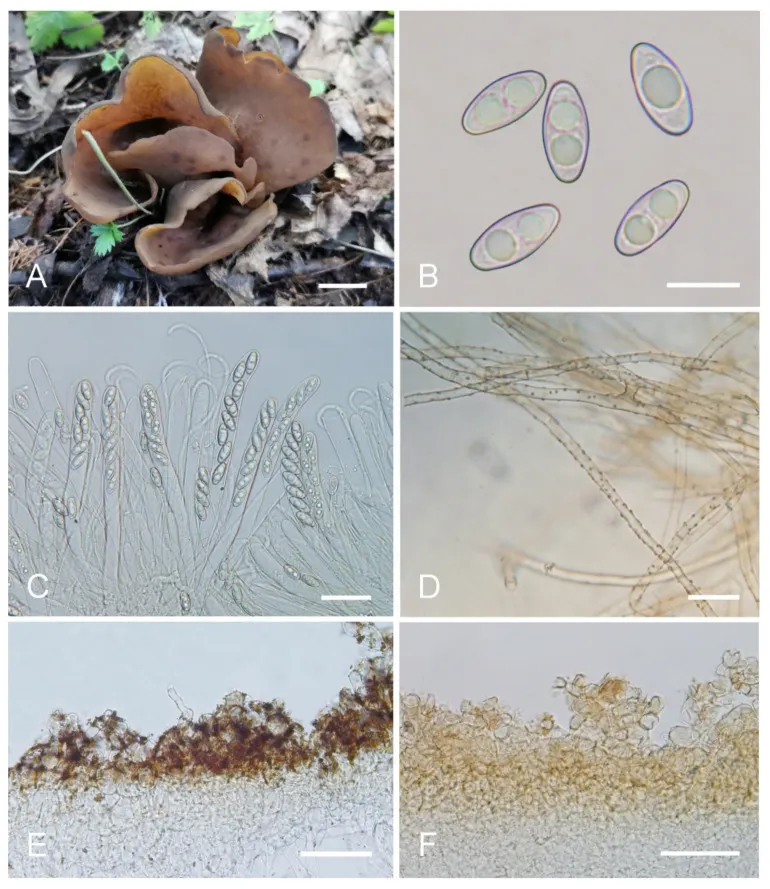
Otidea filiformis (BJTC C505) (A) apothecia, (B) ascospores, (C) asci and paraphyses, (D) basal mycelium, (E) ectal excipulum in water, and (F) ectal excipulum in KOH. Scale bars: (A) = 1 cm, (B) = 10 μm, (C) = 30 μm, (D) = 20 μm, (E, F) = 50 μm.
- Jenis
- Pelat ilmiah
- Kredit
- © 2022 by the authors.
- Lisensi
- CC BY 4.0
- Sumber media
- Buka entri sumber
Sumber profil
- [1] New Species and New Records of Otidea from China Based on Molecular and Morphological Data — Otidea filiformis
- [2] Catalogue of Life Base2026-09-11 — Otidea filiformis
- [3] Dokumentasi visual — Otidea filiformis
Rujukan halaman ini
Fungi. Otidea filiformis. Rilis data fungi-2026-10-12-expansion-2. https://fungi-atlas.mgadib.chatgpt.site/jamur/otidea-filiformis/.
Status: impor sumber; pemeriksaan editorial per profil belum selesai. Untuk klaim biologis, gunakan rujukan pada bagian terkait dan periksa konteks sumber aslinya.