Ciri dan struktur
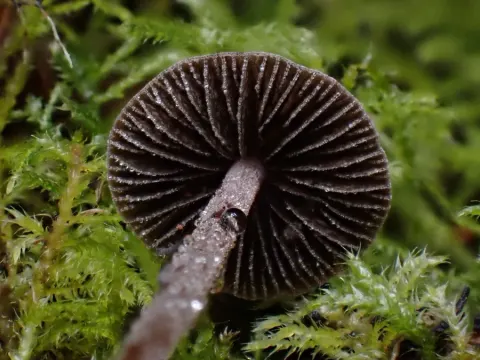
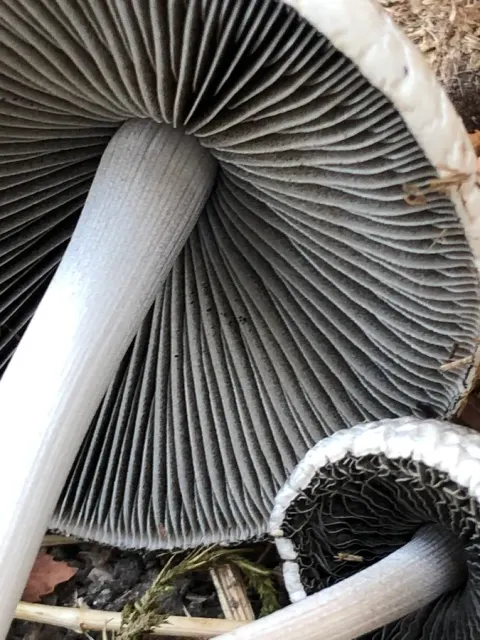
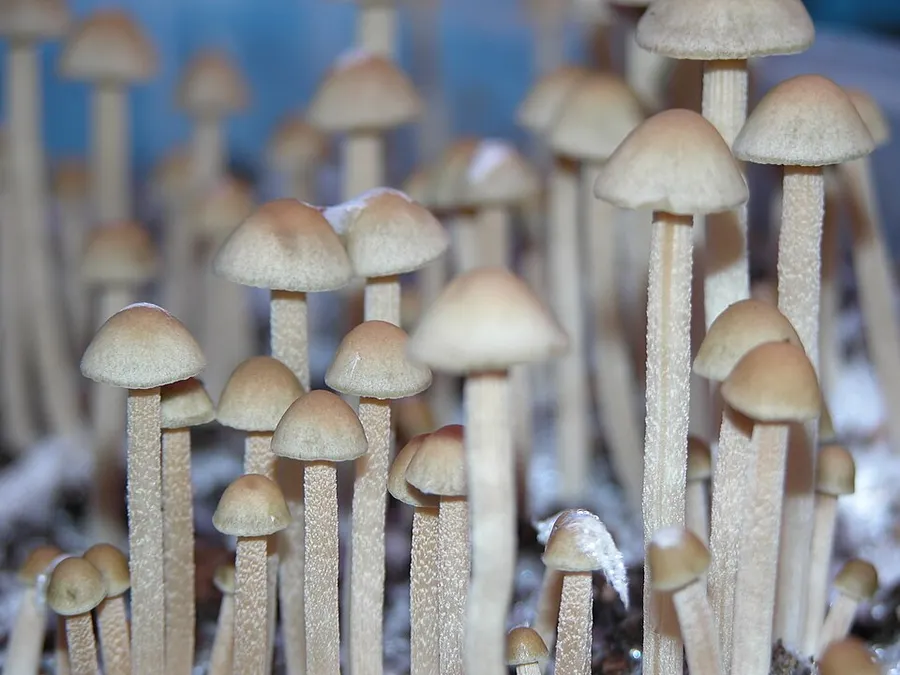
The cap is 1.5 — 2(2.5) cm and hemispheric to convex to companulate. The margin is incurved when young, clay-colored, often reddish brown towards the disc, hygrophanous, smooth, and grayish to greenish; it is translucent-striate at the margin when wet. It becomes blue when bruised. The gills are adnexed, distinctly mottled, and dully grayish with blackish spots. The stipe is 5–12 cm long, 2–3 mm thick, hollow, and vertically striate. It is blackish towards the base, greyish towards the apex, and pallid to whitish fibrils run the length of the stipe. The stipe is equal to slightly swollen at the base and lacks a partial veil. Panaeolus tropicalis spores are dark violet to jet black, ellipsoid, and 10.5–12.0 x 7–9 μm. The basidia each produce two spores. Like many other hallucinogenic mushrooms, this fungus readily bruises blue where it is handled. It can be differentiated from Panaeolus cyanescens by microscopic characteristics.
Habitat dan peran ekologis
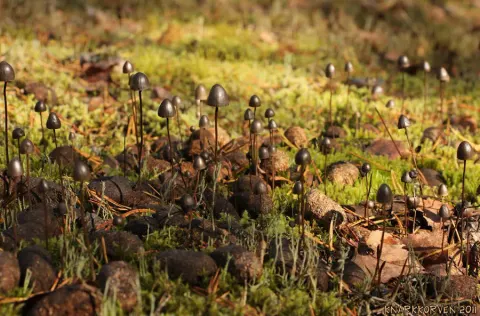
Panaeolus tropicalis is a mushroom that grows on dung. It is most often found in Hawaii, Central Africa, and Cambodia; it can also be found in Mexico, Tanzania, the Philippines, Florida, and Japan.
- Habitat atau konteks temuan
- Informasi belum tersedia pada sumber rilis ini.
- Substrat
- kotoran hewan
- Peran atau konteks
- Belum dikategorikan pada rilis ini.
Reproduksi
The cap is 1.5 — 2(2.5) cm and hemispheric to convex to companulate. The margin is incurved when young, clay-colored, often reddish brown towards the disc, hygrophanous, smooth, and grayish to greenish; it is translucent-striate at the margin when wet. It becomes blue when bruised. The gills are adnexed, distinctly mottled, and dully grayish with blackish spots. The stipe is 5–12 cm long, 2–3 mm thick, hollow, and vertically striate. It is blackish towards the base, greyish towards the apex, and pallid to whitish fibrils run the length of the stipe. The stipe is equal to slightly swollen at the base and lacks a partial veil. Panaeolus tropicalis spores are dark violet to jet black, ellipsoid, and 10.5–12.0 x 7–9 μm.
Catatan identitas dan cakupan
- Nama diterima mengikuti Catalogue of Life Base2026-09-11; uraian mempertahankan konsep dan nama sumber aslinya.
- Original geographic, specimen and life-cycle scope retained; source import awaits individual editorial review.
- Impor dan terjemahan otomatis belum diperiksa editorial per profil. Struktur reproduktif yang disebutkan tidak membuktikan seluruh siklus hidup diketahui.
- Pengukuran pada uraian mengikuti spesimen, kultur, dan metode sumber; angka tidak diperluas ke semua populasi.
Catatan distribusi dalam narasi mengikuti sumbernya. Dokumentasi spesimen atau foto mengikuti catatan sumber. Bukti wilayah Indonesia dan penilaian konservasi tidak disimpulkan dari gambar.
Melihat dengan konteks
Dokumentasi Panaeolus tropicalis dari Wikimedia Commons. Panaeolus tropicalis Identifikasi mengikuti record berkas sumber.
- Jenis
- Fotografi
- Kredit
- Prankster239 — I, Alan Rockefeller
- Lisensi
- CC BY-SA 3.0
- Sumber media
- Buka entri sumber
Sumber profil
- [1] Panaeolus tropicalis — Wikipedia (en)
- [2] Catalogue of Life Base2026-09-11 — Panaeolus tropicalis
- [3] Dokumentasi visual — Panaeolus tropicalis
Rujukan halaman ini
Fungi. Panaeolus tropicalis. Rilis data fungi-2026-10-12-expansion-2. https://fungi-atlas.mgadib.chatgpt.site/jamur/panaeolus-tropicalis/.
Status: impor sumber; pemeriksaan editorial per profil belum selesai. Untuk klaim biologis, gunakan rujukan pada bagian terkait dan periksa konteks sumber aslinya.