01 / Morfologi

Ciri dan struktur

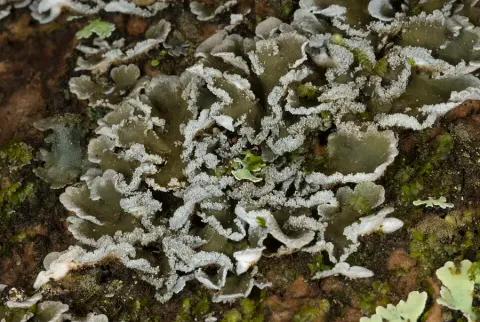
The lichen forms a rosette-shaped thallus (body) that typically reaches 2–5 cm in diameter, though it can grow up to 5 cm across. Multiple thalli sometimes merge to create larger, irregular patches. The thallus is firmly attached to its , with lobed edges and a distinctive blue-black fuzzy layer of root-like structures (rhizines) underneath that anchor it in place. This dark layer sometimes extends beyond the main body as a visible border (). The upper surface is flat or slightly concave, smooth and somewhat shiny, ranging in colour from greenish-brown to yellowish. The lobes at the thallus edges are 2–3.5 mm wide and radiate outward, while the central lobes are smaller and often overlap each other. In shaded conditions, the lobes may grow more spread apart. Pannaria durietzii cephalodia, which contain blue-green algae (Nostoc). These appear as pale brown to flesh-coloured bumps up to 1 mm wide, usually forming near the lobe edges. The cephalodia produce a powdery, blue-grey granular substance (soredia) that helps the lichen reproduce vegetatively. These granules initially form on the underside and edges of the cephalodia but eventually spread to cover their entire surface. Fruiting bodies (apothecia) are rare, occurring in less than 5% of specimens. When present, they are crowded together, 0.5–1.5 mm wide, and start out globe-shaped before becoming cup-shaped. They have thick margins matching the thallus colour and flesh-coloured to pink centres that appear slightly whitish due to a powdery coating. The centres often develop cracks or acquire a plug of sterile tissue.

Sebagian uraian ditampilkan dalam bahasa sumber; terjemahannya belum tersedia atau belum lolos pemeriksaan.

Rujukan: [1]

Pengukuran mengikuti objek, spesimen atau kultur, dan metode yang disebutkan sumber. Baca uraian asli untuk konteks lengkap.

02 / Kehidupan

Habitat dan peran ekologis

Pannaria durietzii is primarily found in New Zealand, with a widespread distribution across both the North and South Islands, as well as several offshore islands. In the North Island, it has been recorded in the South Auckland region (Kuratau) and various ranges in the Wellington area, including the Kaimanawa, Ruahine, Tararua, and Remutaka Ranges. On the South Island, the species is present in diverse locations. It has been observed in Nelson (St Arnaud Range, West Bay, Lake Rotoiti), Westland (Stillwater, Haast), Canterbury (Lewis Pass, Arthur's Pass, Governor's Bush), Otago (Haast Pass, Lake Hāwea, Olivine Valley, Routeburn Valley), and Southland (Milford Sound, Cascade Cove, Dusky Sound, Lake Te Anau, Lake Manapouri, Wilmot Pass). The lichen's range extends to several New Zealand subantarctic islands. It has been documented on Stewart Island (Butterfield's Beach, Glory Cove, Port Pegasus), the Auckland Islands (Laurie Harbour, Ranui Cove, Terror Cove, Rose Island, Ewing Island, Enderby Island), and Campbell Island (Mt Lyall, Mt Dumas, Mt Honey). The species can be found growing on tree bark, and rarely on rocks or dead wood. It prefers relatively open woodlands and clearings rather than dense forest, typically in areas with annual rainfall between 200 and 250 cm.

Sebagian uraian ditampilkan dalam bahasa sumber; terjemahannya belum tersedia atau belum lolos pemeriksaan.

Rujukan: [1]

Habitat atau konteks temuan
hutan
Substrat
Informasi belum tersedia pada sumber rilis ini.
Peran atau konteks
Pembentuk liken
Temukan hubungan serupa
03 / Siklus hidup

Reproduksi

Pannaria durietzii cephalodia, which contain blue-green algae (Nostoc). These appear as pale brown to flesh-coloured bumps up to 1 mm wide, usually forming near the lobe edges. The cephalodia produce a powdery, blue-grey granular substance (soredia) that helps the lichen reproduce vegetatively. These granules initially form on the underside and edges of the cephalodia but eventually spread to cover their entire surface.

Sebagian uraian ditampilkan dalam bahasa sumber; terjemahannya belum tersedia atau belum lolos pemeriksaan.

Rujukan: [1]

Sinonim menurut acuan taksonomi rilis: Psoroma durietzii
04 / Batas informasi

Catatan identitas dan cakupan

  • Nama diterima mengikuti Catalogue of Life Base2026-09-11; uraian mempertahankan konsep dan nama sumber aslinya.
  • Original geographic, specimen and life-cycle scope retained; source import awaits individual editorial review.
  • Impor dan terjemahan otomatis belum diperiksa editorial per profil. Struktur reproduktif yang disebutkan tidak membuktikan seluruh siklus hidup diketahui.
  • Pengukuran pada uraian mengikuti spesimen, kultur, dan metode sumber; angka tidak diperluas ke semua populasi.

Catatan distribusi dalam narasi mengikuti sumbernya. Dokumentasi spesimen atau foto mengikuti catatan sumber. Bukti wilayah Indonesia dan penilaian konservasi tidak disimpulkan dari gambar.

05 / Dokumentasi

Melihat dengan konteks

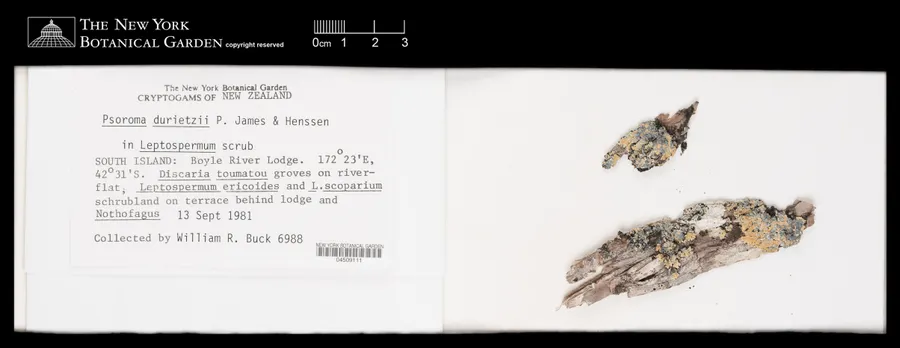
Voucher herbarium Pannaria durietzii (04509111), The New York Botanical Garden. Identifikasi mengikuti record spesimen sumber. Foto bahan, kemasan, atau label herbarium sebagaimana tersedia pada record institusi; bukan foto lapangan atau penentuan spesimen independen.

Jenis
Voucher herbarium
Kredit
The New York Botanical Garden
Lisensi
CC BY 4.0
Sumber media
Buka entri sumber

Gambar menunjukkan objek menurut identifikasi sumber, bukan verifikasi independen spesimen oleh Fungi. Tidak ada skala baru yang ditambahkan.

06 / Rujukan

Sumber profil

  1. [1] Pannaria durietzii — Wikipedia (en)Bagian sumber: Frozen revision 1347914185
    Tanggal penghimpunan sumber: 2026-10-12
    Teks sumber: CC BY-SA4.0 · Wikipedia contributors
  2. [2] Catalogue of Life Base2026-09-11 — Pannaria durietziiBagian sumber: ColDP NameUsage.tsv ID 75MB8; accepted species; source 2073
    Tanggal penghimpunan sumber: 2026-10-12
  3. [3] Dokumentasi visual — Pannaria durietziiBagian sumber: Individual media record; identification follows the source, not independent determination
    Tanggal penghimpunan sumber: 2026-10-12
    Media sumber: CC BY 4.0 · The New York Botanical Garden

Adaptasi teks: CC BY-SA 4.0. Wikipedia contributors — Pannaria durietzii — Wikipedia (en)

Uraian asli dan riwayat sumber

Riwayat atau halaman sumber

Ringkasan sumber

Pannaria durietzii is a species of corticolous (bark-dwelling), foliose lichen in the family Pannariaceae. Primarily found in New Zealand, it has also been reported in southeastern Australia and Tasmania, and southern Chile, indicating a broader southern hemisphere distribution.

Revisi sumber

Morfologi sumber

The lichen forms a rosette-shaped thallus (body) that typically reaches 2–5 cm in diameter, though it can grow up to 5 cm across. Multiple thalli sometimes merge to create larger, irregular patches. The thallus is firmly attached to its , with lobed edges and a distinctive blue-black fuzzy layer of root-like structures (rhizines) underneath that anchor it in place. This dark layer sometimes extends beyond the main body as a visible border (). The upper surface is flat or slightly concave, smooth and somewhat shiny, ranging in colour from greenish-brown to yellowish. The lobes at the thallus edges are 2–3.5 mm wide and radiate outward, while the central lobes are smaller and often overlap each other. In shaded conditions, the lobes may grow more spread apart. Pannaria durietzii cephalodia, which contain blue-green algae (Nostoc). These appear as pale brown to flesh-coloured bumps up to 1 mm wide, usually forming near the lobe edges. The cephalodia produce a powdery, blue-grey granular substance (soredia) that helps the lichen reproduce vegetatively. These granules initially form on the underside and edges of the cephalodia but eventually spread to cover their entire surface. Fruiting bodies (apothecia) are rare, occurring in less than 5% of specimens. When present, they are crowded together, 0.5–1.5 mm wide, and start out globe-shaped before becoming cup-shaped. They have thick margins matching the thallus colour and flesh-coloured to pink centres that appear slightly whitish due to a powdery coating. The centres often develop cracks or acquire a plug of sterile tissue.

Revisi sumber

Ekologi sumber

Pannaria durietzii is primarily found in New Zealand, with a widespread distribution across both the North and South Islands, as well as several offshore islands. In the North Island, it has been recorded in the South Auckland region (Kuratau) and various ranges in the Wellington area, including the Kaimanawa, Ruahine, Tararua, and Remutaka Ranges. On the South Island, the species is present in diverse locations. It has been observed in Nelson (St Arnaud Range, West Bay, Lake Rotoiti), Westland (Stillwater, Haast), Canterbury (Lewis Pass, Arthur's Pass, Governor's Bush), Otago (Haast Pass, Lake Hāwea, Olivine Valley, Routeburn Valley), and Southland (Milford Sound, Cascade Cove, Dusky Sound, Lake Te Anau, Lake Manapouri, Wilmot Pass). The lichen's range extends to several New Zealand subantarctic islands. It has been documented on Stewart Island (Butterfield's Beach, Glory Cove, Port Pegasus), the Auckland Islands (Laurie Harbour, Ranui Cove, Terror Cove, Rose Island, Ewing Island, Enderby Island), and Campbell Island (Mt Lyall, Mt Dumas, Mt Honey). The species can be found growing on tree bark, and rarely on rocks or dead wood. It prefers relatively open woodlands and clearings rather than dense forest, typically in areas with annual rainfall between 200 and 250 cm.

Revisi sumber

Struktur reproduksi sumber

Pannaria durietzii cephalodia, which contain blue-green algae (Nostoc). These appear as pale brown to flesh-coloured bumps up to 1 mm wide, usually forming near the lobe edges. The cephalodia produce a powdery, blue-grey granular substance (soredia) that helps the lichen reproduce vegetatively. These granules initially form on the underside and edges of the cephalodia but eventually spread to cover their entire surface.

Revisi sumber

Rujukan halaman ini

Fungi. Pannaria durietzii. Rilis data fungi-2026-10-12-expansion-2. https://fungi-atlas.mgadib.chatgpt.site/jamur/pannaria-durietzii/.

Status: impor sumber; pemeriksaan editorial per profil belum selesai. Untuk klaim biologis, gunakan rujukan pada bagian terkait dan periksa konteks sumber aslinya.