Ciri dan struktur
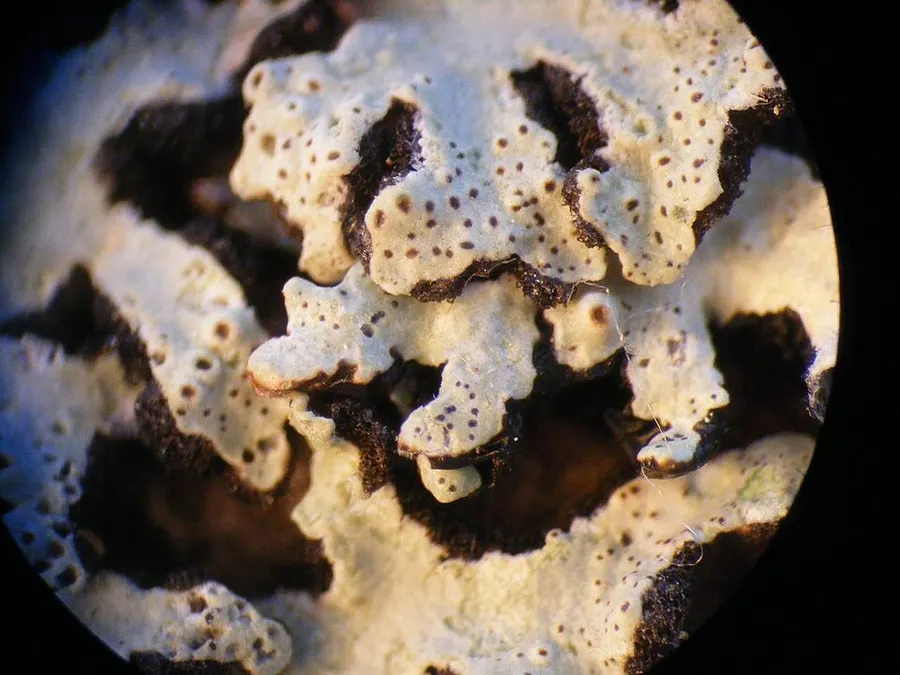
Pannoparmelia angustata is a species of foliose lichen that forms loose, roughly circular patches up to 10 centimeters across. Its narrow are 0.5–2 millimetres wide, linear or sometimes appearing beaded (), and branch moderately to densely, primarily in pairs near the thallus edge. The upper surface appears bright yellowish-green to pale greyish-yellow and is smooth, lacking vegetative reproductive structures like isidia or soredia. The lower surface is white, with a spongy underlayer () ranging from pale yellow-brown to black. Simple root-like structures (rhizines) occur occasionally to frequently along margins. When present, the spore-producing structures (apothecia) are stalked, up to 1 centimetre wide, with varying from pale yellowish-brown to dark red-brown. The spores are egg-shaped, measuring 6–6.5 by 5–6 micrometres (μm). Small, shiny spore-producing structures (pycnidia) commonly appear at lobe tips, producing rod-shaped to slightly spindle-shaped reproductive cells (conidia) 5–6.5 μm long. Chemical spot tests (K, C, KC, P) produce no colour changes in either the outer layer or inner tissue. The lichen contains usnic and divaricatic acids.
Habitat dan peran ekologis
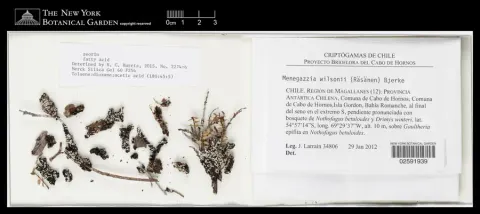
Pannoparmelia angustata is found in southeastern Australia (New South Wales, Australian Capital Territory, Victoria, and Tasmania) as well as New Zealand and southern South America (Argentina and Chile). The species primarily grows on tree bark, with occasional occurrences on mosses. In Chile's Magallanes region, P. angustata characteristically inhabits exposed, smooth bark, particularly on Nothofagus betuloides trees growing at the edges of bogs.
- Habitat atau konteks temuan
- Informasi belum tersedia pada sumber rilis ini.
- Substrat
- Informasi belum tersedia pada sumber rilis ini.
- Peran atau konteks
- Pembentuk liken
Reproduksi
Pannoparmelia angustata is a species of foliose lichen that forms loose, roughly circular patches up to 10 centimeters across. Its narrow are 0.5–2 millimetres wide, linear or sometimes appearing beaded (), and branch moderately to densely, primarily in pairs near the thallus edge. The upper surface appears bright yellowish-green to pale greyish-yellow and is smooth, lacking vegetative reproductive structures like isidia or soredia. The lower surface is white, with a spongy underlayer () ranging from pale yellow-brown to black. Simple root-like structures (rhizines) occur occasionally to frequently along margins. When present, the spore-producing structures (apothecia) are stalked, up to 1 centimetre wide, with varying from pale yellowish-brown to dark red-brown.
Catatan identitas dan cakupan
- Nama diterima mengikuti Catalogue of Life Base2026-09-11; uraian mempertahankan konsep dan nama sumber aslinya.
- Original geographic, specimen and life-cycle scope retained; source import awaits individual editorial review.
- Impor dan terjemahan otomatis belum diperiksa editorial per profil. Struktur reproduktif yang disebutkan tidak membuktikan seluruh siklus hidup diketahui.
- Pengukuran pada uraian mengikuti spesimen, kultur, dan metode sumber; angka tidak diperluas ke semua populasi.
Catatan distribusi dalam narasi mengikuti sumbernya. Dokumentasi spesimen atau foto mengikuti catatan sumber. Bukti wilayah Indonesia dan penilaian konservasi tidak disimpulkan dari gambar.
Melihat dengan konteks
Dokumentasi Pannoparmelia angustata dari Wikimedia Commons. For more information about this, see the observation page at Mushroom Observer. Identifikasi mengikuti record berkas sumber.
- Jenis
- Fotografi
- Kredit
- This image was created by user nastassja (Nastassja Noell) at Mushroom Observer , a source for mycological images. You can contact this user here .
- Lisensi
- CC BY-SA 3.0
- Sumber media
- Buka entri sumber
Sumber profil
- [1] Pannoparmelia angustata — Wikipedia (en)
- [2] Catalogue of Life Base2026-09-11 — Pannoparmelia angustata
- [3] Dokumentasi visual — Pannoparmelia angustata
Rujukan halaman ini
Fungi. Pannoparmelia angustata. Rilis data fungi-2026-10-12-expansion-2. https://fungi-atlas.mgadib.chatgpt.site/jamur/pannoparmelia-angustata/.
Status: impor sumber; pemeriksaan editorial per profil belum selesai. Untuk klaim biologis, gunakan rujukan pada bagian terkait dan periksa konteks sumber aslinya.