01 / Morfologi

Ciri dan struktur

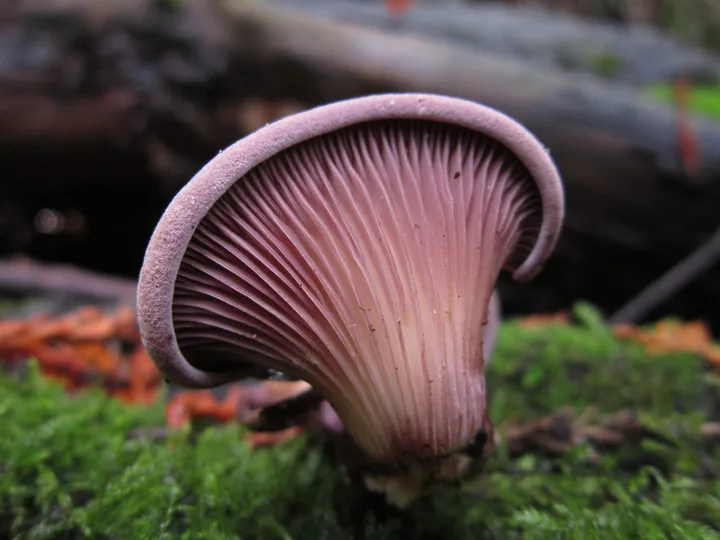
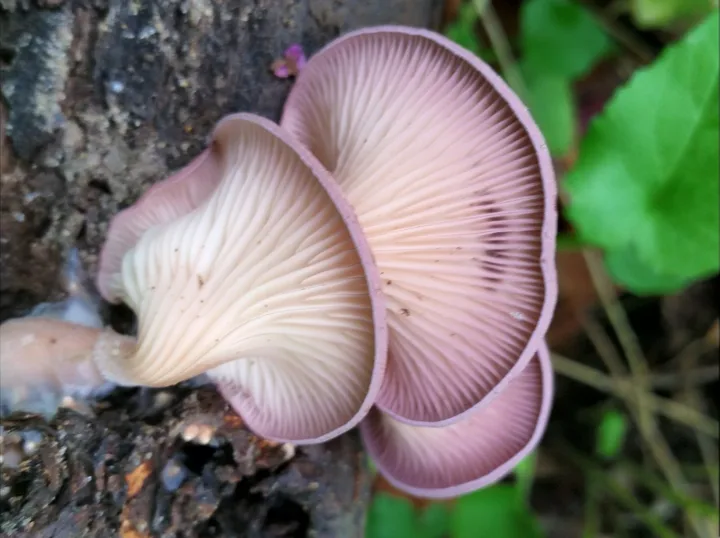
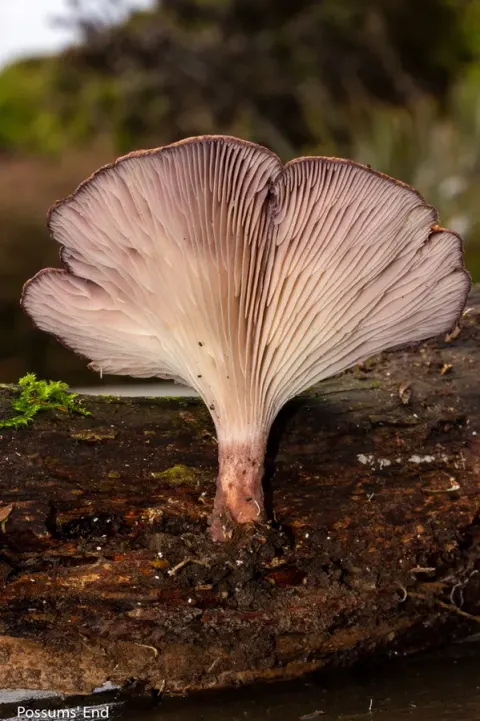
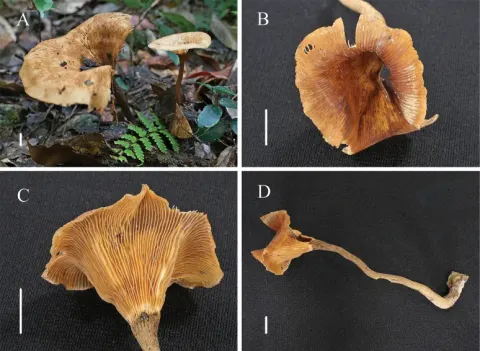
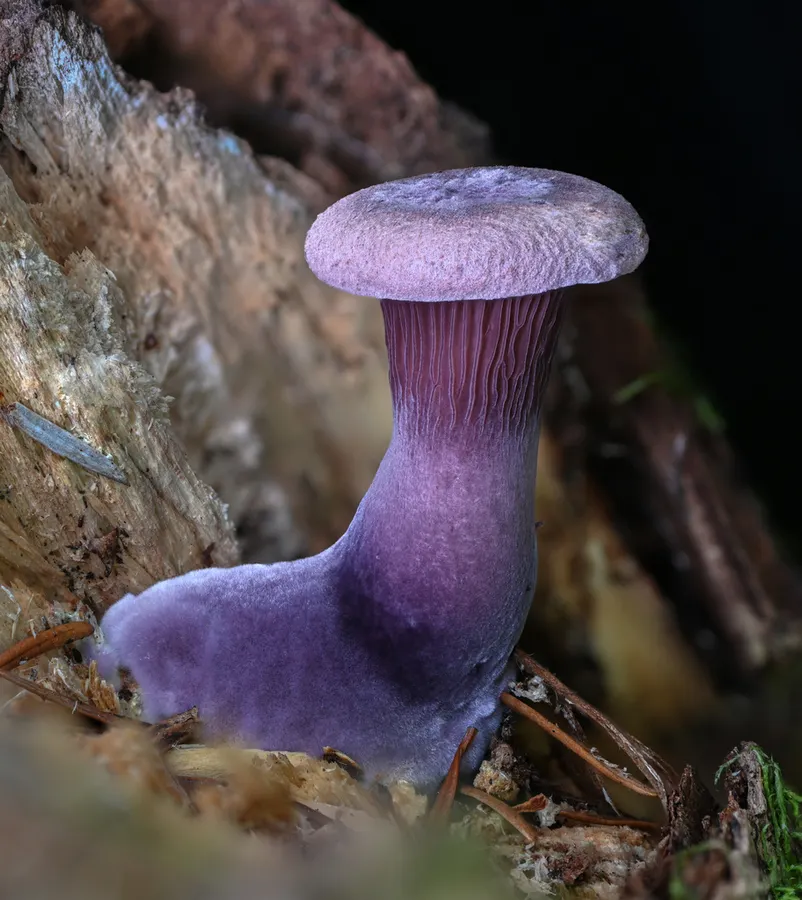
The cap is 3 to 17 cm wide and initially convex before flattening and sometimes becoming centrally depressed in age. The cap is tan, lilac or reddish-brown, and smooth (glabrous); in age the surface may crack into small flattened scales. The cap margin is inrolled and often has a wavy or lobed outline. The flesh is tough and whitish. The gills are attached decurrently (running down the length of the stem) and are narrow and often forked. The gills initially have a violet tinge, but later become light yellow or reddish-violet. The stem is 1.5 to 5 cm long and 0.5 to 3 cm thick, roughly the same color as the cap, but covered with violet hairs; it is attached to the cap laterally, or off-center. The spore print is white. Viewed microscopically, spores are elliptical, smooth, and non-amyloid, with dimensions of 5–7 by 2.5–3.5 μm. The pleurocystidia are either enlarged in the middle (ventricose) or enlarged and spherical at the tip (capitate); these cells have dimensions of 35–45 by 8–11 μm.

Sebagian uraian ditampilkan dalam bahasa sumber; terjemahannya belum tersedia atau belum lolos pemeriksaan.

Rujukan: [1]

Pengukuran mengikuti objek, spesimen atau kultur, dan metode yang disebutkan sumber. Baca uraian asli untuk konteks lengkap.

02 / Kehidupan

Habitat dan peran ekologis

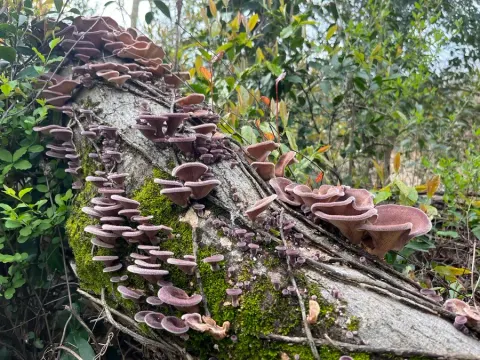
Panus conchatus is a saprobic species—deriving nutrition from rotting or decaying organic matter. Fruit bodies can be found on hardwood stumps, logs and sticks, usually crowded together in clusters. Typical hosts include wood of deciduous trees—especially beech, poplar, birch, and oak, and less frequently on ash and elm. Coniferous hosts include fir, spruce, pine, and yew. Found throughout the Northern Hemisphere, this species has been collected in North America and Europe. It can be found in eastern North America from April to August and on the West Coast from December to June.

Sebagian uraian ditampilkan dalam bahasa sumber; terjemahannya belum tersedia atau belum lolos pemeriksaan.

Rujukan: [1]

Habitat atau konteks temuan
Informasi belum tersedia pada sumber rilis ini.
Substrat
Informasi belum tersedia pada sumber rilis ini.
Peran atau konteks
Pengurai
Temukan hubungan serupa
03 / Siklus hidup

Reproduksi

The cap is 3 to 17 cm wide and initially convex before flattening and sometimes becoming centrally depressed in age. The cap is tan, lilac or reddish-brown, and smooth (glabrous); in age the surface may crack into small flattened scales. The cap margin is inrolled and often has a wavy or lobed outline. The flesh is tough and whitish. The gills are attached decurrently (running down the length of the stem) and are narrow and often forked. The gills initially have a violet tinge, but later become light yellow or reddish-violet. The stem is 1.5 to 5 cm long and 0.5 to 3 cm thick, roughly the same color as the cap, but covered with violet hairs; it is attached to the cap laterally, or off-center.

Sebagian uraian ditampilkan dalam bahasa sumber; terjemahannya belum tersedia atau belum lolos pemeriksaan.

Rujukan: [1]

Sinonim menurut acuan taksonomi rilis: Agaricus carneotomentosus; Agaricus conchatus; Agaricus conchatus var. carneotomentosus; Agaricus conchatus var. inconstans; Agaricus conchatus var. torulosus; Agaricus flabellatus; Agaricus fornicatus; Agaricus fornicatus subsp. torulosus; Agaricus inconstans; Agaricus mesentericus; Agaricus torulosus; Clitocybe inconstans; Lentinopanus conchatus; Lentinus bresadolae; Lentinus carneotomentosus; Lentinus conchatus; Lentinus inconstans; Lentinus obconicus; Lentinus percomis; Lentinus torulosus; Lentinus vaporarius; Panus carneotomentosus; Panus conchatus f. torulosa; Panus conchatus var. inconstans; Panus conchatus var. torulosus; Panus flabelliformis; Panus flabelliformis var. philippinensis; Panus monticola; Panus torulosus; Panus torulosus var. carneotomentosus; Panus torulosus var. conchatus; Panus vaporarius; Pleuropus fornicatus; Pleuropus inconstans; Pleuropus torulosus; Pleurotus carneotomentosus; Pleurotus conchatus; Pleurotus torulosus; Pocillaria conchata; Pocillaria percomis; Pocillaria torulosa; Pocillaria vaporaria
04 / Batas informasi

Catatan identitas dan cakupan

  • Nama diterima mengikuti Catalogue of Life Base2026-09-11; uraian mempertahankan konsep dan nama sumber aslinya.
  • Original geographic, specimen and life-cycle scope retained; source import awaits individual editorial review.
  • Impor dan terjemahan otomatis belum diperiksa editorial per profil. Struktur reproduktif yang disebutkan tidak membuktikan seluruh siklus hidup diketahui.
  • Pengukuran pada uraian mengikuti spesimen, kultur, dan metode sumber; angka tidak diperluas ke semua populasi.

Catatan distribusi dalam narasi mengikuti sumbernya. Dokumentasi spesimen atau foto mengikuti catatan sumber. Bukti wilayah Indonesia dan penilaian konservasi tidak disimpulkan dari gambar.

05 / Dokumentasi

Melihat dengan konteks

Dokumentasi Panus conchatus menurut asosiasi foto pada record takson iNaturalist. Kredit: Alan Rockefeller. Identitas mengikuti sumber; bukan penentuan spesimen independen.

Jenis
Fotografi
Kredit
(c) Alan Rockefeller, some rights reserved (CC BY), uploaded by Alan Rockefeller
Lisensi
CC BY 4.0
Sumber media
Buka entri sumber

Gambar menunjukkan objek menurut identifikasi sumber, bukan verifikasi independen spesimen oleh Fungi. Tidak ada skala baru yang ditambahkan.

Dokumentasi tambahan

06 / Rujukan

Sumber profil

  1. [1] Panus conchatus — Wikipedia (en)Bagian sumber: Frozen revision 1291601223
    Tanggal penghimpunan sumber: 2026-10-12
    Teks sumber: CC BY-SA4.0 · Wikipedia contributors
  2. [2] Catalogue of Life Base2026-09-11 — Panus conchatusBagian sumber: ColDP NameUsage.tsv ID 4CHTM; accepted species; source 2073
    Tanggal penghimpunan sumber: 2026-10-12
  3. [3] Dokumentasi visual — Panus conchatusBagian sumber: Identitas mengikuti sumber dokumentasi; bukan penentuan spesimen independen.
    Tanggal penghimpunan sumber: 2026-10-17
    Media sumber: CC BY 4.0 · (c) Alan Rockefeller, some rights reserved (CC BY), uploaded by Alan Rockefeller
  4. [4] Dokumentasi visual — Panus conchatusBagian sumber: Identitas mengikuti sumber dokumentasi; bukan penentuan spesimen independen.
    Tanggal penghimpunan sumber: 2026-10-17
    Teks sumber: CC BY-SA 4.0 · (c) anonymous, some rights reserved (CC BY-SA)
  5. [5] Dokumentasi visual — Panus conchatusBagian sumber: Identitas mengikuti sumber dokumentasi; bukan penentuan spesimen independen.
    Tanggal penghimpunan sumber: 2026-10-17
    Teks sumber: CC BY-SA 4.0 · (c) Crystal Davidson, some rights reserved (CC BY-SA), uploaded by Crystal Davidson

Adaptasi teks: CC BY-SA 4.0. Wikipedia contributors — Panus conchatus — Wikipedia (en)

Uraian asli dan riwayat sumber

Riwayat atau halaman sumber

Ringkasan sumber

{{Speciesbox The fruit bodies are characterized by a smooth, lilac- or tan-colored cap, and decurrent gills. The fungus is saprophytic and fruits on the decomposing wood of a wide variety of deciduous and coniferous trees throughout the Northern Hemisphere.

Revisi sumber

Morfologi sumber

The cap is 3 to 17 cm wide and initially convex before flattening and sometimes becoming centrally depressed in age. The cap is tan, lilac or reddish-brown, and smooth (glabrous); in age the surface may crack into small flattened scales. The cap margin is inrolled and often has a wavy or lobed outline. The flesh is tough and whitish. The gills are attached decurrently (running down the length of the stem) and are narrow and often forked. The gills initially have a violet tinge, but later become light yellow or reddish-violet. The stem is 1.5 to 5 cm long and 0.5 to 3 cm thick, roughly the same color as the cap, but covered with violet hairs; it is attached to the cap laterally, or off-center. The spore print is white. Viewed microscopically, spores are elliptical, smooth, and non-amyloid, with dimensions of 5–7 by 2.5–3.5 μm. The pleurocystidia are either enlarged in the middle (ventricose) or enlarged and spherical at the tip (capitate); these cells have dimensions of 35–45 by 8–11 μm.

Revisi sumber

Ekologi sumber

Panus conchatus is a saprobic species—deriving nutrition from rotting or decaying organic matter. Fruit bodies can be found on hardwood stumps, logs and sticks, usually crowded together in clusters. Typical hosts include wood of deciduous trees—especially beech, poplar, birch, and oak, and less frequently on ash and elm. Coniferous hosts include fir, spruce, pine, and yew. Found throughout the Northern Hemisphere, this species has been collected in North America and Europe. It can be found in eastern North America from April to August and on the West Coast from December to June.

Revisi sumber

Struktur reproduksi sumber

The cap is 3 to 17 cm wide and initially convex before flattening and sometimes becoming centrally depressed in age. The cap is tan, lilac or reddish-brown, and smooth (glabrous); in age the surface may crack into small flattened scales. The cap margin is inrolled and often has a wavy or lobed outline. The flesh is tough and whitish. The gills are attached decurrently (running down the length of the stem) and are narrow and often forked. The gills initially have a violet tinge, but later become light yellow or reddish-violet. The stem is 1.5 to 5 cm long and 0.5 to 3 cm thick, roughly the same color as the cap, but covered with violet hairs; it is attached to the cap laterally, or off-center.

Revisi sumber

Rujukan halaman ini

Fungi. Panus conchatus. Rilis data fungi-2026-10-12-expansion-2. https://fungi-atlas.mgadib.chatgpt.site/jamur/panus-conchatus/.

Status: impor sumber; pemeriksaan editorial per profil belum selesai. Untuk klaim biologis, gunakan rujukan pada bagian terkait dan periksa konteks sumber aslinya.