01 / Morfologi

Ciri dan struktur

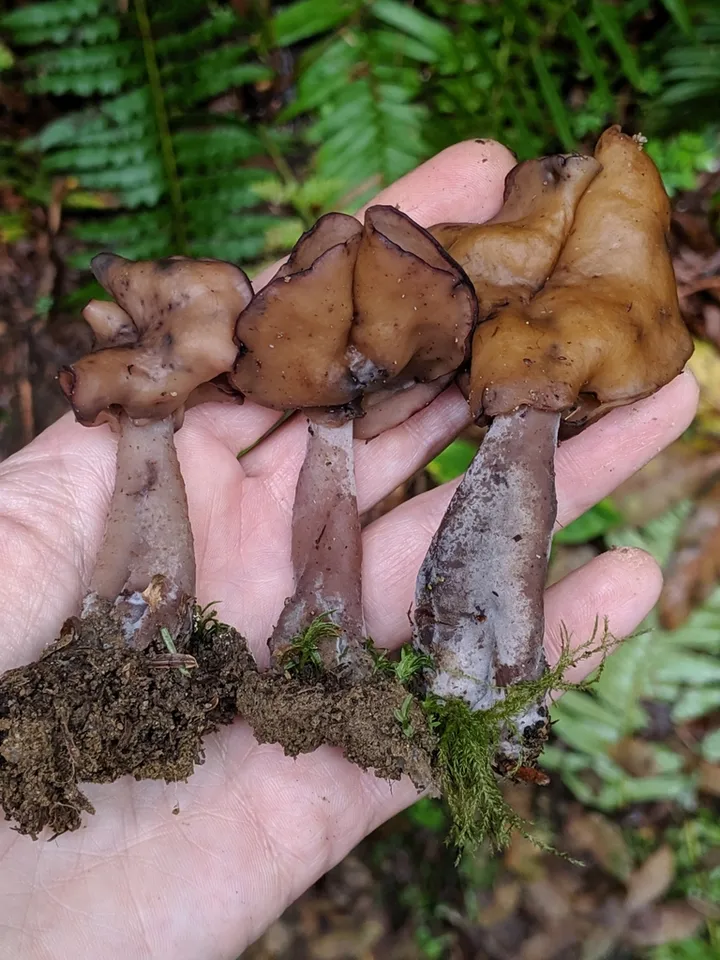
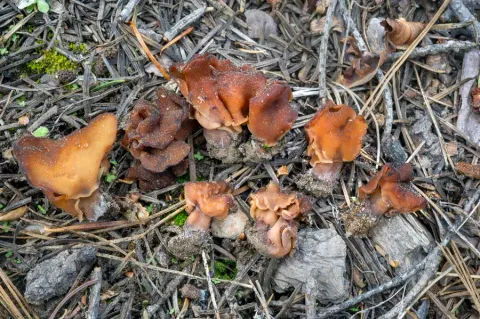
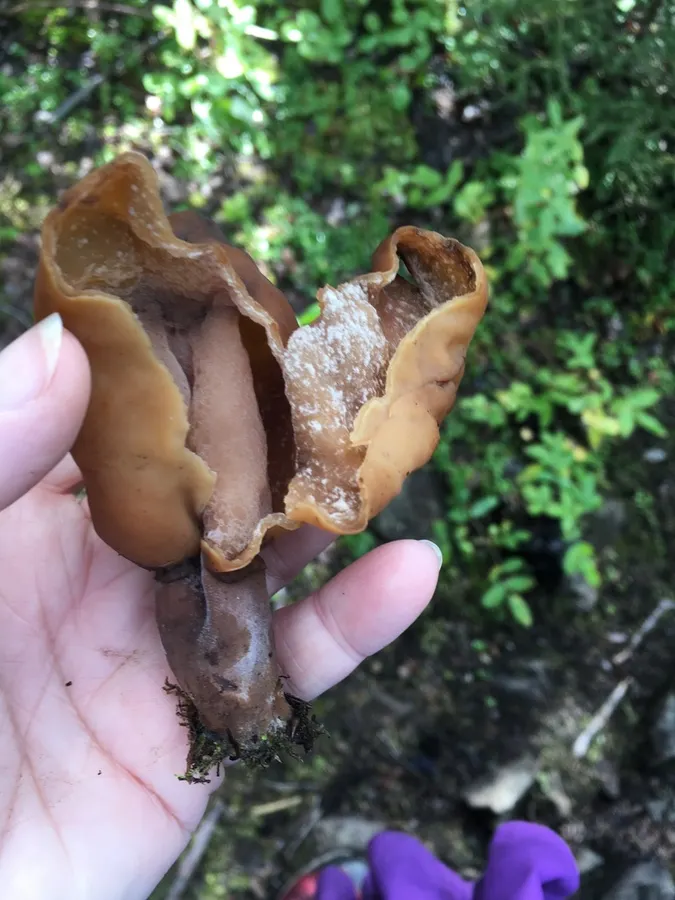
The cap of the fruit body (technically an apothecium) is about 2.5-9 cm wide and tall, reddish to orangish brown, and saddle-shaped with 2–4 lobes. It is chambered or hollow within and frequently develops blackish-brown spots on the surface. During the mushroom's development, the cap's periphery grows into the stipe below to form a hollow, roughly bell-shaped structure with the fertile spore-bearing surface (the hymenium) on the outside; as the surface growth of the hymenium continues to expand even after joining to the stipe, the hymenium can no longer follow and it arches up into folds and pads. The mostly hollow stipe is between 2–8 cm high and 1–2.5 cm thick, varying in color from reddish brown to whitish or even bluish, but is typically lighter than the cap. The stipe is minutely tomentose – covered with a layer of very fine hairs. The context (flesh) is 1–2 millimetres thick, brittle, and whitish to brownish. It lacks a notable odor or taste. Ascospores are ellipsoidal in shape, hyaline, smooth, thin-walled, with dimensions of 17–22 by 7–9 μm. They are also biguttulate, containing two large oil droplets at either end. The spore-producing cells, the asci, are roughly cylindrical, eight-spored, operculate (opening by an apical lid to discharge the spores) and have dimensions of 200–350 by 12–17 |μm. The diameter of the club-shaped paraphyses is 7–10 μm at the apex.

Sebagian uraian ditampilkan dalam bahasa sumber; terjemahannya belum tersedia atau belum lolos pemeriksaan.

Rujukan: [1]

Pengukuran mengikuti objek, spesimen atau kultur, dan metode yang disebutkan sumber. Baca uraian asli untuk konteks lengkap.

02 / Kehidupan

Habitat dan peran ekologis

P. infula tersebar luas di seluruh hutan boreal, pegunungan dan pesisir di Amerika Utara. The North American range extends north to Canada and south to Mexico. Hal ini juga dilaporkan dari Amerika Selatan, Eropa, dan Asia. Jamur ini dapat ditemukan tumbuh secara terpisah untuk tersebar di hutan konifer atau dekatnya pada musim gugur, seringkali di atas kayu busuk. Hal ini juga sering ditemukan di tanah yang penuh, seperti di tepi jalan-jalan pedesaan, atau di perkampungan. Associated conifers include Picea glauca, P. mariana, P. sitchensis, Pinus contorta, P. banksiana, P. monticola, Abies balsamea, A. grandis, Pseudotsuga menziesii, Tsuga heterophylla, Larix occidentalis, Thuja plicata, as well as the deciduous tree species Populus balsamifera, P. tremuloides, Acer macrophyllum, Alnus species, and Betula papyrifera.

Sebagian uraian ditampilkan dalam bahasa sumber; terjemahannya belum tersedia atau belum lolos pemeriksaan.

Rujukan: [1]

Habitat atau konteks temuan
hutan
Substrat
Informasi belum tersedia pada sumber rilis ini.
Peran atau konteks
Belum dikategorikan pada rilis ini.
Temukan hubungan serupa
03 / Siklus hidup

Reproduksi

The cap of the fruit body (technically an apothecium) is about 2.5-9 cm wide and tall, reddish to orangish brown, and saddle-shaped with 2–4 lobes. It is chambered or hollow within and frequently develops blackish-brown spots on the surface. During the mushroom's development, the cap's periphery grows into the stipe below to form a hollow, roughly bell-shaped structure with the fertile spore-bearing surface (the hymenium) on the outside; as the surface growth of the hymenium continues to expand even after joining to the stipe, the hymenium can no longer follow and it arches up into folds and pads. Ascospores are ellipsoidal in shape, hyaline, smooth, thin-walled, with dimensions of 17–22 by 7–9 μm.

Sebagian uraian ditampilkan dalam bahasa sumber; terjemahannya belum tersedia atau belum lolos pemeriksaan.

Rujukan: [1]

Sinonim menurut acuan taksonomi rilis: Gyromitra infula; Gyromitra infula f. gyrosa; Gyromitra infula var. apiculatispora; Helvella friesiana; Helvella infula; Helvella infula f. friesiana; Helvella infula var. terrestris; Helvella infula var. truncigena; Helvella rhodopus; Physomitra infula; Physomitra infula var. friesiana; Physomitra infula var. rhodopus
04 / Batas informasi

Catatan identitas dan cakupan

  • Nama diterima mengikuti Catalogue of Life Base2026-09-11; uraian mempertahankan konsep dan nama sumber aslinya.
  • Original geographic, specimen and life-cycle scope retained; source import awaits individual editorial review.
  • Impor dan terjemahan otomatis belum diperiksa editorial per profil. Struktur reproduktif yang disebutkan tidak membuktikan seluruh siklus hidup diketahui.
  • Pengukuran pada uraian mengikuti spesimen, kultur, dan metode sumber; angka tidak diperluas ke semua populasi.

Catatan distribusi dalam narasi mengikuti sumbernya. Dokumentasi spesimen atau foto mengikuti catatan sumber. Bukti wilayah Indonesia dan penilaian konservasi tidak disimpulkan dari gambar.

05 / Dokumentasi

Melihat dengan konteks

Dokumentasi Paragyromitra infula menurut asosiasi foto pada record takson iNaturalist. Kredit: pynklynx. Identitas mengikuti sumber; bukan penentuan spesimen independen.

Jenis
Fotografi
Kredit
no rights reserved, uploaded by pynklynx
Lisensi
CC0 1.0
Sumber media
Buka entri sumber

Gambar menunjukkan objek menurut identifikasi sumber, bukan verifikasi independen spesimen oleh Fungi. Tidak ada skala baru yang ditambahkan.

Dokumentasi tambahan

06 / Rujukan

Sumber profil

  1. [1] Paragyromitra infula — Wikipedia (en)Bagian sumber: Frozen revision 1299258603
    Tanggal penghimpunan sumber: 2026-10-12
    Teks sumber: CC BY-SA4.0 · Wikipedia contributors
  2. [2] Catalogue of Life Base2026-09-11 — Paragyromitra infulaBagian sumber: ColDP NameUsage.tsv ID CCK2D; accepted species; source 2073
    Tanggal penghimpunan sumber: 2026-10-12
  3. [3] Dokumentasi visual — Paragyromitra infulaBagian sumber: Identitas mengikuti sumber dokumentasi; bukan penentuan spesimen independen.
    Tanggal penghimpunan sumber: 2026-10-17
    Media sumber: CC0 1.0 · no rights reserved, uploaded by pynklynx
  4. [4] Dokumentasi visual — Paragyromitra infulaBagian sumber: Identitas mengikuti sumber dokumentasi; bukan penentuan spesimen independen.
    Tanggal penghimpunan sumber: 2026-10-17
    Teks sumber: CC BY 4.0 · (c) Sharon Squazzo, some rights reserved (CC BY), uploaded by Sharon Squazzo

Adaptasi teks: CC BY-SA 4.0. Wikipedia contributors — Paragyromitra infula — Wikipedia (en)

Uraian asli dan riwayat sumber

Riwayat atau halaman sumber

Ringkasan sumber

Paragyromitra infula, commonly known as the hooded false morel or the elfin saddle, is a species of fungus in the family Discinaceae. The dark reddish-brown caps of the fruit bodies develop a characteristic saddle-shape in maturity, and the ends of both saddle lobes are drawn out to sharp tips that project above the level of the fruit body. The stipe is white or flushed pale brown, smooth on the outside, but hollow with some chambers inside. P. infula is found in the Northern Hemisphere, usually in the late summer and autumn, growing on rotting wood or on hard packed ground.

Revisi sumber

Morfologi sumber

The cap of the fruit body (technically an apothecium) is about 2.5-9 cm wide and tall, reddish to orangish brown, and saddle-shaped with 2–4 lobes. It is chambered or hollow within and frequently develops blackish-brown spots on the surface. During the mushroom's development, the cap's periphery grows into the stipe below to form a hollow, roughly bell-shaped structure with the fertile spore-bearing surface (the hymenium) on the outside; as the surface growth of the hymenium continues to expand even after joining to the stipe, the hymenium can no longer follow and it arches up into folds and pads. The mostly hollow stipe is between 2–8 cm high and 1–2.5 cm thick, varying in color from reddish brown to whitish or even bluish, but is typically lighter than the cap. The stipe is minutely tomentose – covered with a layer of very fine hairs. The context (flesh) is 1–2 millimetres thick, brittle, and whitish to brownish. It lacks a notable odor or taste. Ascospores are ellipsoidal in shape, hyaline, smooth, thin-walled, with dimensions of 17–22 by 7–9 μm. They are also biguttulate, containing two large oil droplets at either end. The spore-producing cells, the asci, are roughly cylindrical, eight-spored, operculate (opening by an apical lid to discharge the spores) and have dimensions of 200–350 by 12–17 |μm. The diameter of the club-shaped paraphyses is 7–10 μm at the apex.

Revisi sumber

Ekologi sumber

P. infula is widely distributed throughout boreal, montane and coastal forests in North America. The North American range extends north to Canada and south to Mexico. It has also been reported from South America, Europe, and Asia. The fungus can be found growing singly to scattered in or near coniferous woodland in autumn, often on rotten wood. It is also commonly found on packed ground, such as beside country roads, or in campgrounds. Associated conifers include Picea glauca, P. mariana, P. sitchensis, Pinus contorta, P. banksiana, P. monticola, Abies balsamea, A. grandis, Pseudotsuga menziesii, Tsuga heterophylla, Larix occidentalis, Thuja plicata, as well as the deciduous tree species Populus balsamifera, P. tremuloides, Acer macrophyllum, Alnus species, and Betula papyrifera.

Revisi sumber

Struktur reproduksi sumber

The cap of the fruit body (technically an apothecium) is about 2.5-9 cm wide and tall, reddish to orangish brown, and saddle-shaped with 2–4 lobes. It is chambered or hollow within and frequently develops blackish-brown spots on the surface. During the mushroom's development, the cap's periphery grows into the stipe below to form a hollow, roughly bell-shaped structure with the fertile spore-bearing surface (the hymenium) on the outside; as the surface growth of the hymenium continues to expand even after joining to the stipe, the hymenium can no longer follow and it arches up into folds and pads. Ascospores are ellipsoidal in shape, hyaline, smooth, thin-walled, with dimensions of 17–22 by 7–9 μm.

Revisi sumber

Rujukan halaman ini

Fungi. Paragyromitra infula. Rilis data fungi-2026-10-12-expansion-2. https://fungi-atlas.mgadib.chatgpt.site/jamur/paragyromitra-infula/.

Status: impor sumber; pemeriksaan editorial per profil belum selesai. Untuk klaim biologis, gunakan rujukan pada bagian terkait dan periksa konteks sumber aslinya.