Ciri dan struktur
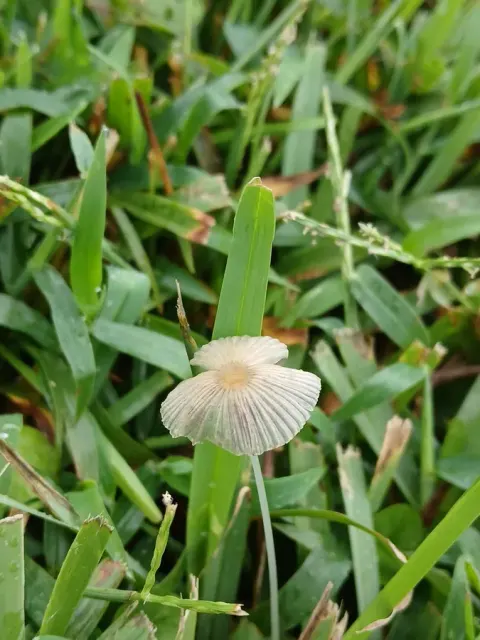
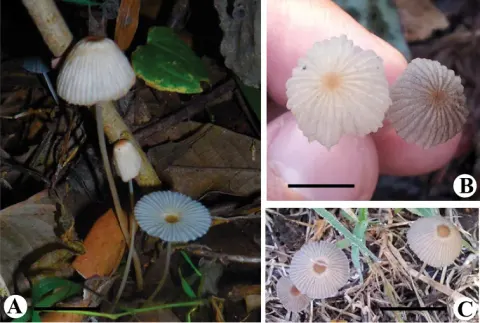
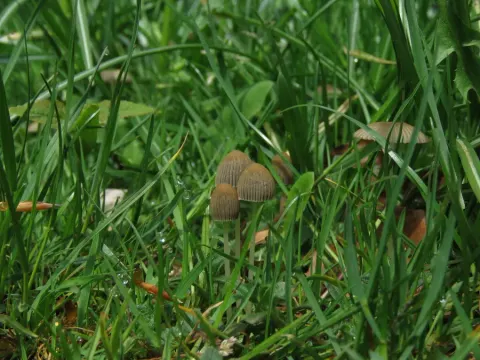
Pileus 8–11 × 6–9 mm when still closed, 15–18 mm when mature, at first semiglobose to mitriform, expanded pileus conical to flattened, mostly with a depressing disc at center; dry; ochreous to dark yellow-brown at center, surrounded with a water-soaked circulus, pale brown-gray at margin, dark yellow-brown at ridge of plication; sulcate-striate up to center. Context extremely thin, almost unseen in membrane part of pileus, cream to sordid yellow, odor and taste not distinctive. Lamellae crowded, free and remote from stipe, with a circular empty space which is visible around the apex of the stipe, 1 mm in wide, L = 35–42, I = 0 or 1, first pale-yellow gray then become gray to purple-gray, or dark gray; hardly deliquescent with age. Stipe 48–71 × 2–3 mm, cylindrical, hollow, equal or slightly attenuate towards the apex, cream and darker at base, glabrous. Spore print not recorded. Basidiospores (13.1–)14.4–15.1(–16.3) × (9.3–)10.1–10.5(–11.9) × (8.3–)8.8–9.5(–9.7)μm, Q 1 = 1.28–1.55, Q 2 = 1.59–1.61, av. Q 1 = 1.43, av. Q 2 = 1.60; ellipsoid, with apical papilla and convex base in front view, narrow ellipsoid in side view; smooth, dark brown to almost black; inamyloid; germ pore central, 2.0–2.9 μm wide. Basidia dimorphic, 17–44 × 11–15 μm (in average 32 × 13 μm), sterigma 4–6 μm, clavate, sometimes constricted in middle part, hyaline, 4-spored, surrounded with 5–7 pseudoparaphyses; subhymenium yellow brown, composed of subglobose, ellipsoid, oblong or cylindrical elements. Cheilocystidia 25–55 × 23–34 μm, abundant, subglobose, utriform, ellipsoid or sublageniform, smooth, colorless, thin-walled.
Habitat dan peran ekologis
Solitary, subfasciculate or in small groups, grow on sandy soil or soil with manure in grassy place. Fruiting in July to August. Recorded with certainty from Netherlands, Britain, Poland in Europe (Uljé 2005; Gierczyk et al. 2011; Schafer 2014) and America (Mainland and Hawaii Islands) (Keirle et al. 2004); other reports also from New Zealand (https://www.gbif.org/); only known from Inner Mongolia Autonomous Region in China so far.
- Habitat atau konteks temuan
- Informasi belum tersedia pada sumber rilis ini.
- Substrat
- Informasi belum tersedia pada sumber rilis ini.
- Peran atau konteks
- Belum dikategorikan pada rilis ini.
Reproduksi
Pileus 8–11 × 6–9 mm when still closed, 15–18 mm when mature, at first semiglobose to mitriform, expanded pileus conical to flattened, mostly with a depressing disc at center; dry; ochreous to dark yellow-brown at center, surrounded with a water-soaked circulus, pale brown-gray at margin, dark yellow-brown at ridge of plication; sulcate-striate up to center. Context extremely thin, almost unseen in membrane part of pileus, cream to sordid yellow, odor and taste not distinctive. Lamellae crowded, free and remote from stipe, with a circular empty space which is visible around the apex of the stipe, 1 mm in wide, L = 35–42, I = 0 or 1, first pale-yellow gray then become gray to purple-gray, or dark gray; hardly deliquescent with age.
Catatan identitas dan cakupan
- Nama diterima mengikuti Catalogue of Life Base2026-09-11; uraian mempertahankan konsep dan nama sumber aslinya.
- Preserve original treatment localities, hosts and substrate scope. Materials examined describe documented specimens, not the full global range.
- Impor dan terjemahan otomatis belum diperiksa editorial per profil. Struktur reproduktif yang disebutkan tidak membuktikan seluruh siklus hidup diketahui.
- Pengukuran pada uraian mengikuti spesimen, kultur, dan metode sumber; angka tidak diperluas ke semua populasi.
Catatan distribusi dalam narasi mengikuti sumbernya. Dokumentasi spesimen atau foto mengikuti catatan sumber. Bukti wilayah Indonesia dan penilaian konservasi tidak disimpulkan dari gambar.
Melihat dengan konteks
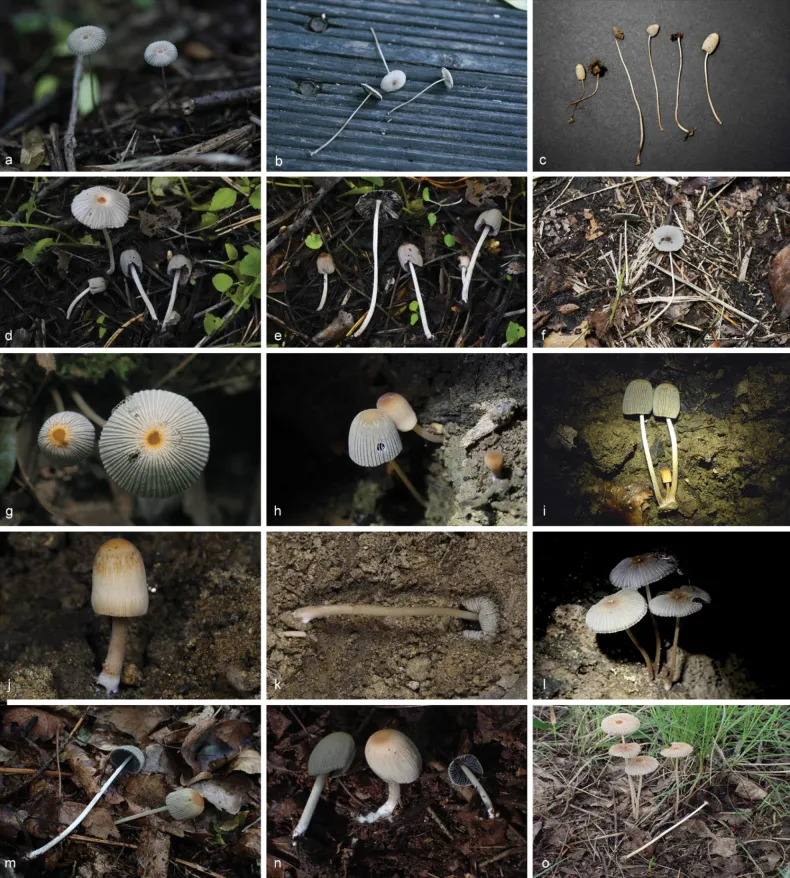
Basidiomata of species in Clade Plicatilis and Clade Misera of sect. Parasola. a–c Parasola tenuissima: a HMJAU64085, b HMJAU64086, c HMJAU64084; d–f Parasola chowii: d HMJAU60358, e HMJAU60374, f HMJAU64099; g–l Parasola neoplicatilis: g, h HMJAU64087, i HMJAU64088, j, k HMJAU60084, l HMJAU64089; m, n Parasola plicatilis: m HMJAU60367, n HMJAU60366; o Parasola megasperma HMJAU60099.
- Jenis
- Pelat ilmiah
- Kredit
- LiYang Zhu, Tolgor Bau
- Lisensi
- CC BY 4.0
- Sumber media
- Buka entri sumber
Dokumentasi tambahan
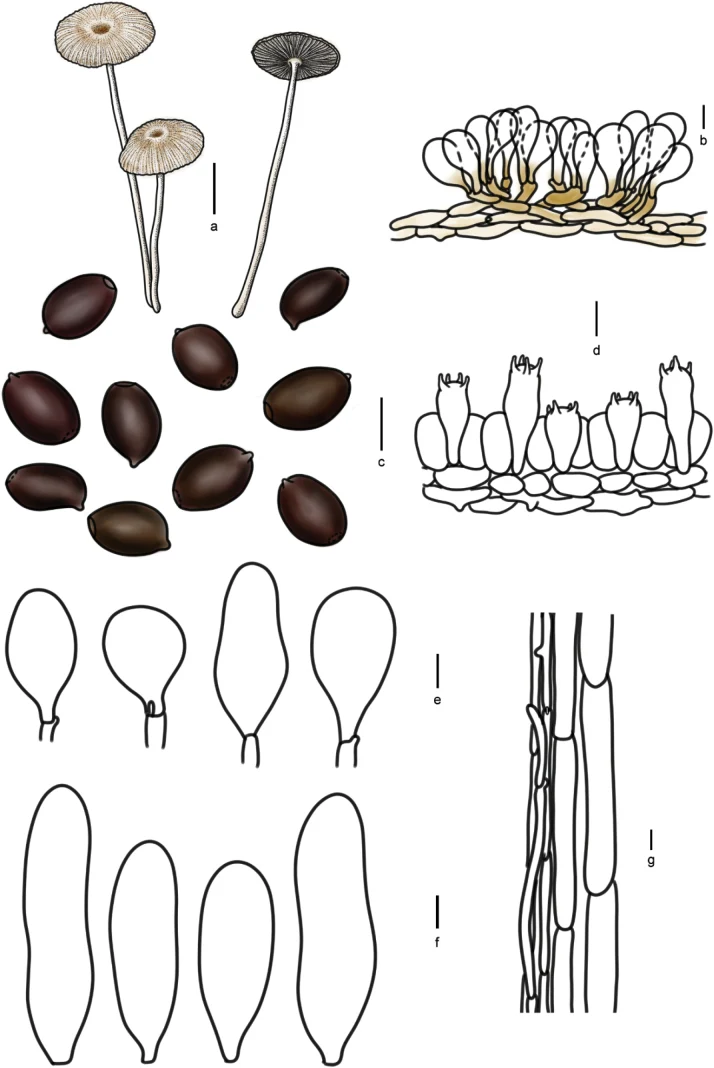
Basidiomata and microscopic structures of Parasola megasperma: a basidiomata (HMJAU64101), b pileipellis (HMJAU60099), c basidiospores (HMJAU60099), d basidia (HMJAU60099), e cheilocystidia (HMJAU60099), f pleurocystidia (HMJAU60099, HMJAU64101), g stipitipellis (HMJAU60099). Scale bars: 1 cm (a); 10 μm (b–g).
Kredit dan penggunaan
LiYang Zhu, Tolgor Bau
Ukuran dan format gambar disesuaikan tanpa pemotongan, retus, atau penambahan skala. Lisensi sumber dipertahankan.
Sumber profil
- [1] Emendation of morphology and infrageneric standards of Parasola (Psathyrellaceae, Agaricales) and its species diversity in China — Parasola megasperma
- [2] Catalogue of Life Base2026-09-11 — Parasola megasperma
- [3] Dokumentasi visual — Parasola megasperma
- [4] Dokumentasi visual — Parasola megasperma
Rujukan halaman ini
Fungi. Parasola megasperma. Rilis data fungi-2026-10-12-expansion-2. https://fungi-atlas.mgadib.chatgpt.site/jamur/parasola-megasperma/.
Status: impor sumber; pemeriksaan editorial per profil belum selesai. Untuk klaim biologis, gunakan rujukan pada bagian terkait dan periksa konteks sumber aslinya.