01 / Morfologi

Ciri dan struktur

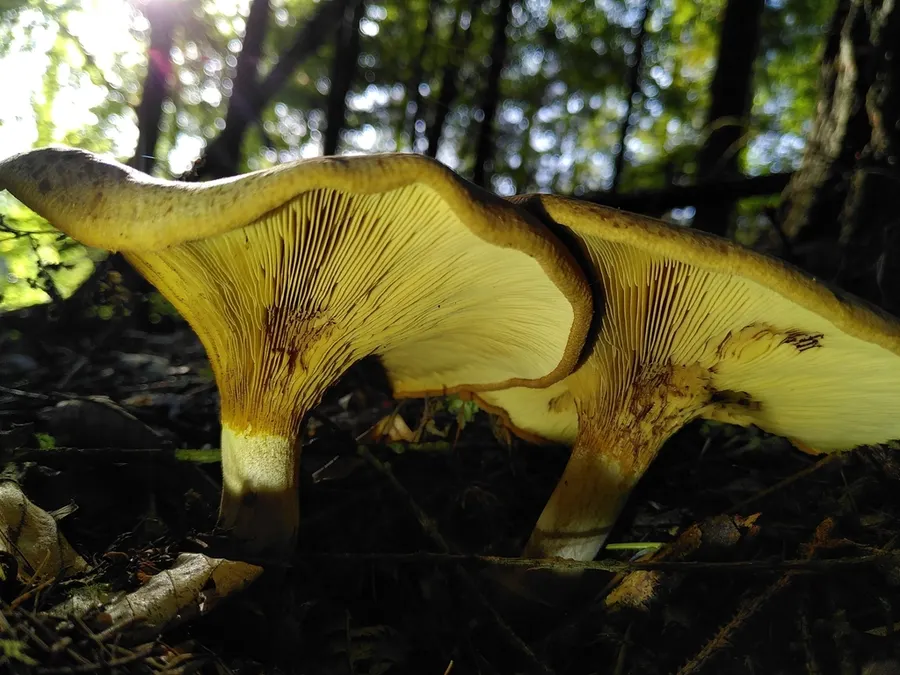
PILEUS: convex or occasionally umbonate when young, applanate, centrally depressed or shallowly infundibuliform at maturity, 4-12 cm diam., slightly to moderately viscid under wet conditions, otherwise dry, velutinate to subtomentose when young, sparsely felted to subglabrous at maturity, often areolately creviced, brownish fawn, ochraceous brown, rusty brown, or faintly olive brown, frequently mottled and with dark reddish brown stains; cuticle a trichodermium when young, composed of erect, filamentous hyphae with clamp connections and brown contents, terminal cells unspecialised, 4-8.5 µm. diam., becoming disorganised at maturity and hyphae obliquely ascending or repent; margins strongly involute and coarsely tomentose when young, irregularly involute and sparsely felted or subglabrous at maturity, often faintly radially sulcate when old. LAMELLAE: crowded, deeply decurrent, meruloid or anastomosing near stipe, simple, anastomosing, or repeatedly dichotomously branched to 3 times, often with prominent side veins, 3-7 mm deep, dull creamy ochraceous when young, darkening to dull yellowish brown or yellowish rusty brown at maturity, discoloured dark reddish brown where damaged, lamellulae present, irregularly arranged. STIPE: 1.5-6 cm long, subequal or tapering basally, occasionally expanded at extreme base, to 1.8 cm diam. apically, to 0.8 cm. diam. basally, central or occasionally eccentric, solid, dry, tomentose, subtomentose, or finely velutinate by presence of filamentous, clamped hyphae with brown contents, or subglabrous, more or less concolorous with lamellae apically, brownish fawn or sordid brown towards base, often with reddish brown tints; flesh sordid brownish fawn, brownish yellow or pallid brown, turning faint reddish brown on exposure to air; veil absent.

Sebagian uraian ditampilkan dalam bahasa sumber; terjemahannya belum tersedia atau belum lolos pemeriksaan.

Rujukan: [1]

Pengukuran mengikuti objek, spesimen atau kultur, dan metode yang disebutkan sumber. Baca uraian asli untuk konteks lengkap.

02 / Kehidupan

Habitat dan peran ekologis

Paxillus involutus is widely distributed throughout temperate and warm temperate regions of the Northern Hemisphere. The species has also been recorded from temperate South America and Australia, but Singer (1964) considered that it might be introduced rather than indigenous to the Southern Hemisphere. It is not clear whether Singer and Moser (1965) regarded P. involutus as an introduced species in Chile. However, the strict association of P. involutus with exotic trees in Australia (Cleland, 1934) and New Zealand strongly suggests that it is not indigenous to these two countries. The mycorrhizal status of P. involutus is uncertain. Singer (1964) considered it to be facultatively mycorrhizal and remarked that while it generally occurred in the shade of trees, it did not necessarily form mycorrhizas with them. Singer and Moser (1965) later regarded the species as transitionally mycorrhizal and capable of living either as a mycorrhizal fungus or independently. The fact that P. involutus occurs only in association with introduced ectotrophs indicates that it is obligatorily mycorrhizal in this country. P. involutus is considered edible but of inferior quality. It has been reported to cause poisonings in Europe and it is now thought necessary to boil the fruitbodies and discard the liquid before eating (Singer, 1962).

Sebagian uraian ditampilkan dalam bahasa sumber; terjemahannya belum tersedia atau belum lolos pemeriksaan.

Rujukan: [1]

Habitat atau konteks temuan
Informasi belum tersedia pada sumber rilis ini.
Substrat
Informasi belum tersedia pada sumber rilis ini.
Peran atau konteks
Mitra tumbuhan
Temukan hubungan serupa
03 / Siklus hidup

Reproduksi

PILEUS: convex or occasionally umbonate when young, applanate, centrally depressed or shallowly infundibuliform at maturity, 4-12 cm diam., slightly to moderately viscid under wet conditions, otherwise dry, velutinate to subtomentose when young, sparsely felted to subglabrous at maturity, often areolately creviced, brownish fawn, ochraceous brown, rusty brown, or faintly olive brown, frequently mottled and with dark reddish brown stains; cuticle a trichodermium when young, composed of erect, filamentous hyphae with clamp connections and brown contents, terminal cells unspecialised, 4-8.5 µm. diam., becoming disorganised at maturity and hyphae obliquely ascending or repent; margins strongly involute and coarsely tomentose when young, irregularly involute and sparsely felted or subglabrous at maturity, often faintly radially sulcate when old.

Sebagian uraian ditampilkan dalam bahasa sumber; terjemahannya belum tersedia atau belum lolos pemeriksaan.

Rujukan: [1]

Sinonim menurut acuan taksonomi rilis: Agaricus adscendibus; Agaricus involutus; Agaricus involutus truncigenus; Agaricus involutus var. stillans; Agaricus involutus var. terrestris; Agaricus involutus var. truncigenus; Omphalia involuta; Omphalia involuta var. truncigena; Paxillus involutus f. eburneus; Paxillus involutus f. subrubicundulus; Paxillus involutus var. leptopus; Paxillus involutus var. simplex; Paxillus leptopus; Rhymovis involuta; Tapinia involuta
04 / Batas informasi

Catatan identitas dan cakupan

  • Nama diterima mengikuti Catalogue of Life Base2026-09-11; uraian mempertahankan konsep dan nama sumber aslinya.
  • Historical description as cited by BiotaNZ. Preserve explicit New Zealand/locality, host and specimen qualifiers. Distribution is the cited source scope, not a current global range.
  • Impor dan terjemahan otomatis belum diperiksa editorial per profil. Struktur reproduktif yang disebutkan tidak membuktikan seluruh siklus hidup diketahui.
  • Pengukuran pada uraian mengikuti spesimen, kultur, dan metode sumber; angka tidak diperluas ke semua populasi.

Catatan distribusi dalam narasi mengikuti sumbernya. Dokumentasi spesimen atau foto mengikuti catatan sumber. Bukti wilayah Indonesia dan penilaian konservasi tidak disimpulkan dari gambar.

05 / Dokumentasi

Melihat dengan konteks

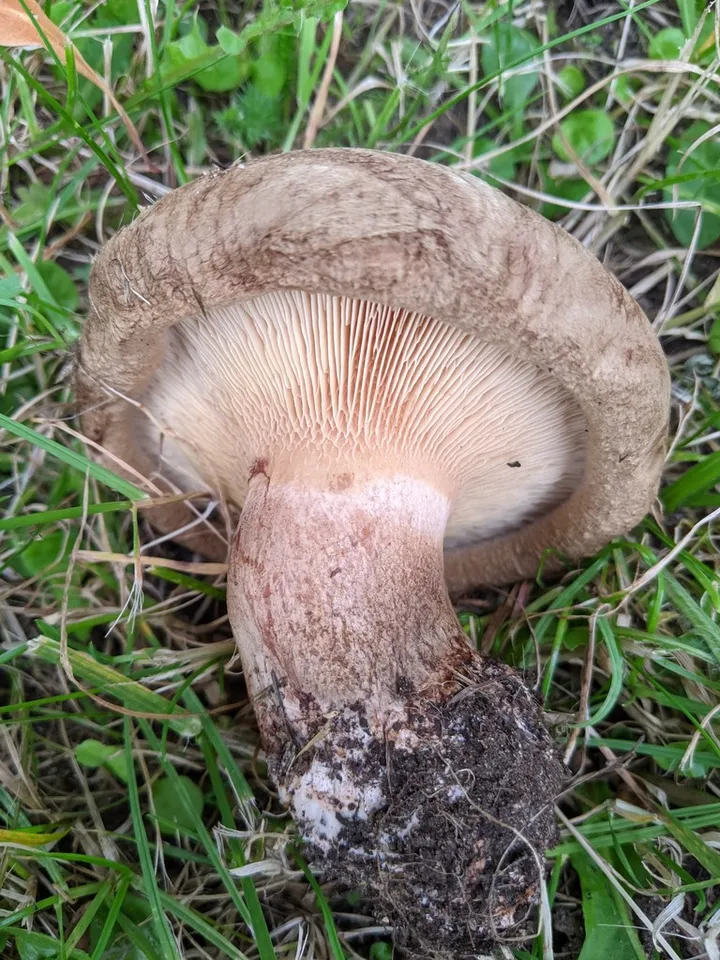
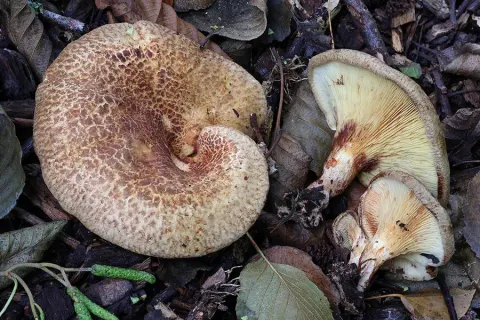
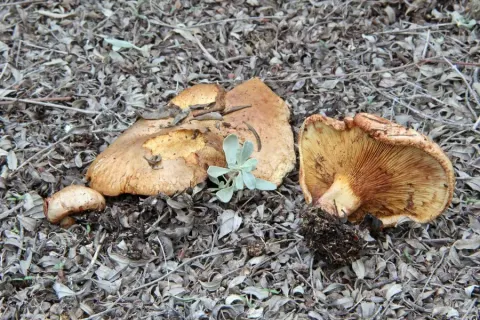
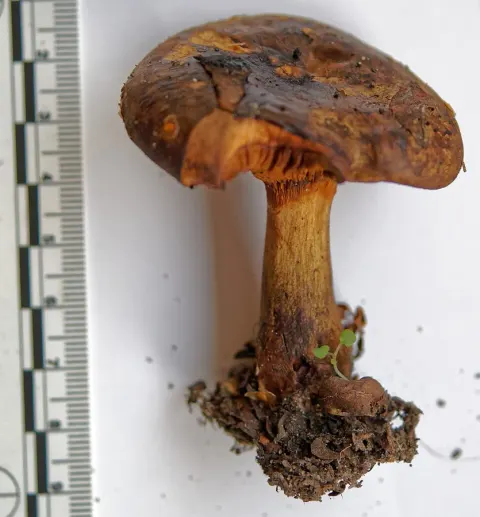
Dokumentasi Paxillus involutus menurut asosiasi foto pada record takson iNaturalist. Kredit: Lorenz Wenner. Identitas mengikuti sumber; bukan penentuan spesimen independen.

Jenis
Fotografi
Kredit
(c) Lorenz Wenner, some rights reserved (CC BY), uploaded by Lorenz Wenner
Lisensi
CC BY 4.0
Sumber media
Buka entri sumber

Gambar menunjukkan objek menurut identifikasi sumber, bukan verifikasi independen spesimen oleh Fungi. Tidak ada skala baru yang ditambahkan.

Dokumentasi tambahan

06 / Rujukan

Sumber profil

  1. [1] McNabb, R.F.R. 1969: The Paxillaceae of New Zealand. New Zealand Journal of Botany 7(4): 349-362. — Paxillus involutusBagian sumber: biota:1cb0ffd5-36b9-11d5-9548-00d0592d548c:1cb1979c-36b9-11d5-9548-00d0592d548c
    Tanggal penghimpunan sumber: 2026-10-12
    Teks sumber: CC BY 4.0 · McNabb, R.F.R. 1969: The Paxillaceae of New Zealand. New Zealand Journal of Botany 7(4): 349-362.
  2. [2] Catalogue of Life Base2026-09-11 — Paxillus involutusBagian sumber: ColDP NameUsage.tsv ID 75VQZ; accepted species; source 2073
    Tanggal penghimpunan sumber: 2026-10-12
  3. [3] Dokumentasi visual — Paxillus involutusBagian sumber: Identitas mengikuti sumber dokumentasi; bukan penentuan spesimen independen.
    Tanggal penghimpunan sumber: 2026-10-17
    Media sumber: CC BY 4.0 · (c) Lorenz Wenner, some rights reserved (CC BY), uploaded by Lorenz Wenner
  4. [4] Dokumentasi visual — Paxillus involutusBagian sumber: Identitas mengikuti sumber dokumentasi; bukan penentuan spesimen independen.
    Tanggal penghimpunan sumber: 2026-10-17
    Teks sumber: CC0 1.0 · no rights reserved, uploaded by Piermario Maculan

Adaptasi teks: CC BY 4.0. McNabb, R.F.R. 1969: The Paxillaceae of New Zealand. New Zealand Journal of Botany 7(4): 349-362. — McNabb, R.F.R. 1969: The Paxillaceae of New Zealand. New Zealand Journal of Botany 7(4): 349-362. — Paxillus involutus

Uraian asli dan riwayat sumber

Riwayat atau halaman sumber

Ringkasan sumber

PILEUS: convex or occasionally umbonate when young, applanate, centrally depressed or shallowly infundibuliform at maturity, 4-12 cm diam., slightly to moderately viscid under wet conditions, otherwise dry, velutinate to subtomentose when young, sparsely felted to subglabrous at maturity, often areolately creviced, brownish fawn, ochraceous brown, rusty brown, or faintly olive brown, frequently mottled and with dark reddish brown stains; cuticle a trichodermium when young, composed of erect, filamentous hyphae with clamp connections and brown contents, terminal cells unspecialised, 4-8.5 µm. diam., becoming disorganised at maturity and hyphae obliquely ascending or repent; margins strongly involute and coarsely tomentose when young, irregularly involute and sparsely felted or subglabrous at maturity, often faintly radially sulcate when old.

Revisi sumber

Morfologi sumber

PILEUS: convex or occasionally umbonate when young, applanate, centrally depressed or shallowly infundibuliform at maturity, 4-12 cm diam., slightly to moderately viscid under wet conditions, otherwise dry, velutinate to subtomentose when young, sparsely felted to subglabrous at maturity, often areolately creviced, brownish fawn, ochraceous brown, rusty brown, or faintly olive brown, frequently mottled and with dark reddish brown stains; cuticle a trichodermium when young, composed of erect, filamentous hyphae with clamp connections and brown contents, terminal cells unspecialised, 4-8.5 µm. diam., becoming disorganised at maturity and hyphae obliquely ascending or repent; margins strongly involute and coarsely tomentose when young, irregularly involute and sparsely felted or subglabrous at maturity, often faintly radially sulcate when old. LAMELLAE: crowded, deeply decurrent, meruloid or anastomosing near stipe, simple, anastomosing, or repeatedly dichotomously branched to 3 times, often with prominent side veins, 3-7 mm deep, dull creamy ochraceous when young, darkening to dull yellowish brown or yellowish rusty brown at maturity, discoloured dark reddish brown where damaged, lamellulae present, irregularly arranged. STIPE: 1.5-6 cm long, subequal or tapering basally, occasionally expanded at extreme base, to 1.8 cm diam. apically, to 0.8 cm. diam. basally, central or occasionally eccentric, solid, dry, tomentose, subtomentose, or finely velutinate by presence of filamentous, clamped hyphae with brown contents, or subglabrous, more or less concolorous with lamellae apically, brownish fawn or sordid brown towards base, often with reddish brown tints; flesh sordid brownish fawn, brownish yellow or pallid brown, turning faint reddish brown on exposure to air; veil absent.

Revisi sumber

Ekologi sumber

Paxillus involutus is widely distributed throughout temperate and warm temperate regions of the Northern Hemisphere. The species has also been recorded from temperate South America and Australia, but Singer (1964) considered that it might be introduced rather than indigenous to the Southern Hemisphere. It is not clear whether Singer and Moser (1965) regarded P. involutus as an introduced species in Chile. However, the strict association of P. involutus with exotic trees in Australia (Cleland, 1934) and New Zealand strongly suggests that it is not indigenous to these two countries. The mycorrhizal status of P. involutus is uncertain. Singer (1964) considered it to be facultatively mycorrhizal and remarked that while it generally occurred in the shade of trees, it did not necessarily form mycorrhizas with them. Singer and Moser (1965) later regarded the species as transitionally mycorrhizal and capable of living either as a mycorrhizal fungus or independently. The fact that P. involutus occurs only in association with introduced ectotrophs indicates that it is obligatorily mycorrhizal in this country. P. involutus is considered edible but of inferior quality. It has been reported to cause poisonings in Europe and it is now thought necessary to boil the fruitbodies and discard the liquid before eating (Singer, 1962).

Revisi sumber

Struktur reproduksi sumber

PILEUS: convex or occasionally umbonate when young, applanate, centrally depressed or shallowly infundibuliform at maturity, 4-12 cm diam., slightly to moderately viscid under wet conditions, otherwise dry, velutinate to subtomentose when young, sparsely felted to subglabrous at maturity, often areolately creviced, brownish fawn, ochraceous brown, rusty brown, or faintly olive brown, frequently mottled and with dark reddish brown stains; cuticle a trichodermium when young, composed of erect, filamentous hyphae with clamp connections and brown contents, terminal cells unspecialised, 4-8.5 µm. diam., becoming disorganised at maturity and hyphae obliquely ascending or repent; margins strongly involute and coarsely tomentose when young, irregularly involute and sparsely felted or subglabrous at maturity, often faintly radially sulcate when old.

Revisi sumber

Rujukan halaman ini

Fungi. Paxillus involutus. Rilis data fungi-2026-10-12-expansion-2. https://fungi-atlas.mgadib.chatgpt.site/jamur/paxillus-involutus/.

Status: impor sumber; pemeriksaan editorial per profil belum selesai. Untuk klaim biologis, gunakan rujukan pada bagian terkait dan periksa konteks sumber aslinya.