01 / Morfologi

Ciri dan struktur

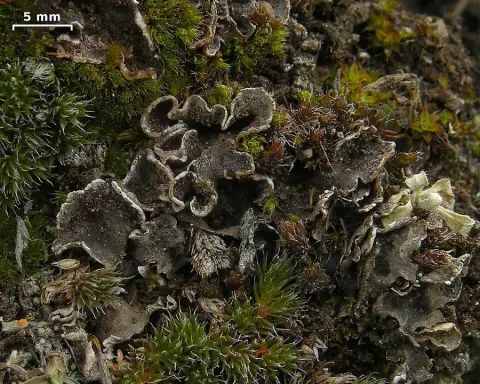
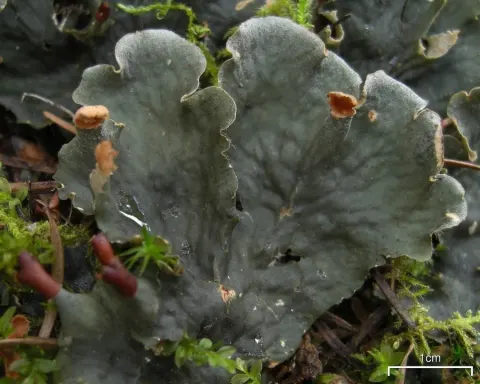
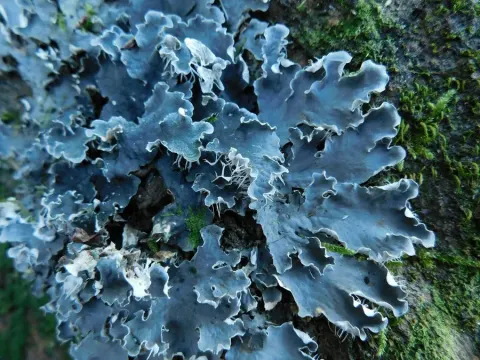
Peltigera latiloba is a large foliose lichen, with thalli reaching about 30 cm across. Its lobes are typically broad (about 3–4 cm wide, occasionally to 6 cm), boat-shaped, and have ascending, scalloped () margins. The upper surface is pale greyish green and often finely furrowed or bumpy, and it is covered with hyaline hairs extending well beyond the lobe-ends towards the centre of the thallus. Small cephalodia (small cyanobacteria-bearing nodules) occur on the upper surface and are greyish blue and brain-like in form, reaching about 1 mm in diameter. The main is a green alga, while the cyanobacterial partner is housed in these external cephalodia. The lower surface has a broad pale marginal zone and a darker central area, and it shows an irregular pattern of depressions that gives it a netlike, pitted appearance. Rhizines (root-like anchoring strands) are dark brown to black, bush-shaped, and mostly separate. Apothecia are reported as not uncommon, and are saddle- to finger-shaped on elongated lobes, with a reddish-brown that can reach about 10 mm in diameter. The spores are 3-septate and needle-like, measuring about 55–62 × 4.5–5.0 μm. Holtan-Hartwig reported two chemotypes that share the same main set of lichen substances but differ in minor components detected by thin-layer chromatography. Fertile thalli of section Peltidea can be separated from often co-occurring P. latiloba (and P. leucophlebia) by the lower side of the apothecia, which is continuous-corticate in section Peltidea but ecorticate or only patchily corticate in P. latiloba. Because broad-lobed, trimembered Peltigera can show overlapping morphology and chemistry, sequence data are sometimes used to confirm identifications in difficult material.

Sebagian uraian ditampilkan dalam bahasa sumber; terjemahannya belum tersedia atau belum lolos pemeriksaan.

Rujukan: [1]

Pengukuran mengikuti objek, spesimen atau kultur, dan metode yang disebutkan sumber. Baca uraian asli untuk konteks lengkap.

02 / Kehidupan

Habitat dan peran ekologis

In Norway, the species occurs on the ground in well-developed, fluffy moss carpets, especially in subalpine birch forests and low-alpine dwarf-shrub vegetation. The type locality in Finnmark was in moist birch forest on a steep east-facing slope at about 130 m elevation. Holtan-Hartwig reported Norwegian records from Oppland, Sør-Trøndelag, and Finnmark. It has also been recorded from Greenland, East Karelia, and from northern Kamchatka, Russia. In the latter record, the lichen was parasitized by the lichenicolous fungus species Arthonia peltigerea.

Sebagian uraian ditampilkan dalam bahasa sumber; terjemahannya belum tersedia atau belum lolos pemeriksaan.

Rujukan: [1]

Habitat atau konteks temuan
hutan
Substrat
tanah
Peran atau konteks
Pembentuk liken
Temukan hubungan serupa
03 / Siklus hidup

Reproduksi

The lower surface has a broad pale marginal zone and a darker central area, and it shows an irregular pattern of depressions that gives it a netlike, pitted appearance. Rhizines (root-like anchoring strands) are dark brown to black, bush-shaped, and mostly separate. Apothecia are reported as not uncommon, and are saddle- to finger-shaped on elongated lobes, with a reddish-brown that can reach about 10 mm in diameter. The spores are 3-septate and needle-like, measuring about 55–62 × 4.5–5.0 μm. Holtan-Hartwig reported two chemotypes that share the same main set of lichen substances but differ in minor components detected by thin-layer chromatography.

Sebagian uraian ditampilkan dalam bahasa sumber; terjemahannya belum tersedia atau belum lolos pemeriksaan.

Rujukan: [1]

04 / Batas informasi

Catatan identitas dan cakupan

  • Nama diterima mengikuti Catalogue of Life Base2026-09-11; uraian mempertahankan konsep dan nama sumber aslinya.
  • Original geographic, specimen and life-cycle scope retained; source import awaits individual editorial review.
  • Impor dan terjemahan otomatis belum diperiksa editorial per profil. Struktur reproduktif yang disebutkan tidak membuktikan seluruh siklus hidup diketahui.
  • Pengukuran pada uraian mengikuti spesimen, kultur, dan metode sumber; angka tidak diperluas ke semua populasi.

Catatan distribusi dalam narasi mengikuti sumbernya. Dokumentasi spesimen atau foto mengikuti catatan sumber. Bukti wilayah Indonesia dan penilaian konservasi tidak disimpulkan dari gambar.

05 / Dokumentasi

Melihat dengan konteks

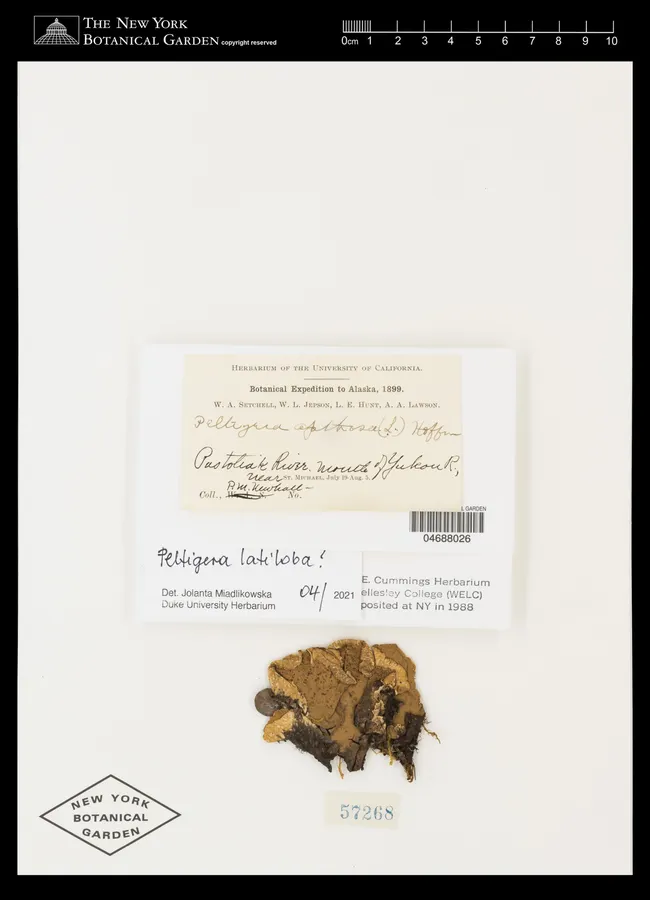
Voucher herbarium Peltigera latiloba (04688026), The New York Botanical Garden. Identifikasi mengikuti record spesimen sumber. Foto bahan, kemasan, atau label herbarium sebagaimana tersedia pada record institusi; bukan foto lapangan atau penentuan spesimen independen.

Jenis
Voucher herbarium
Kredit
The New York Botanical Garden
Lisensi
CC BY 4.0
Sumber media
Buka entri sumber

Gambar menunjukkan objek menurut identifikasi sumber, bukan verifikasi independen spesimen oleh Fungi. Tidak ada skala baru yang ditambahkan.

06 / Rujukan

Sumber profil

  1. [1] Peltigera latiloba — Wikipedia (en)Bagian sumber: Frozen revision 1341959063
    Tanggal penghimpunan sumber: 2026-10-12
    Teks sumber: CC BY-SA4.0 · Wikipedia contributors
  2. [2] Catalogue of Life Base2026-09-11 — Peltigera latilobaBagian sumber: ColDP NameUsage.tsv ID 76F86; accepted species; source 2073
    Tanggal penghimpunan sumber: 2026-10-12
  3. [3] Dokumentasi visual — Peltigera latilobaBagian sumber: Individual media record; identification follows the source, not independent determination
    Tanggal penghimpunan sumber: 2026-10-12
    Media sumber: CC BY 4.0 · The New York Botanical Garden

Adaptasi teks: CC BY-SA 4.0. Wikipedia contributors — Peltigera latiloba — Wikipedia (en)

Uraian asli dan riwayat sumber

Riwayat atau halaman sumber

Ringkasan sumber

Peltigera latiloba is a species of lichen-forming fungus in the family Peltigeraceae. It is a large, leafy (foliose) lichen with broad, boat-shaped and a hairy upper surface, growing on mossy ground in subalpine and low-alpine habitats. Like other members of the P. aphthosa group, it is a trimembered lichen, housing both a green alga and a cyanobacterium as photosynthetic partners. It was described in 2005 from Norway and Alaska, and has since been recorded from Greenland, East Karelia, and Kamchatka.

Revisi sumber

Morfologi sumber

Peltigera latiloba is a large foliose lichen, with thalli reaching about 30 cm across. Its lobes are typically broad (about 3–4 cm wide, occasionally to 6 cm), boat-shaped, and have ascending, scalloped () margins. The upper surface is pale greyish green and often finely furrowed or bumpy, and it is covered with hyaline hairs extending well beyond the lobe-ends towards the centre of the thallus. Small cephalodia (small cyanobacteria-bearing nodules) occur on the upper surface and are greyish blue and brain-like in form, reaching about 1 mm in diameter. The main is a green alga, while the cyanobacterial partner is housed in these external cephalodia. The lower surface has a broad pale marginal zone and a darker central area, and it shows an irregular pattern of depressions that gives it a netlike, pitted appearance. Rhizines (root-like anchoring strands) are dark brown to black, bush-shaped, and mostly separate. Apothecia are reported as not uncommon, and are saddle- to finger-shaped on elongated lobes, with a reddish-brown that can reach about 10 mm in diameter. The spores are 3-septate and needle-like, measuring about 55–62 × 4.5–5.0 μm. Holtan-Hartwig reported two chemotypes that share the same main set of lichen substances but differ in minor components detected by thin-layer chromatography. Fertile thalli of section Peltidea can be separated from often co-occurring P. latiloba (and P. leucophlebia) by the lower side of the apothecia, which is continuous-corticate in section Peltidea but ecorticate or only patchily corticate in P. latiloba. Because broad-lobed, trimembered Peltigera can show overlapping morphology and chemistry, sequence data are sometimes used to confirm identifications in difficult material.

Revisi sumber

Ekologi sumber

In Norway, the species occurs on the ground in well-developed, fluffy moss carpets, especially in subalpine birch forests and low-alpine dwarf-shrub vegetation. The type locality in Finnmark was in moist birch forest on a steep east-facing slope at about 130 m elevation. Holtan-Hartwig reported Norwegian records from Oppland, Sør-Trøndelag, and Finnmark. It has also been recorded from Greenland, East Karelia, and from northern Kamchatka, Russia. In the latter record, the lichen was parasitized by the lichenicolous fungus species Arthonia peltigerea.

Revisi sumber

Struktur reproduksi sumber

The lower surface has a broad pale marginal zone and a darker central area, and it shows an irregular pattern of depressions that gives it a netlike, pitted appearance. Rhizines (root-like anchoring strands) are dark brown to black, bush-shaped, and mostly separate. Apothecia are reported as not uncommon, and are saddle- to finger-shaped on elongated lobes, with a reddish-brown that can reach about 10 mm in diameter. The spores are 3-septate and needle-like, measuring about 55–62 × 4.5–5.0 μm. Holtan-Hartwig reported two chemotypes that share the same main set of lichen substances but differ in minor components detected by thin-layer chromatography.

Revisi sumber

Rujukan halaman ini

Fungi. Peltigera latiloba. Rilis data fungi-2026-10-12-expansion-2. https://fungi-atlas.mgadib.chatgpt.site/jamur/peltigera-latiloba/.

Status: impor sumber; pemeriksaan editorial per profil belum selesai. Untuk klaim biologis, gunakan rujukan pada bagian terkait dan periksa konteks sumber aslinya.