Etimologi: Epitet spesifik palmicola mengacu pada pohon palma tuan rumah, yang hidup jamur. Saprobic on mati, daun jatuh dari sawit tak dikenal. Morph seksual tidak ditentukan. Aseksual morph koloni di substratum superficial, banyak, effuse, hitam, floccose. Mycelium immersed pada substrat, terdiri dari bersepta, bercabang, halus, gelap hifa. konidiofor 151–188 μm panjang × 5.6–8 μm lebar (\(\bar{x} \) = 175.4 × 6.8 μm, n = 10), makronemat, mononemat, bersepta, sebagian membentuk kepala bola dan bercabang di puncak, tegak, sebagian besar sedikit lentur ke melengkung, cokelat gelap ke hitam.
Profil ini diimpor dari uraian spesies pada sumber berlisensi dan sebagian teks diterjemahkan otomatis. Pemeriksaan editorial per profil belum selesai. Bagian yang belum diterjemahkan atau belum lolos pemeriksaan terjemahan tetap ditampilkan dalam bahasa sumber. Angka dan nama ilmiah dipertahankan.
Etymolgy: The specific epithet “ palmicola ” refers to the host palm, of which the fungus was living. Saprobic on dead, fallen leaves of unidentified palm. Sexual morph Undetermined. Asexual morph Colonies on the substratum superficial, numerous, effuse, black, floccose. Mycelium immersed on the substrate, composed of septate, branched, smooth, dark hyphae. Conidiophores 151–188 μm long × 5.6–8 μm wide (\(\bar{x} \) = 175.4 × 6.8 μm, n = 10), macronematous, mononematous, septate, partly forming sphaerical heads and branched at apex, erect, mostly slightly flexuous to curved, dark brown to black. Conidiogenous cells 3–3.5 μm long × 3–4.8 μm wide (\(\bar{x} \) = 3.2 × 4 μm, n = 10), mono- to polyblastic, discrete, terminal, globose, hyaline to subhyaline. Conidia 5.1–7.4 μm long × 4.8–6.1 μm wide (\(\bar{x} \) = 6.2 × 5.5 μm, n = 20), solitary to catenate, in acropetal chains, subglobose to globose, light brown to brown, verruculose. Culture characteristics: Conidia germinating on PDA within 14 h and germ tubes produced from top cells. Colonies growing on PDA, hairy or cottony, white to grey, reaching 5 mm in 20 days at 25 °C, mycelium superficial, effuse, radially striate, with regular edge, subhyaline to pale white hyphae; Asexual spores and sexual spores were not formed within two months.
Sebagian uraian ditampilkan dalam bahasa sumber; terjemahannya belum tersedia atau belum lolos pemeriksaan.
Pengukuran mengikuti objek, spesimen atau kultur, dan metode yang disebutkan sumber. Baca uraian asli untuk konteks lengkap.
02 / Kehidupan
Habitat dan peran ekologis
Saprobic on dead, fallen leaves of unidentified palm. Sexual morph Undetermined. Asexual morph Colonies on the substratum superficial, numerous, effuse, black, floccose. Mycelium immersed on the substrate, composed of septate, branched, smooth, dark hyphae. Conidiophores 151–188 μm long × 5.6–8 μm wide (\(\bar{x} \) = 175.4 × 6.8 μm, n = 10), macronematous, mononematous, septate, partly forming sphaerical heads and branched at apex, erect, mostly slightly flexuous to curved, dark brown to black. Conidiogenous cells 3–3.5 μm long × 3–4.8 μm wide (\(\bar{x} \) = 3.2 × 4 μm, n = 10), mono- to polyblastic, discrete, terminal, globose, hyaline to subhyaline. Conidia 5.1–7.4 μm long × 4.8–6.1 μm wide (\(\bar{x} \) = 6.2 × 5.5 μm, n = 20), solitary to catenate, in acropetal chains, subglobose to globose, light brown to brown, verruculose. Culture characteristics: Conidia germinating on PDA within 14 h and germ tubes produced from top cells. Colonies growing on PDA, hairy or cottony, white to grey, reaching 5 mm in 20 days at 25 °C, mycelium superficial, effuse, radially striate, with regular edge, subhyaline to pale white hyphae; Asexual spores and sexual spores were not formed within two months.
Sebagian uraian ditampilkan dalam bahasa sumber; terjemahannya belum tersedia atau belum lolos pemeriksaan.
Saprobic on dead, fallen leaves of unidentified palm. Sexual morph Undetermined. Asexual morph Colonies on the substratum superficial, numerous, effuse, black, floccose. Mycelium immersed on the substrate, composed of septate, branched, smooth, dark hyphae. Conidiophores 151–188 μm long × 5.6–8 μm wide (\(\bar{x} \) = 175.4 × 6.8 μm, n = 10), macronematous, mononematous, septate, partly forming sphaerical heads and branched at apex, erect, mostly slightly flexuous to curved, dark brown to black. Conidiogenous cells 3–3.5 μm long × 3–4.8 μm wide (\(\bar{x} \) = 3.2 × 4 μm, n = 10), mono- to polyblastic, discrete, terminal, globose, hyaline to subhyaline. Conidia 5.1–7.4 μm long × 4.8–6.1 μm wide (\(\bar{x} \) = 6.2 × 5.5 μm, n = 20), solitary to catenate, in acropetal chains, subglobose to globose, light brown to brown, verruculose.
Sebagian uraian ditampilkan dalam bahasa sumber; terjemahannya belum tersedia atau belum lolos pemeriksaan.
Nama diterima mengikuti Catalogue of Life Base2026-09-11; uraian mempertahankan konsep dan nama sumber aslinya.
Preserve original monograph treatment localities, hosts and specimen/substrate scope. Materials examined document specimens, not the full global range.
Impor dan terjemahan otomatis belum diperiksa editorial per profil. Struktur reproduktif yang disebutkan tidak membuktikan seluruh siklus hidup diketahui.
Pengukuran pada uraian mengikuti spesimen, kultur, dan metode sumber; angka tidak diperluas ke semua populasi.
Catatan distribusi dalam narasi mengikuti sumbernya. Dokumentasi spesimen atau foto mengikuti catatan sumber. Bukti wilayah Indonesia dan penilaian konservasi tidak disimpulkan dari gambar.
05 / Dokumentasi
Melihat dengan konteks
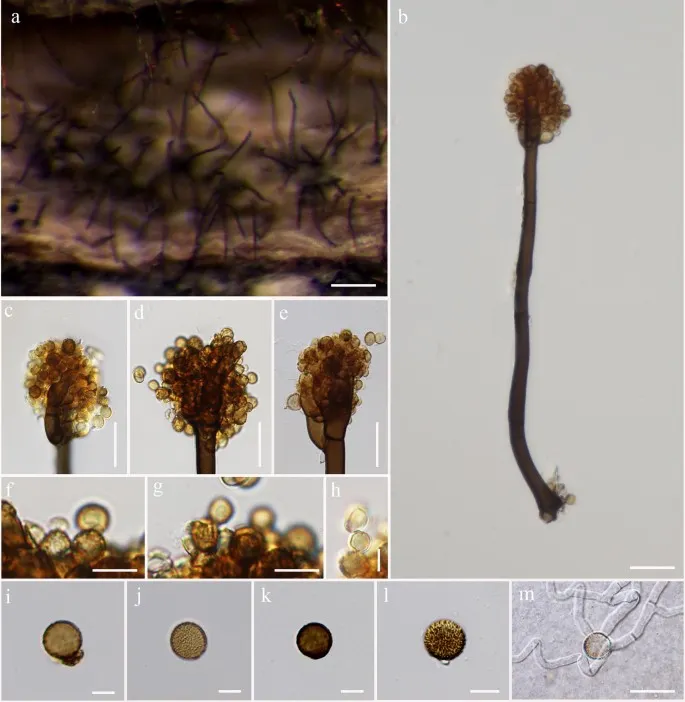
Periconia palmicola (MFLU 14-0198, holotype). a Appearance of fungal colonies on host substrate. b Conidiophores. c – e Close up conidiophores attached with conidiogenous cells. f – h Conidiogenous cells. i – l Conidia. m Germinated conidia. Scale bars: a = 100 µm, c – e = 20 µm, b, m = 10 µm, f – h = 5 µm, i – l = 2 µm
Jenis
Pelat ilmiah
Kredit
Penulis dan sumber artikel: Hyde, Kevin D.; Dong, Yang; Phookamsak, Rungtiwa; Jeewon, Rajesh; Bhat, D. Jayarama; Jones, E. B. Gareth; Liu, Ning-Guo; Abeywickrama, Pranami D.; Mapook, Ausana; Wei, Deping; Perera, Rekhani H.; Manawasinghe, Ishara S.; Pem, Dhandevi; Bundhun, Digvijayini; Karunarathna, Anuruddha; Ekanayaka, Anusha H.; Bao, Dan-Feng; Li, Junfu; Samarakoon, Milan C.; Chaiwan, Napalai; Lin, Chuan-Gen; Phutthacharoen, Kunthida; Zhang, Sheng-Nan; Senanayake, Indunil C.; Goonasekara, Ishani D.; Thambugala, Kasun M.; Phukhamsakda, Chayanard; Tennakoon, Danushka S.; Jiang, Hong-Bo; Yang, Jing; Zeng, Ming; Huanraluek, Naruemon; Liu, Jian-Kui (Jack); Wijesinghe, Subodini N.; Tian, Qing; Tibpromma, Saowaluck; Brahmanage, Rashika S.; Boonmee, Saranyaphat; Huang, Shi-Ke; Thiyagaraja, Vinodhini; Lu, Yong-Zhong; Jayawardena, Ruvishika S.; Dong, Wei; Yang, Er-Fu; Singh, Sanjay K.; Singh, Shiv Mohan; Rana, Shiwali; Lad, Sneha S.; Anand, Garima; Devadatha, Bandarupalli; Niranjan, M.; Sarma, V. Venkateswara; Liimatainen, Kare; Aguirre-Hudson, Begoña; Niskanen, Tuula; Overall, Andy; Alvarenga, Renato Lúcio Mendes; Gibertoni, Tatiana Baptista; Pfliegler, Walter P.; Horváth, Enikő; Imre, Alexandra; Alves, Amanda Lucia; da Silva Santos, Ana Carla; Tiago, Patricia Vieira; Bulgakov, Timur S.; Wanasinghe, Dhanushaka N.; Bahkali, Ali H.; Doilom, Mingkwan; Elgorban, Abdallah M.; Maharachchikumbura, Sajeewa S. N.; Rajeshkumar, Kunhiraman C.; Haelewaters, Danny; Mortimer, Peter E.; Zhao, Qi; Lumyong, Saisamorn; Xu, Jianchu; Sheng, Jun
Etymolgy: The specific epithet “ palmicola ” refers to the host palm, of which the fungus was living.
Saprobic on dead, fallen leaves of unidentified palm.
Sexual morph Undetermined.
Asexual morph Colonies on the substratum superficial, numerous, effuse, black, floccose.
Mycelium immersed on the substrate, composed of septate, branched, smooth, dark hyphae.
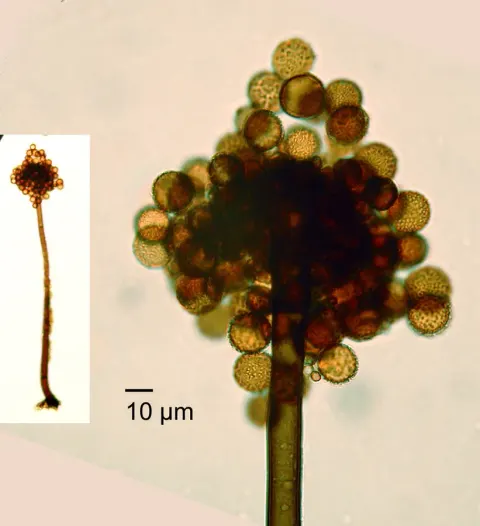
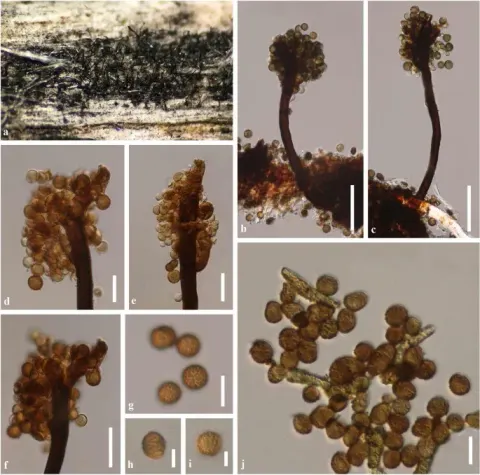
Conidiophores 151–188 μm long × 5.6–8 μm wide (\(\bar{x} \) = 175.4 × 6.8 μm, n = 10), macronematous, mononematous, septate, partly forming sphaerical heads and branched at apex, erect, mostly slightly flexuous to curved, dark brown to black.
Etymolgy: The specific epithet “ palmicola ” refers to the host palm, of which the fungus was living.
Saprobic on dead, fallen leaves of unidentified palm. Sexual morph Undetermined. Asexual morph Colonies on the substratum superficial, numerous, effuse, black, floccose. Mycelium immersed on the substrate, composed of septate, branched, smooth, dark hyphae. Conidiophores 151–188 μm long × 5.6–8 μm wide (\(\bar{x} \) = 175.4 × 6.8 μm, n = 10), macronematous, mononematous, septate, partly forming sphaerical heads and branched at apex, erect, mostly slightly flexuous to curved, dark brown to black. Conidiogenous cells 3–3.5 μm long × 3–4.8 μm wide (\(\bar{x} \) = 3.2 × 4 μm, n = 10), mono- to polyblastic, discrete, terminal, globose, hyaline to subhyaline. Conidia 5.1–7.4 μm long × 4.8–6.1 μm wide (\(\bar{x} \) = 6.2 × 5.5 μm, n = 20), solitary to catenate, in acropetal chains, subglobose to globose, light brown to brown, verruculose.
Culture characteristics: Conidia germinating on PDA within 14 h and germ tubes produced from top cells. Colonies growing on PDA, hairy or cottony, white to grey, reaching 5 mm in 20 days at 25 °C, mycelium superficial, effuse, radially striate, with regular edge, subhyaline to pale white hyphae; Asexual spores and sexual spores were not formed within two months.
Saprobic on dead, fallen leaves of unidentified palm.
Sexual morph Undetermined.
Asexual morph Colonies on the substratum superficial, numerous, effuse, black, floccose.
Mycelium immersed on the substrate, composed of septate, branched, smooth, dark hyphae.
Conidiophores 151–188 μm long × 5.6–8 μm wide (\(\bar{x} \) = 175.4 × 6.8 μm, n = 10), macronematous, mononematous, septate, partly forming sphaerical heads and branched at apex, erect, mostly slightly flexuous to curved, dark brown to black.
Conidiogenous cells 3–3.5 μm long × 3–4.8 μm wide (\(\bar{x} \) = 3.2 × 4 μm, n = 10), mono- to polyblastic, discrete, terminal, globose, hyaline to subhyaline.
Conidia 5.1–7.4 μm long × 4.8–6.1 μm wide (\(\bar{x} \) = 6.2 × 5.5 μm, n = 20), solitary to catenate, in acropetal chains, subglobose to globose, light brown to brown, verruculose.
Culture characteristics: Conidia germinating on PDA within 14 h and germ tubes produced from top cells.
Colonies growing on PDA, hairy or cottony, white to grey, reaching 5 mm in 20 days at 25 °C, mycelium superficial, effuse, radially striate, with regular edge, subhyaline to pale white hyphae; Asexual spores and sexual spores were not formed within two months.
Saprobic on dead, fallen leaves of unidentified palm.
Sexual morph Undetermined.
Asexual morph Colonies on the substratum superficial, numerous, effuse, black, floccose.
Mycelium immersed on the substrate, composed of septate, branched, smooth, dark hyphae.
Conidiophores 151–188 μm long × 5.6–8 μm wide (\(\bar{x} \) = 175.4 × 6.8 μm, n = 10), macronematous, mononematous, septate, partly forming sphaerical heads and branched at apex, erect, mostly slightly flexuous to curved, dark brown to black.
Conidiogenous cells 3–3.5 μm long × 3–4.8 μm wide (\(\bar{x} \) = 3.2 × 4 μm, n = 10), mono- to polyblastic, discrete, terminal, globose, hyaline to subhyaline.
Conidia 5.1–7.4 μm long × 4.8–6.1 μm wide (\(\bar{x} \) = 6.2 × 5.5 μm, n = 20), solitary to catenate, in acropetal chains, subglobose to globose, light brown to brown, verruculose.
Status: impor sumber; pemeriksaan editorial per profil belum selesai. Untuk klaim biologis, gunakan rujukan pada bagian terkait dan periksa konteks sumber aslinya.
Culture characteristics: Conidia germinated pada PDA dalam 18 h. Colonies on PDA fast-growing, reaching 25 diam in one week at room temperature (10–25 °C), medium dense, circular, flattened, dull, surface smooth, with standing white…
Saprobic on mati, tergantung cabang Caragana arborescens. Morph seksual tidak ditentukan. Aseksual morph koloni di substratum superficial, banyak, effuse, hitam, floccose. Mycelium immersed pada substrat, terdiri dari bersepta, bercabang,…