01 / Morfologi

Ciri dan struktur

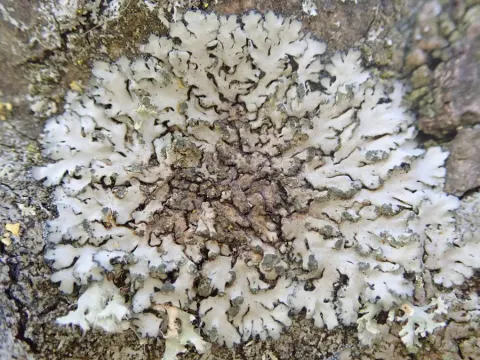
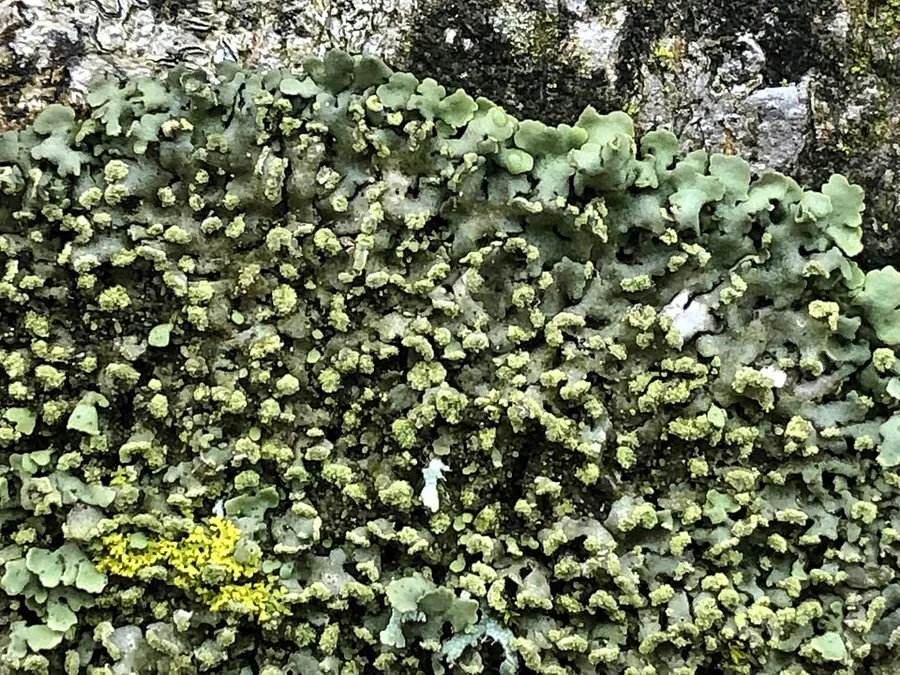
Phaeophyscia endophoenicea is a foliose (leaf-like) lichen characterised by a , thallus that forms orbicular to more commonly irregular rosettes measuring 1–3 cm in width. The thallus is narrow-lobed and closely (tightly attached) to the substrate in the central portion. The are grey to pale brown in specimens exposed to sunlight, typically measuring 1–1.5 mm in width. They appear dull to weakly shiny, lack (a powdery coating), and feature ascending tips. The lobes develop terminal, (lip-shaped) soralia, with (surface) soralia often present as well. The soredia (vegetative reproductive propagules) are frequently yellowish to reddish due to the exposed medulla, appearing (flour-like) in texture, with individual soredia typically less than 40 μm in diameter. The lower surface of the thallus is black and has abundant, black, simple (unbranched) rhizines (root-like structures that anchor the lichen to its substrate). The upper (protective outer layer) is (composed of closely packed fungal cells resembling a cellular tissue) and exceeds 22 μm in thickness. The medulla (inner layer) is characteristically yellow to orange-red in its lower part, though rarely white throughout. The lower cortex is also paraplectenchymatous in structure. Apothecia (disc-shaped fruiting bodies) are rare and in form (with a rim containing algal cells). The (uppermost layer of the hymenium) is brown, while both the hymenium (spore-producing layer) and (layer beneath the hymenium) are colourless. The paraphyses (sterile filaments in the hymenium) are slender and often forked in their upper portions, with (club-shaped) apical cells featuring a thin dark cap.

Sebagian uraian ditampilkan dalam bahasa sumber; terjemahannya belum tersedia atau belum lolos pemeriksaan.

Rujukan: [1]

Pengukuran mengikuti objek, spesimen atau kultur, dan metode yang disebutkan sumber. Baca uraian asli untuk konteks lengkap.

02 / Kehidupan

Habitat dan peran ekologis

Phaeophyscia endophoenicea typically occurs on bark substrates, particularly on inclined or slanting trees. Although rare and possibly underreported, it has been found in diverse European regions extending northward into Scandinavia. The first record for the Netherlands was from a slanting willow tree near Haamstede in Zeeland. It is rare in central European Russia, where it occurs primarily in old-growth and relatively undisturbed forests. It has been reported from Bryansk oblast, growing on moss-covered bark of fallen trees in floodplain mixed forests. Within the European part of Russia, it has also been found in Karelia, Leningrad, Mordovia, and Pskov oblasts. In Ukraine, it has been recorded from several regions, including the Carpathian Mountains and Crimea.

Sebagian uraian ditampilkan dalam bahasa sumber; terjemahannya belum tersedia atau belum lolos pemeriksaan.

Rujukan: [1]

Habitat atau konteks temuan
hutan
Substrat
kulit kayu
Peran atau konteks
Pembentuk liken
Temukan hubungan serupa
03 / Siklus hidup

Reproduksi

The are grey to pale brown in specimens exposed to sunlight, typically measuring 1–1.5 mm in width. They appear dull to weakly shiny, lack (a powdery coating), and feature ascending tips. The lobes develop terminal, (lip-shaped) soralia, with (surface) soralia often present as well. The soredia (vegetative reproductive propagules) are frequently yellowish to reddish due to the exposed medulla, appearing (flour-like) in texture, with individual soredia typically less than 40 μm in diameter. Apothecia (disc-shaped fruiting bodies) are rare and in form (with a rim containing algal cells). The (uppermost layer of the hymenium) is brown, while both the hymenium (spore-producing layer) and (layer beneath the hymenium) are colourless.

Sebagian uraian ditampilkan dalam bahasa sumber; terjemahannya belum tersedia atau belum lolos pemeriksaan.

Rujukan: [1]

Sinonim menurut acuan taksonomi rilis: Physcia ciliaris var. endophoenicea; Physcia ciliata var. endophoenicea; Physcia endophoenicea; Physcia labrata var. endophoenicea; Physcia obscura var. endophoenicea
04 / Batas informasi

Catatan identitas dan cakupan

  • Nama diterima mengikuti Catalogue of Life Base2026-09-11; uraian mempertahankan konsep dan nama sumber aslinya.
  • Original geographic, specimen and life-cycle scope retained; source import awaits individual editorial review.
  • Impor dan terjemahan otomatis belum diperiksa editorial per profil. Struktur reproduktif yang disebutkan tidak membuktikan seluruh siklus hidup diketahui.
  • Pengukuran pada uraian mengikuti spesimen, kultur, dan metode sumber; angka tidak diperluas ke semua populasi.

Catatan distribusi dalam narasi mengikuti sumbernya. Dokumentasi spesimen atau foto mengikuti catatan sumber. Bukti wilayah Indonesia dan penilaian konservasi tidak disimpulkan dari gambar.

05 / Dokumentasi

Melihat dengan konteks

Dokumentasi Phaeophyscia endophoenicea dari Wikimedia Commons. Phaeophyscia endophoenicea. Species of lichenized fungus. Identifikasi mengikuti record berkas sumber.

Jenis
Fotografi
Kredit
Jason Grant
Lisensi
CC BY 4.0
Sumber media
Buka entri sumber

Gambar menunjukkan objek menurut identifikasi sumber, bukan verifikasi independen spesimen oleh Fungi. Tidak ada skala baru yang ditambahkan.

06 / Rujukan

Sumber profil

  1. [1] Phaeophyscia endophoenicea — Wikipedia (en)Bagian sumber: Frozen revision 1288936658
    Tanggal penghimpunan sumber: 2026-10-12
    Teks sumber: CC BY-SA4.0 · Wikipedia contributors
  2. [2] Catalogue of Life Base2026-09-11 — Phaeophyscia endophoeniceaBagian sumber: ColDP NameUsage.tsv ID 7783Q; accepted species; source 2073
    Tanggal penghimpunan sumber: 2026-10-12
  3. [3] Dokumentasi visual — Phaeophyscia endophoeniceaBagian sumber: Individual media record; identification follows the source, not independent determination
    Tanggal penghimpunan sumber: 2026-10-12
    Media sumber: CC BY 4.0 · Jason Grant

Adaptasi teks: CC BY-SA 4.0. Wikipedia contributors — Phaeophyscia endophoenicea — Wikipedia (en)

Uraian asli dan riwayat sumber

Riwayat atau halaman sumber

Ringkasan sumber

Phaeophyscia endophoenicea is a species of corticolous (bark-dwelling) foliose lichen in the family Physciaceae. It is characterized by a grey to pale brown rosette-forming thallus that grows 1–3 cm wide. It features narrow with yellowish to reddish powdery reproductive structures called soredia, and a distinctive black lower surface with abundant root-like rhizines that anchor it to its substrate. The lichen's inner tissue (medulla) is typically yellow to orange-red in its lower part. Though rare and possibly underreported, P. endophoenicea primarily grows on the bark of slanting trees across various European regions, extending from southern areas into Scandinavia, with presence in relatively undisturbed forests of European Russia, Ukraine, and the Netherlands.

Revisi sumber

Morfologi sumber

Phaeophyscia endophoenicea is a foliose (leaf-like) lichen characterised by a , thallus that forms orbicular to more commonly irregular rosettes measuring 1–3 cm in width. The thallus is narrow-lobed and closely (tightly attached) to the substrate in the central portion. The are grey to pale brown in specimens exposed to sunlight, typically measuring 1–1.5 mm in width. They appear dull to weakly shiny, lack (a powdery coating), and feature ascending tips. The lobes develop terminal, (lip-shaped) soralia, with (surface) soralia often present as well. The soredia (vegetative reproductive propagules) are frequently yellowish to reddish due to the exposed medulla, appearing (flour-like) in texture, with individual soredia typically less than 40 μm in diameter. The lower surface of the thallus is black and has abundant, black, simple (unbranched) rhizines (root-like structures that anchor the lichen to its substrate). The upper (protective outer layer) is (composed of closely packed fungal cells resembling a cellular tissue) and exceeds 22 μm in thickness. The medulla (inner layer) is characteristically yellow to orange-red in its lower part, though rarely white throughout. The lower cortex is also paraplectenchymatous in structure. Apothecia (disc-shaped fruiting bodies) are rare and in form (with a rim containing algal cells). The (uppermost layer of the hymenium) is brown, while both the hymenium (spore-producing layer) and (layer beneath the hymenium) are colourless. The paraphyses (sterile filaments in the hymenium) are slender and often forked in their upper portions, with (club-shaped) apical cells featuring a thin dark cap.

Revisi sumber

Ekologi sumber

Phaeophyscia endophoenicea typically occurs on bark substrates, particularly on inclined or slanting trees. Although rare and possibly underreported, it has been found in diverse European regions extending northward into Scandinavia. The first record for the Netherlands was from a slanting willow tree near Haamstede in Zeeland. It is rare in central European Russia, where it occurs primarily in old-growth and relatively undisturbed forests. It has been reported from Bryansk oblast, growing on moss-covered bark of fallen trees in floodplain mixed forests. Within the European part of Russia, it has also been found in Karelia, Leningrad, Mordovia, and Pskov oblasts. In Ukraine, it has been recorded from several regions, including the Carpathian Mountains and Crimea.

Revisi sumber

Struktur reproduksi sumber

The are grey to pale brown in specimens exposed to sunlight, typically measuring 1–1.5 mm in width. They appear dull to weakly shiny, lack (a powdery coating), and feature ascending tips. The lobes develop terminal, (lip-shaped) soralia, with (surface) soralia often present as well. The soredia (vegetative reproductive propagules) are frequently yellowish to reddish due to the exposed medulla, appearing (flour-like) in texture, with individual soredia typically less than 40 μm in diameter. Apothecia (disc-shaped fruiting bodies) are rare and in form (with a rim containing algal cells). The (uppermost layer of the hymenium) is brown, while both the hymenium (spore-producing layer) and (layer beneath the hymenium) are colourless.

Revisi sumber

Rujukan halaman ini

Fungi. Phaeophyscia endophoenicea. Rilis data fungi-2026-10-12-expansion-2. https://fungi-atlas.mgadib.chatgpt.site/jamur/phaeophyscia-endophoenicea/.

Status: impor sumber; pemeriksaan editorial per profil belum selesai. Untuk klaim biologis, gunakan rujukan pada bagian terkait dan periksa konteks sumber aslinya.